Finding bliss

Fourteen blissful moments stand out from my busy tour of Europe; moments where my soul was filled with joy, awe and contentment. This was the beauty I was aching for and found in these moments. Each experience stands alone complete in itself as if within a glass bubble – a diamond.

  • Discovering the Lion of Lucerne which sits upon a ledge on a cliff in a quiet grotto amidst the busy city streets of Lucerne. I stood spellbound as I felt the sorrow and serenity of the Lion’s message.
  • Seeing the huge statue of Jesus with outstretched arms accepting all, as he stands on an outcrop on the lakeside at Lucerne. We spend a quiet moment taking in the bliss while drifting on the calm green waters.
  • White swans and brown ducks paddling briskly on the rapid moving crystal clear Alpine water of the Reuss River that runs through Lucerne. Children feed the ducks at the water edge on steps below the Roccoco Cathedral perched on the banks. An old roofed wooden foot bridge crosses the river and is adorned with flowers of purple, white, yellow and pink. Meanwhile colourful flags flap in the summer’s breeze heralding the Yodeling Festival that has attracted crowds of people dressed in traditional costumes. We wander.
  • Seated on a balcony at Engelberg I listen to birds singing tunefully and sweetly (no Aussie squawking here). I also hear the rushing water of the swift Alpine stream that runs through the town. The church bells chime for the 6am call to prayers at a nearby monastery. Cow bells clang from the fields nearby. The warm air stirs the red and white Swiss flags atop the chalets. The sun has risen and strains to penetrate its rays into the darkened valleys and forests, still working to melt the remaining snow upon the mountain peaks.
  • Returning to Innsbruck from nearby Rinn we travel down the mountains listening to “The first time ever I saw your face” by Roberta Flack on the bus sound system. The sun slips behind snow-crested alps, glowing golden swords of light that swathe the already picture-perfect landscape into an impossibly more beautiful scene.
  • Burano is a tiny residential island in the lagoon near Venice. Casanova once lived here. Canals wind through the village. The houses are painted different colours, traditionally so that the fishermen could identify their own house when returning by boat in the frequent fog. Our stomachs full and content from a fantastic local seafood feast, we wander along the canals in the hot afternoon sunshine, looking in shops for souvenirs.
  • Seeing the masterpiece of Michelangelo at the Sistine Chapel I sit with my back against the wall gazing up like the crowds of people gathered to do the same. The paintings glow with the bright colours looking as fresh as if Michelangelo had just left the room. How lucky I am to see the paintings now after recent removal of decades of built up grime.
  • Tony’s Bar in Sorrento stopped us in our tracks and we succumbed to the quirky and inviting makeshift bar set up on a cobbled carpark. The animated Italian waiters offer us seats, drinks, music and conversation. The ladies have Bellinis and the men drink beer. We listen to Dean Martin sing That’s Amore and watch with amusement as the crazy traffic of small cars and mopeds whiz by.
  • We queue outside the Galleria Acadamie in Florence waiting for our turn to see the Statue of David. The street is narrow, hot, grimy, and the wall beside us is covered with graffiti. An unlikely home for David I think. Inside though the first glimpse of his glowing white perfection is stunning. How did Michelangelo create such a beautiful image of man? It has such grace and beauty and emotion and there must be no finer work of art on this Earth.
  • Sparkling summer rain fell gently as we took shelter in a tiny shop entrance in the hilltop town of Saint Paul de Vence in France. The artfully arranged cobblestones glistening in the wet. Exquisite art, jewelry, lace, weavings, clothing fill these unique ancient stone shops. We share a Croque Monsieur, talk to the shop keepers, buy some gifts, and feel happiness that communities like this still exist in our multi-national corporate world.
  • We rested in the shade sitting on the grassy river bank beside the Pont d’Avignon. Free from vendors and the hustle and bustle of the busy streets we watched people walk to the end of the ancient arched bridge where it ended in ruin mid-stream. Meanwhile black dogs swam after brown ducks in the water. Boys paddled yellow canoes and cruise boats motored up and down the river.
  • The French experience enveloped me at Beaunne, a small quaint stone village in the wine region of Burgundy. We sat drinking coffee outside a café watching locals shop, read newspapers, walk small dogs and deliver goods. I speak French to the shopkeepers. We buy local red wine and gaze at displays of frois grois, snails, terrines and pates in shop windows.
  • Laugh, laugh laugh! The weird French acrobat/comedian had me laughing the minute he appeared on stage at the cabaret show at Nouvelle Eve in Paris. His act was not original but the practiced skill with which he delivered his silly antics was masterful. He milked the audience and I was hysterical, tears pouring down my face. After his final bow I gasped for air, exhausted from the laughing, my cheeks sore from the strain.
  • Blue lights twinkled on the Eiffel Tower. We stood on the bridge nearby where the small Stature of Liberty greets visitors who arrive on the Seine. The hand of the statue reaches up towards a small half moon. We group together in the warm night air under street lamps helping each other try to capture that perfect image of the twinkling Eiffel Tower at night with our digital cameras. We all hoped for a special image that would help our memories preserve this unique moment forever.
Staying connected

While on holiday touring Europe I tried to stay connected to my family via email. I found that the variables with internet facilities were as ubiquitous as the variables in bathroom plumbing. Everywhere presented different systems that needed re-negotiation.


Not all hotels offer a PC with internet connection. Some are free to hotel guests while others require payment, either by coin in a slot, or credit card logon. And the fees vary.

Internet shops can be found here and there, but not everywhere. Again fees vary considerably.


Browsers and keyboards differ from what we are used to. Software systems are usually in the language of the country and sometimes there is no address box for typing in URL’s. MS Windows is worldwide so it is easy to recognise familiar icons. A lady in Italy asked me to help her with her PC because she assumed I could understand Italian from my apparent familiarity with the Italian browser. Keyboard arrangements differ too according to the language of the country, so familiar typing habits can hinder the speed of writing an email and inevitably cost you more money. Imagine “q” for “a” and “y” for “z” and the “m” moved entirely. Finding the “@” key can prove to be a challenge every time.


Deqr familz,

It is Summer in Europe so the weqther is hot qnd sunnz. We hqve seen the Eiffel Tower, the Sistine Chqpel, the stqtue of Dqvid qnd the Monq Lisq.

Be home soon.

Xxx


I managed to send and receive emails in Engelberg, Rome, Venice, Florence, Paris and London. Accessing Facebook was not always possible, but I updated when I could. Hearing news from Australia on TV or in the newspapers is almost non-existent. We Australians do not rate in the world’s thinking. Even world weather reports ignore us altogether. I think this is a good thing though and hope it remains that way. “Where the bloody hell are you?” spoken by a young Aussie lady in a television commercial for tourism, wondering where all the tourists are, could be more accurately expressed by most residents of the Northern Hemisphere when asked about Australia.

Zen, quality and labels

Zen and the Art of Motorcycle Maintenance by Robert M. Pirsig was first published in 1974 and is one of my all-time favourite books. It follows a couple of motorcyclists as they tour around the United States. Whilst on this trip the orator ponders the concept of Quality. Calling this discussion a Chautauqua, he begins with, “Quality…you know what it is, yet you don’t know what it is.”  The geyser at Yellowstone National Park is used as one example of this, saying that by putting a sign on the natural wonder of the geyser, labeling it, the quality of the spectacle in diminished.  I agree with this notion. It reminds you that someone else has seen this before your own discovery. And not only that, but they have named it, described it, and labeled it. This robs you of some essential and unique experience. It places in your mind smaller notions of the possibility of the natural wonder that it is.


We could apply this to all natural wonders. Pristine environments retain the ability to inspire and fill us with humility. Put a sign on it, a fence around it, and describe it and the awe is gone. Our own sense of personal discovery and adventure is stolen by small minds.


This argument applies to people too. Do we all fall into the false habit of labeling people, if not out loud, then certainly in our minds? This person is a baby-boomer. That person is old. That one is young. And the labels go on. This diminishes the person and impedes the labeler’s potential for an authentic interaction with the person they label. It detracts from the Quality of the relationship and fails to allow for a deeper experience to the detriment of everyone in our community.


Librarians are labelers; if not by nature then certainly by vocation. It serves as a way to find stuff and that is the crux of the job. It can be a pitfall though if it becomes habitual and when applied outside of the realm of information and artifacts.


Pirsig later states, through his character Phaedrus; “Quality is a characteristic of thought and statement that is recognized by a nonthinking process. Because definitions are a product of rigid, formal thinking, quality cannot be defined.” To me that states that quality and labeling are mutually exclusive. Is this correct? Food for thought.


I’d like to see an end to this trend of putting people into small inaccurate categories. The reality is that we are all here now in this time and space experiencing this world together as humans! The similarities of that experience are far greater that the differences, and the complexities and ever-changing variants that reside inside each individual cannot be neatly tied up with one meager label.


I was interested to know if this discussion about quality had continued since Pirsig’s novel in 1974 and so I did a bit of web-searching. I was thrilled to find the Metaphysics of Quality website and this provides a very detailed and academic discussion.


I am taking an ebreak to explore this beautiful physical Earth of ours. Au revoir. A bientot!

Eastlink Cycle

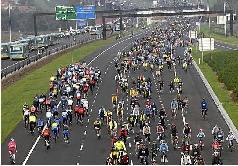
Picture by Jon Hargest for heraldsun.com.auIt was still dark as we donned our cycling gear at the shopping centre car park early on Sunday morning. The chill morning air froze our faces as we cycled along the new blemish-free tollway surface to the event start point.

A crowd of keen cyclists grew rapidly and soon a tangle of bright coloured Lycra and aluminium frames surrounded us and stretched as far as we could see. We stood shivering under an overpass waiting for the starters signal. I was anxious amongst the group worried I’d struggle to hold my space amongst the forward jostling.

The signal sounded and it began, slow at first as the crowds shuffled forward, then the cleats clicked into place and we were off. The downward run towards Frankston was unexpectedly well-spaced and smooth allowing me to enjoy the building momentum as we all gathered speed and settled into our varying comfort zones. Groups formed and reformed. A spill of bikes and riders caused us all to slow as the cry of “stopping” rippled back through the palaton.

This event promoted the completion of the Eastlink Tollway. Reports varied from 40,000 to 100,000 people who turned up to either cycle, walk, run or roller-skate this new expanse of bitumen. Six friends from our regular Saturday morning cycle group enjoyed the challenge of the 65 kilometre looped course. My time was 2 hours and 11 minutes averaging about 30km/hr, which is pretty good for me. It was a rare chance for cyclists to ride on good roads with plenty of space and no cars to be concerned about.

Echoes of the early tides

Australian surgeon and author Tony Moore, has written two books that explore the healing process eloquently. Cry of the Damaged Man tells of his near-fatal car accident and how this changed his attitude to patients, whilst trying to heal his own physical injuries. Echoes of the Early Tides is the sequel that goes on to explore the healing of his spirit.


The descriptions in Echoes of the Early Tides are often abstract as he describes the uncertainty of navigating around the dark pit of grief that often threatens to overwhelm him, or those that find themselves in similar territory. It is all at once heart-breaking, depressing, hopeful, and eloquent. He states, “There is no sound more agonising than the breaking of a human spirit, and there is no sound sweeter than the pulse of its recovery.” His daily walks along the beach frame this exploration of the traumatised psyche, using the changing moods of the sea as metaphors for understanding.


A walk along the beach or sitting in the sand dunes amongst the spiky tussocks soothes my soul when I feel overwhelmed by life’s complications. With the big wild sky above and the sea so large and alive stretching out beyond the horizon whilst simultaneously falling at my feet, it is impossible to dwell on the trivialities of daily gripes.


Tony Moore begins, “I will need to be brave.”

Making movies

Have you seen the movie Cloverfield? I watched it on the weekend and loved it mainly because of the way it is presented. One character uses a hand-held camera to document events as they unfold. Of course the events quickly take an unexpected and awful turn for the worse, but the characters don’t know that at the beginning of the movie. It is not a cheap production by any means and the continuity of the events as they unfold makes you wonder exactly how they created the scenes and edited the content.


I think we will see more and more of these types of movies due to the availability of hand-held digital cameras and their ease of use. The school library where I work has dozens of cameras that we regularly loan out to the students and teachers for school projects and events. Because of this I have learnt how to use them and then how to capture the video and edit the movies using the software on the pc’s. It is all so easy and the results can be fantastic. The students work is often outstanding as these digital natives have such an inherent ability to handle these tools in a fresh and creative way.


YouTube offers instant publication to a global audience. So some kind of success can be measured by the number of views that accumulate, as well as network spread.


My own humble attempts have been to use MovieMaker as photo stories as each of my three “children” turned 21. Adding music, using slide transitions, and combining still photos with video clips makes for a dynamic and interesting result that can be kept as a digital scrapbook. I plan to document my upcoming trip to Europe in this way. It is a heap of fun.

Our State Library

The scene before me was mesmerizing. I stood at the entrance to a cavernous room: circular in plan, the walls soared upwards on all sides towards a domed ceiling; shelves of books lining the walls. Ladders were propped intermittently against the shelves on various levels. There was a hush over the interior; this was a library – the State Library of Victoria. People sat studying at wooden desks that were arranged in rows like spokes of a cartwheel converging at a central hub. Green reading lamps glowed across the room illuminating the study areas and softly lighting the gloomy interior. This first memory of mine was when I was about five or six years old and already having a love of books and reading, this cathedral of books validated my own obsession. This awesome vision planted the seed of my desire to become an architect. It is ironic that becoming a librarian did not occur to me.


I had cause to visit the State Library of Victoria again this week and it never ceases to inspire me. The thoughtful and spectacular renovations have brought the library into the 21st century. I could not resist a visit to the domed reading room that is no longer gloomy as the skylights have been rebuilt. The Redmond Barry Reading Room is such an inviting place I wished I could stay all day. Their approach to their collections and exhibitions also send out firm messages that this is not an old stuffy and irrelevant institution. With offerings such as Inside a Dog for teenagers, Mirror of the World for book lovers, SLV21 for electronic media, and their new Ergo site for student researchers, they truly do try to engage and inspire us all. I looked in at the Medieval Books exhibition that was so busy it was difficult to squeeze in between other people to see the rare books on display.

I love a sunburnt country

Dorothea MacKellar’s famous ode to Australia echoes loudly down through the generations.


The harsh Australian sun has taken its toll on my fair freckled skin after a youth spent outdoors. This week I have had a basal cell carcinoma removed from my forehead.


Bay swim about 1991Spending my childhood and teenage years outdoors without a hat or sunscreen was normal for me and my generation. I spent most of my free daylight hours outside playing tennis, swimming, and water-skiing. Cracked lips, peeling noses, and sun burnt skulls were badges of honour as proof of sun-worship. My skin did tan to a light golden colour and to me this was some kind of validation of my Australian identity, shunning my English, Scottish and French ancestry. I inherited my skin type from my mother and aunt and they both have had many nasty things cut and burnt from their skin. My aunt who will turn 90 years of age this year has had so many cuts made to her face that she looks like she has been in a car accident. She is not the slightest bit vain about it and I admire her common-sense and practical attitude.


I still enjoy an active outdoor life but nowadays I wear a hat and sunscreen. Unfortunately the damage is already done and I fear this little operation may be the first of many.


The recent Web 2.0 conference resulted in some new connections with suggestions and requests for more work. With a couple of days off work I know my workload is piling up. I have lots to do. I need to report on the conference; think about writing an article for an organisation whose representative approached me after my presentation, create more wikis, find some appropriate videos for classroom projects, transfer the library content from our intranet to the new content management system, as well as my usual library work. Not to mention catching up on reading the email, blogs and twitters that will be accumulating.

Wiki wacky

Wiki software allows any dummy to create a website. No need to know html code, nor be able to use intricate web creation software like MS FrontPage or Dreamweaver. No need for access to servers. It’s all free online.

Wikipedia provides this definition of wiki and tells us that it is derived from a Hawaiian word meaning “fast”.

As a person who knows html code, takes pride in my use of website creation software, and works diligently to create webpages that are well designed both graphically and informatively, I find the wiki tools to be extremely restrictive. The wiki people control the look and feel of the finished wiki. Attempts to push these constraints to the limits are frustratingly awkward and never provide the desired result.

My job as the eLibrarian in the school though means that I have been using wiki tools to create wikis for the staff and students. So far this year I have created 30 wikis. There is no doubt that wikis provide an online platform that is perfect for collaborative projects; and the web-wise students take up these tools with ease and enthusiasm. So I create the wiki skeleton, invite the participants, provide the access points on the library website and in the library catalogue, and provide any training and assistance as it is required.

This week I presented at the SLAV Conference in Melbourne on the topic of wikis. My session was a joint effort between myself and work colleague.

Typically as a Librarian I am an introvert and not a confident public speaker, however I know my topic and this helped. I could sense that the audience was keen to hear the practical how-to steps into the Web 2.0 world, so I concentrated on delivering that content to them. As I spoke I could see them taking notes in earnest. I gave the URL’s for the instructional information I have placed online and hopefully this will help others to take up this tool in a thoughtful way. How to create a wiki and How to create a wiki using pbwiki2

The keynote speaker was Will Richardson and his opening address was thought-provoking, informative, and rich with knowledge from an obvious expert in this field.

Just do it!

Just do it! A term coined by a man I’d bet. Many women who are mothers don’t have time to “just do” anything else except be a mother.


Trying not to lose track of the lap count in my head, I thought about my exercise routine as I enjoyed my early morning swim. I have always tried to be active but when women have babies their bodies are not their own, and then when the babies grow into children and teenagers, the mothers time is not their own. Twenty years can disappear in the blink of an eye while all the attention for nurturing is on the children, not oneself.


It feels like a luxury for me to do as I please now without having to first consider the schedules, demands and needs of others. Having said that, I miss the daily conversations and interactions with my children, that I enjoyed for all those years.


So I swim, do pilates, lift weights, practice yoga, cycle and walk; all of these regularly. It feels great and I feel stronger, fitter and healthier than I have for a long time.


Given the choice I would exercise before I went online. A walk outside breathing in the fresh air interests me more that surfing the net. I admire those who have a regular exercise routine and use their web time to try to inspire others to exercise by logging their efforts. Keep it up Leo.