Choose Your Own Library Adventure

In this exciting politically incorrect episode you get to Choose Your Own Library Adventure based on two possible scenarios:

Scenario 1 – The Community Lounge Room

The automatic doors open on time and in you hustle with the crowd of others from the community: seniors; pensioners of all ages; those needing care and their carers; the unemployed; homeless people; parents; children; babies; toddlers; teens; students; the aimless; business people; travellers; visitors; group members attending meetings; and the curious.

The people carry bags, phones, backpacks, coffee, water, food, shopping, books, DVD’s, CD’s, coats, laptops, hats, toys, and not a pen amongst them.

Many arrive on wheels: strollers; walkers; motorized scooters; shopping trolleys; wheel chairs; and skateboards.

This community library is inclusive, caters for all, is paid for by taxpayers, and welcomes everyone without obstacles, barriers, judgment or discretion.

Everyone makes themselves at home settling in for a few hours or the day. There is shelter, warmth, comfort, food, hot and cold drinks, and others to interact with. Everyone is free to eat, drink, talk, read, play games, surf the Internet, laugh, gamble online, shout, scream, run, dance, play music, run a business, study, research, argue, and put their feet up without concern or bother. Indeed they are entitled to do so.

This is The Community Third Place; the lounge room for the town; a makerspace; the library of the present, hopefully morphing into some similar version of the Library of the Future where community wellbeing predominates.

Personal hygiene in this community lounge room differs notably and is commented upon by customers and staff. What to do about this while remaining ‘pc’?

Random screams punctuate the day with too much frequency. These erupt from over excited children, and unfortunate adults forever anchored with the minds of toddlers.

Derelict and homeless people shuffle to their daily corner, rummage through their plastic bags for snacks, before sleeping the day away.

Damaged and disappointed people approach the library staff for assistance with a mixture of fear, bravado, entitlement, envy, and try to persuade or bully their opinions, complaints, and excuses, to further bend the flimsy policies to suit themselves. The “SHUSH” disappeared and the avalanche of guidelines for good behavior followed. Do what you want – make this space.

Custodial protection of our precious printed and digital words and knowledge is deemed to be of no real worth or value. Come take it – it is yours afterall.

Scenario 2 – The Quiet Study

This unassuming small shop/office has small quaint signs to let you know this is a “Library”. It is unapologetic in the retro feel that values books, ideas, and knowledge. It requires a membership application to join; beyond the usual personal ID with current address, a questionnaire is filled in, a deposit for the annual membership payment is made, and then the potential member must wait until the application is successful on approval by the management. A typical question might be: Name the title of your favourite book when you were a child. And: Name ten of the books you read in the past year, and please provide a short review of each. Etc.

Once approved, paid-up, signed the agreement to the terms and conditions, and have your library membership card, you are free to use the services. So you enter, sign in at the front desk, leave your bag, phone, and all belongings in a locker-room. There is water available in the foyer, but no drink or food is allowed in the Library. You are allowed to bring in a notepad (print or digital) and that is all.

The inner library has shelves full of books. There is no WiFi. There is not Internet access, other than pc’s with the digital resources provided by the library. There are no DVD’s, no music CD’s. There are pc’s for the library catalogue. There is a separate room for the printer, photocopier, fax machines available for the usual fees to library members. There are desks and seats scattered around for research, reading, writing, and study purposes.

There is no talking allowed. SHUSH reigns supreme. Talk and you are out. Repeat offenders have their memberships cancelled with no refund. Conversations with Master Librarians are done in whispers at the front desk.

The Library closes at lunch-time for everyone to go and have an unhurried meal. The Library reopens in the afternoon and then again in the evenings.

Although just offering books for browsing and borrowing, these include fiction, the classics, non-fiction, beautiful coffee-table books, books in a variety of languages as well as English, journals in print and digital format, and small collections for children and teens.

This is a place for quiet study and reflective practice. It is for personal enquiry and discovery. The resources are cared-for and protected. If you run, destroy property, speak loudly, act with entitlement, not pay your dues, or interfere with others, your membership will be cancelled for the year with no refund.

Choose Your Own Adventure Library

So do you want the maker-space, community lounge room complete with screaming people, for random, multi-purpose, entertaining, every person, public library/asylum?

Or are there some quiet unassuming people out there who want to return to the days of library shush, for a quiet space to study, learn, read great literature, and formulate new knowledge? And you would happily pay the annual membership?

Perhaps there is another alternative that I have not considered, apart from our excellent Academic libraries where students are the members.

What do you think?
An afternoon with ALIA

I was fortunate to be able to attend the final afternoon session of this year’s ALIA Conference in Melbourne.

Here is my summary:

eSmart Libraries Sallyanne English presented an overview of the Esmart Libraries program. Hume Libraries have recently been accredited. The eSmart program offers a framework for libraries so they can work towards incorporating cyber-safety into policies, procedures, training and technology use by staff and customers.

The Big Projects – update From the successful National Year of Reading in 2012, the Love2Read brand continues as a nationwide marketing effort. The Reading Hour is a current effort they  promote. They invite stories and stats from Australian libraries to spread the message.

Return On Investment Demonstrating the value of libraries is an ongoing need and there are many reports and advocacy tools available on the ALIA and PLVN websites. Of note in Victoria are these reports: Libraries 2030Creative Communities Cultural Benefits: and Dollars and Sense. These reports can be found here. NSW libraries offer this report for future planning.

ALIA PD Scheme Judy Brookner talked about the value of becoming a certified professional through the ALIA PD scheme.

IFLA update Marian Morgan Minden talked about the Lyon Declaration which highlights the need for open access to ICT. IFLA invite people to nominate a must-see library to the list of 1001 libraries to see before you die.

Digital Capability An overview of digital capability of libraries was presented by Sarah Slade of the NSLA Digital Preservation Group. This project has allowed an shared understanding of the needs and capabilities of libraries to manage digital materials.

It was also great to catch with colleagues/friends from across the State.

Book Club Lists

One of the joys of my job is being able to choose books for the book clubs to read. The existing Book Club Collection I work with has currently almost 150 titles. And there are about twelve book clubs using this service.

My job in recent months has been to trim the existing list by analyzing whether titles were unpopular and not likely to be read, as well as what titles were already read by our clubs. I decided on ten titles that I offered to other library services and these were all gratefully accepted and moved on.

At the same time I began a new list of possible contenders for the 2015 list. This list grew to about 25 titles that we read and debated about, although we didn’t get time to read them all. One is not yet published. So there is an element of educated guesswork and relying on published reviews.

My colleagues and I agreed on ten titles and these we have ordered to add to our collection for 2015. We also add ten titles from the SLV Summer Read from last season. Add two titles that we picked up through the library swaps, and we have 22 new titles to add to our Book Club Collection. You can see the list here.

Now all I have to do is find time to continue to read the ones I haven’t yet read.

Square astronaut round hole

Chris Hadfield is known for his rendition of A Space Oddity performed on the International Space Station. It is a beautiful, unique and poignant piece of poetry in motion.

“The purpose of the music video was to make the rare and beautiful experience of space flight more accessible.”

Square astronaut, round hole” is Chris’s final assessment of his career. As a 9 year old Canadian boy he was inspired when he saw the grainy black and white television broadcast of Neil Armstrong’s “small step” on to the Moon. He decided then to become an astronaut. His plan was firmly placed in his mind and from that day he applied himself to that purpose.

And as we can all appreciate, this is no small task, especially for someone who is not an American. His tenacity, humility, and intelligence provided him with the skills needed to endure this difficult quest.

Not only did he need all of the complex technical knowledge and be able to apply those with precision, but he also needed to learn to speak Russian, survive in the wilderness, be an underwater reconnaissance specialist, fly and test jet planes, and be patient. What a guy! Most mere mortals would only be able to fit one or two of those things into a single lifetime. As well as all of this he finds time for a family, and to play guitar.

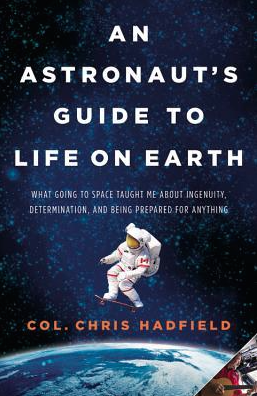
an_astronauts_guide_to_life_on_earthChris Hadfield writes an interesting account of his career in An Astronaut’s Guide to Life on Earth. I loved this book. Chris shows his humility and generosity that serves him well as he establishes himself as part of the large NASA team.

Not only does this book provide a great description about what is required to become an astronaut; he also provides an excellent blueprint that could be applied to any vision or goal. And he writes this all with humour and humility.


“…everything counts: the small moments, the medium ones, the successes that make the papers, and also the ones that no one knows about but me.”

In his TED Talk he tells us how to face our fears while also sharing his absolute love of our planet. He has played his part of the larger quest to take “giant leaps” into our Universe, and he has communicated that experience to us on the ground through the poetry of description and the art of photography from the ISS, distributed through social media channels.

“The windows of a spaceship casually frame miracles.”

You can follow Commander Chris Hadfield on Twitter @Cmdr_Hadfield

Ambrosia between paper leaves

What is that state of being between books? How do we describe it? What word properly fits the feeling?

You know the feeling of that lull between reading books? Especially when you read a satisfyingly great story such as The Goldfinch by Donna Tartt.

You close the last page, you feel satisfied by a great ending, you sit and pause with the book closed on your lap, and you drift, still absorbed in the atmosphere of the story. You wait, linger, dwell, reflect, and hesitate before reaching for the next book to read.

You know if you try to relive or reread the story it won’t have the same impact. The surprising twists in the plot won’t surprise you. You know the fate of the characters. You know what it is about now.

A great satisfying work of fiction is a rarity, so you are not keen to start a new book just yet. And you want to continue to luxuriate in this story while it continues to have a hold on you.

What is this feeling? Is there a word that best describes it? I wracked my brain, used a thesaurus, gathered together a word cloud of possibilities:

Screen Shot 2014-07-10 at 8.16.45 pm

Once the lovely hiatus is over and we have properly assimilated the themes and meaning within the story, we are enriched and can never return to our former selves known to us before we read this story. We are more. We mature a little more. Our knowledge and wisdom has grown.

“A mind that is stretched by a new experience can never go back to its old dimensions.” ~ Oliver Wendell Homes Junior

I wonder if anyone who chances to read this blog post can offer the perfect word that describes this delicious lull between reading books?

Reading fiction

Reading fiction is not my preference. I prefer true stories; epic adventures; personal quests; travel, and description of place. Fiction has to grab me in the first ten pages; otherwise I become bored and abandon the book. After all, life is too short and there are too many books to read.

For me, a good fiction story is a page-turner that makes me keen to know what happens next. I hate reverse chronology. Often I find a story has hooked me in the first chapter, and then the following chapter takes me back to some point in the past. And that’s where I usually abandon the book.

I like a good story, told from the beginning to end with some unobvious point of focus that gradually unfolds to a satisfactory close. It is disappointing to say, “ I liked the story, but I didn’t like the ending.” I loathe nihilistic tales of woe with hopeless and detestable characters that seems to be a current popular theme.

But is reading fiction a waste of time, as some people suggest? After all it is just someone’s imaginary tale. And why bother when our world is full of amazing and interesting real people, lives, places and situations?

Research provides interesting reasons that support reading fiction as a valuable activity. Not only does this pursuit provide insight into situations and ideas outside of our everyday life, but there is evidence to suggest that it has positive effects on our brains by making new neurological connections that remain activated long after the reading activity is over. This heightened activity called a ‘shadow activity’, similar to muscle memory, by scientists working on the Emory study.

We reiterate the idea that there are only seven basic plots:

  1. Overcoming the monster.
  2. Rags to riches.
  3. The quest.
  4. Voyage and return.
  5. Comedy.
  6. Tragedy.
  7. Rebirth

Typically though our bookstores and libraries arrange fiction into genres of:

  • Romance
  • Relationship
  • Humour
  • Horror
  • Mystery
  • Thriller
  • Adventure
  • Historical
  • Classic
  • Western
  • Chick Lit
  • Paranormal romance
  • General
  • And others.

My fiction reading sometimes follows a typical pattern of author trails. I discover an author I like, then I am keen to read more by that person; until I am satiated with their voice, style, and ideas. Elizabeth Gilbert and Joanne Harris are two authors I enjoy reading. I loved The Signature of All Things by Elizabeth Gilbert. It is stunning with its unique story and intelligent prose. I like to follow a trail of reading that is unique to my interests at that time.

Many librarians use website tools such as Fantastic Fiction, Literature Map, LibraryThing, GoodReads, and others to find the next great read for ourselves and our customers.

But there is more to be said and understood about the activity of reading fiction and how it impacts and influences our community and society. Librarians get a very real sense of this phenomenon when working with library users. Some book titles seem to grab hold of the attention of the populace and there is a groundswell of interest that seems to defy understanding. The Slap by Christos Tsolkias is an example that comes to mind. It was an uncomfortable book to read. Not everyone liked it. One incident provides the focus for a masterful portrayal of multi-cultural suburban Melbourne in current times. The slap itself – right or wrong – receives attention and opinions from different generations and cultures, and ultimately judged in politically correct times. This resonates with a culture where this experience is known, shared, and debated. We all have an opinion and all are valid.

“Texts affect readers on many levels – emotional, ethical, intellectual, sensual, spiritual. Consequently, two readers can respond very differently to the same text.” ~ Robert Beardwood

But this book had its time and that groundswell of attention is past. Did we learn anything? How has the experience of reading this book of fiction influenced our society? You will still find this title in the bookstores, libraries, and on Book Club lists, but it has been read, discussed, made into a TV series. Why have we gone past that particular book when there would still be many people who haven’t read it? We could apply the analysis of this phenomenon to many new and popular fiction titles. It would be an interesting study.

Fiction of this type leads our collective conscience. We read, we think, we learn, we discuss, we grow, we evolve. I think that this is key to the function and popularity of Book Clubs in our communities. But we know that.

Now relieved of my requirement to read bureaucratic reports and academic articles, I have been trying to catch up with some fiction reading. I have just read Gone Girl by Gillian Flynn and The Best of Me by Nicholas Sparks. And now, like so many others at present, I am immersed in the book The Goldfinch by Donna Tartt, and I am thoroughly enjoying the voice, the story, the situation, and the intelligence.

Books as life rafts

A library in the middle of a community is a cross between an emergency exit, a life raft and a festival. They are cathedrals of the mind; hospitals of the soul; theme parks of the imagination. ~ Caitlin Moran

Forlorn and adrift on the sea of life; I flounder.

No longer daughter, mother, sister, granddaughter, daughter-in-law; my ego plunges into the classic existential crisis – if not that, then who is this ‘I’? The identities that gave the ego a firm structure where it could reside with comfort and confidence, vanish into the whirlpool of the relentless hunger of “life’s longing for itself”.

Stripped bare, languishing with the flow, the ego in abeyance, waiting, watching, wondering.

I recall the story told by Og Mandino. Reading books in a public library saved him. Homeless, destitute, and about to end his miserable life, he walked into a public library to pass some time before the gun shop next door opened. He sat and started to read, then came back the next day, and the next, turning his life around to become an author, speaker and motivator.

Lovers of books and reading know the power of the written word and that’s what keeps our noses inside books. But why are the words of others more influential than the words we might string together ourselves? They aren’t! The thing is that when we find ourselves in a state of despair or confusion, often due to circumstances not of our making (such as the death of a loved one, or two), then we might be incapable of making our mind do anything beyond grieve.

This is when the words of others offer a lifeline. Throw us a book and we will use it as a life raft. It doesn’t matter what book. Some might say it needs to be a religious book and that would be fine. But really, it could be anything. Works of fiction are perfect because they allow our mind to escape. It gives us a holiday from our own dismal and repetitive interior and whisks us away to another land and time.

As a long time reader of self-help books I can attest to the fact that this genre does not help at these fragile times.

As I steer my life raft to safer waters, these are the books that buoyed me over these past few months: 

*   A New Earth by Eckhart Tolle

*   Radical Forgiveness by Colin Tipping

*   The Gospel of Joy by Amanda Gore

*   Into Thin Air by Jon Krakauer

*   Maya’s Notebook by Isabel Allende

 But really they could have been anything. I would have liked to have re-read Echoes of the Early Tides by Tony Moore but my copy is packed away in a box somewhere still. I am about to plunge into Under Magnolia by Frances Mayes.

Re-imagine your truth with IN-Q

I am listening to a podcast by Rich Roll, hearing him talk to IN-Q. I am inspired by their discussions about vulnerability, authenticity, honesty, and truth. IN-Q is a modern-day poet of note, rubbing shoulders with Cirque du Soleil, President Obama, Red Hot Chilli Peppers, and others.

Poetry is a beautiful genre that allows people to share their stories and speak their soul. ~ IN-Q

As a teen IN-Q wanted to be a rapper, and his poetry reflects modern day America. It is raw, witty, intelligent, spiritual, gritty, and moving.

Back to busyness

I have been back working in public libraries for a few weeks now and it’s great to feel useful and able to help people with their questions. In general the level of sophistication in regard to technology related questions is notable. Many in our population have become quite adept at using and navigating the Internet and all of the associated technologies. The days where it was assumed that the older generation did not ‘get’ this stuff are behind us. Many people are curious about things like ebooks and will ask about them, even if they decide not to give them a try – just yet.

The busy libraries where I work require an agile mind that can handle a day of mental gymnastics, able to negotiate the barrage of unique questions in quick succession.

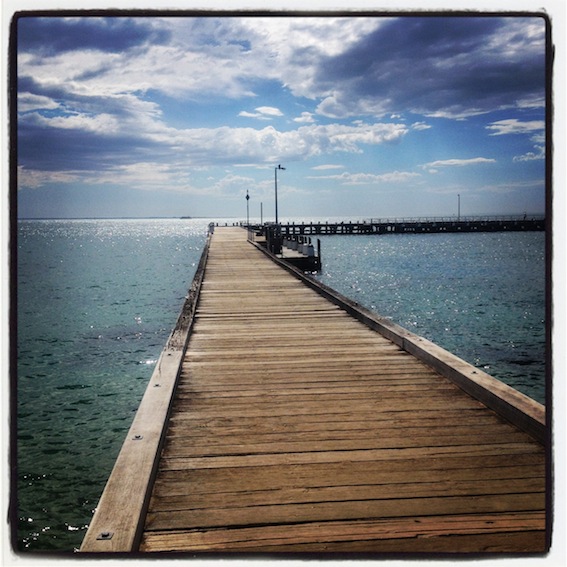
portsea_pier_01042014This week I was lucky to work some shifts on the mobile library truck. I took this photo near one of our stops, during a short break.

I have been reacquainting myself with the different Library Management System, as well as the different procedures and work-flows associated with a large and multi-branch public library service. I feel very much welcomed back and I am appreciative of that.

Strength in curiosity

It is telling when you still pursue information about a field of interest even when you are not currently working in that field. Of course this is what a true career path is all about. It also applies to hobbies, and passions.

Over these past few months (when I haven’t been designing our new house) I have been spending my time reading, watching, and listening to information about libraries. It is an interesting time for libraries worldwide, with the vast amount of resources now available online. Add to this the prevalence of personal devices, wide connectivity, and the sophisticated ability of the user to find and access that resource, then it is no surprise that library professionals are scurrying to remain relevant and required.

The biennial VALA Conference was held in Melbourne in February and I was disappointed that I was not able to attend this year. However, I readied myself to read and review the presentations when they became available online. And now they are; but it is so satisfying to find the whole multi-media experience available online. The audio, video, slides, and twitter-feed all on the one screen. So thank you to the VALA team for providing this amazing resource. I have been able to bathe like a duck in rainwater enjoying the torrent of inspirational presentations.

The keynote speakers were: Johan Bollen; Christine Boroman; Joe Murphy; Mia Ridge; Gene Tan; and Matt Finch.

Johan Bollen spoke about big data and how to use twitter posts for data visualisation and to analyse for predicting social trends. He pointed out that not only can one see what is happening as it is happening, but it is possible to see how people are feeling about what is happening. And this information is valuable.

Christine Borgman also spoke about big data and open access to data repositories, explaining in detail what that means in reality, especially for academics and research.

Joe Murphy talked about the future of libraries; his main point being that libraries will have a robust future if we all encourage curiosity.

Mia Ridge talks about libraries as maker-spaces for cultural heritage; making the point that libraries have always provided this service opportunity. For example: people writing their family history using the library and resources is using the space for making something that has value for cultural heritage. 

Gene Tan talked about the Singapore Memory Project, and organising multiple perspectives of moments in life with a random approach. Of significance is the project that gave every Singaporian a personal account for their memories, from which the library would organise, and store for prosperity. “Giving your past a present”. Gene has a unique and endearing style that really gets to the heart of people. Don’t skip the Q&A session at the end.

Matt Finch took off his clothes and redressed in another outfit on stage, to make the point that libraries are not just for hipsters but for everyone – even those dressed in regulation fluoro stripes.

I was validated by the comments made by Joe Murphy; that the librarian who encourages curiosity in her self and others is strong and will persist and thrive into the unsure future of libraries. I am that person who always wants to discover new things, and I am as yet unsatisfied with the answers to my questions about life, the universe and everything in it.