I have let all of the old words go; dropped them into the dumpster of time never to return. Back in the mid ‘90’s I was inspired by Julia Cameron’s work The Artists Way and like so many people I began writing morning pages and these evolved into regular journal writing. I was only writing for myself in order to make sense of the world and my errant mind. As expressed by The Moody Blues, these were my “letters I’ve written, never meaning to send”.
My journal is a place for me to whinge and complain, and to try to get some kind of perspective on normal things going on in my life.
I still have a journal that I write in once in a while. But while going through my mother’s belongings recently after her death, I was struck by the impropriety of this act. It felt like snooping and I didn’t want to find anything that would make me feel uncomfortable. So I thought about my children and if they had to face this difficult task, and I thought that I wouldn’t want them to read the crap in my journals. It was only meant for me anyway and there is nothing noteworthy contained within the scribbled pages. So they have gone. And I must say I feel liberated. I was tempted to read the old words but after a few pages I could almost recall the whole lot – 17 years of it. Blah! I did find this little gem stuck in the pages and it made me laugh:
I’m writing enough words at present: at work; in my online blogs; and for my Masters studies. My journal is neglected and that is not a bad thing.
Wow! Two months of 2013 have disappeared already. And it’s been busier than ever. What can I tell you about my work at the library so far this year?
We installed new movable shelving for our non-fiction collection in our main branch which entailed a team effort of unloading, loading, reloading, unloading, reloading books by hand. But the end result is very pleasing and we have just ordered the display fittings that go along with this new configuration. The plan is to rearrange the non-fiction books from Dewey to shop-style subject categories. Then we will need to get some new signage to suit.
We have also embarked on the RFID implementation. At present we have completed one small branch and almost finished the second small branch. Then it is just the tagging at the main branch to go. Another team effort is required to get this job done, and everyone is stepping up to the plate. This new technology will allow customers to check out their own items giving them more privacy and independency. It will also free up our staff so they can provide some deeper and more meaningful conversations with the customers.
“Time rolls away, it rolls away, every single day it rolls away…”
My youngest son was married last month and that was a fun event despite my mother passing away the week before and her not being there (in body) with us all.
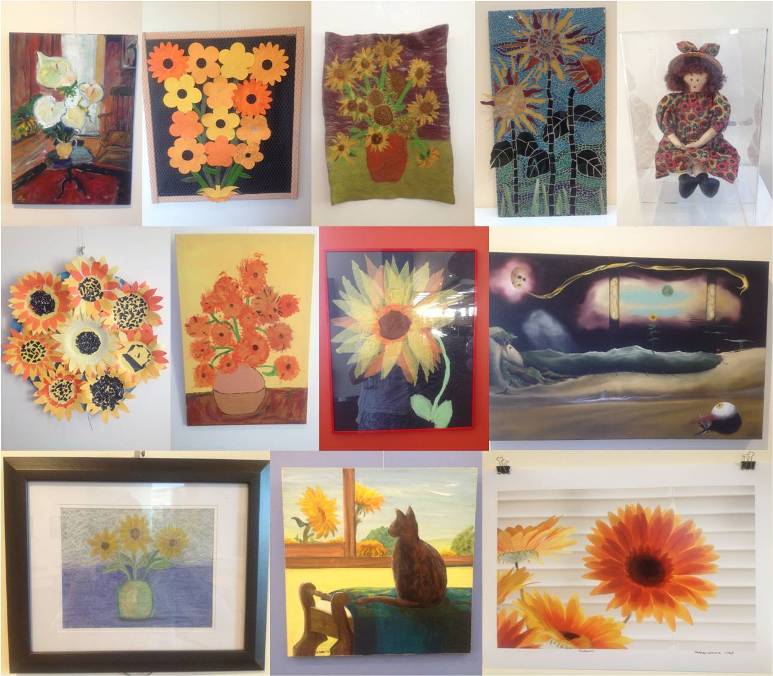
Our current open art exhibition is ‘Sunflowers” and we have received many bright works of art from local people. It is always such a privilege to receive and hang these creative pieces. I totally love the idea of inclusive community art, because after all we are all creative to some extent.
Yesterday (on a Sunday) I attended a workshop Social Media for Small Business and the Arts presented by John Paul Fischbach and Criag Lambie of Auspicious Arts Incubators. It was a really worthwhile session and these guys really know their stuff. I got a lot out of it and wrote my notes to Twitter until my phone battery went dead. It really gives me a better perspective for revamping the social media presence of our library.
I feel like I’ve been holding my breath for the last four years bracing myself in anticipation for the inevitable crash that was my mother’s messy destiny. I lacked motivation to move or plan of think or enjoy simple pleasures. I had a tight grip on the handrails of life.
Now I feel I can breathe easily for the first time in ages. It is uncomfortable to admit there is relief but there it is. It is hard to watch a loved one suffer. So the relief is mine, as well as the guilt in feeling that.
Anyway, amazingly I have begun to move – to swim, cycle, walk and practice yoga, as well as meditate, study, read and I hope to paint again too.
Also cook – yesterday I made this Chocolate and Zucchini cake using zucchini’s from our garden and based on the recipe from Clothilde Dusoulier the author of the book Chocolate & Zucchini, but I changed it to be gluten free.
I was so lucky to be able to look my mother in the eyes before The Big C finally claimed her after a four year battle. With both of her parents living healthily into their mid-90’s, it was a surprise to us all that she would be gone before her 78th birthday.
Cancer is a cruel disease robbing a person of all vanity, dignity, and hope. It ravages the body, is successfully excised with toxic drugs, only to sneak up in another area where no one is looking.
My mum was lucky in many ways; she had my father beside her for the whole treacherous trip and he tended to her every need without complaint, nor a moments wavering of resolve. It began in 2008 with a diagnosis of secondary lung cancer developed from undiagnosed breast cancer. Ironically mum was never a smoker.
They beat the lung cancer but the chemotherapy wiped out her immune system. The cancer morphed into Leukaemia. As an Australian with white freckled skin inherited from British ancestry she had already been treated for many years for squamous cell carcinoma. The Leukaemia needed an accomplice so the SCC assisted. Time after time the skin sores budded, bloomed and were excised by the surgeon’s knife. Bigger and nastier they became until skin grafts became the norm.
It was a skin infection arising from Necrotizing fascitis that proved to be a foe too mean for her weakened immunity. How cruel!! How much indignity can a person bare?
As I sat holding her hand in the intensive care unit watching her machine-assisted breathing get slower I considered the double-edged sword of the privileged Western existence. Cancer is our plight borne of our environment, production, food, lifestyle, modern developments, and privilege. It runs rampant among us. Yet she lay on a high-tech bed connected to multi-million dollar equipment in a brand new ICU in a public hospital on a public health scheme. Our taxes might be high but we know how to care for our loved ones when they are sick. The hospital staff were amazing catering to all the psychological needs of the family as we fumbled with our personal goodbyes. This was an exceptional level of care that Mum and Dad received from Day 1 through all of their varied treatments and doctors rooms.
Last night as I sat in the glorious St. John’s Anglican Church listening to the music of dead composers, Bach, Vivaldi, Mozart, Tchaikovsky, Paganini, and Borne, brought to life by Sergey Didorenko, Evrydiki Iladou, Alexandra Castle, and the Chamber Philharmonia of Cologne, I realised that my love and appreciation of classical music was a precious gift given to me by my mother.
It was a fruitful year at work. After three years in a leadership role I feel the library team are functioning happily and effectively. This is positive and noticed and commented upon by our customers.
On a National level the National Year of Reading and love2read campaign provided a brand and focus to work around. Our locally organised and funded events were successful and included: an entertaining talk by David Astle of SBS’s program Letters and Numbers; a Dr Suess Olympic Reading Relay Challenge; a visit and talk by author Kathryn Fox; a short story competition with the NYR theme for November “What makes you cry?”; book reviews; and competitions. It must be said that for our small rural region the NYR offered nothing except a logo. We provided everything all the planning, funding, organisation, seeking and paying for authors, staffing. We should have used our own logo!
On a State level Tomorrow’s Library and the Victorians Love Libraries campaign prompted passionate discussion. The Stage 1 Report has leapt to a ‘solution’ that needs quite a lot of detail IMHO. Hopefully Stage 2 will fill in the gaps, especially for small libraries on the remote fringes of the state.
As a technology lover I enjoyed using my new devices to access information for work and play. I am adept at sourcing and reading eBooks, e-journals, and multimedia. I listen to a variety of podcasts from around the world on my iPod as I drive to and from work. I watch TV programs, podcasts and other videos on my iPad. I sync my devices to my work email and calendar to stay on track. Facebook is a horrid and deceitful form of communication that has lost its value since being infiltrated by advertisements, organisations, and payment for sharing. Twitter I ignore now that it has become too big and unwieldy. Free Apps are king. I read blogs via the Google Reader app and this is a very convenient way to spend down time. Pinterestand Goodreads are top of the tree in terms of social media I think.
I began a Master of Information Studies via distance education at Charles Sturt University. With just four subjects to complete, the first two subjects are Strategic Planning and Project Management. The reading of academic papers on these topics has been interesting and rewarding and I hope will assist me as I lead the library into the strategic planning process in 2013.
On a more personal level I have been meditating and practicing yoga and hope to increase my involvement in these. Leadership for the disillusioned by Amanda Sinclair provided a useful model of mindful leadership that supports my own attitudes. I read her book then was lucky to attend a seminar at the SLV.
My eldest son was married earlier this year and my youngest son gets married early in 2013. My daughter was married some years ago now – can’t think how many! My mother continues to respond to all the cancer treatment they throw at her and my father does everything in his power to support her. My husband continues to cycle with the local cycling club, as well as working with the local Council.
The 2012 Local Government Rural Management challenge was held at Renmark in South Australia. I was part of a team of six people representing our organisation. Seven teams competed – six from South Australia and one from Victoria. Our team consisted of: Mr. Les Al Dance, Miss Ima Hugga, Ms Heaven Lea, Mr Doug A Trench, Mr Al Grandé, Ms Ginger Plum and the Team Coach Dr Tor Mentor.
We travelled the 800km in a mini bus and got to know our team mates a little better as most of us had not worked together before. We appeared to be a fairly reserved and quite bunch. We had been briefed and prepared for the challenge. So we had a logo, a flag, a motto, a vision and values, team rules, banners, and team t-shirts; as well as a heap of stationery, documents, laptops, printer, lollies and music.
We were all nervous on the day but keen to set up our designated room. We moved beds, put up posters, set up the banners, made our work areas, set up the laptops and printer, and prepared the customer service area complete with fresh flowers, sign-in book, picture of The Mayor, and welcome sign.
Then the whirlwind hit. After a briefing with all the teams, we started work on the four tasks that were delivered, with two more undefined tasks expected to arrive at any time. We brainstormed as a group, wrote up the task schedule on the whiteboard, divided the tasks accordingly, and got our heads down.
Three reports, one briefing paper, a meeting, a flowchart, and two customer service actions with file notes later and it was lunch time. PHEW! I felt dehydrated, headachey, stressed and overwhelmed. After lunch it was straight back into it with three more tasks to complete. Another report, a media release, and a presentation and we were done. Our presentation was a group effort and we kicked off the seven presentations to finish the day. FRED formed the basis of our Staff Code of Conduct Training Overview.
The scenarios and tasks formed an interesting and descriptive narrative for the District Council of Galeforz, so much so that I felt as if I knew the place and the people. Rather than dry tasks, the tasks proved to be interesting, challenging, relevant and realistic. Two women acted some parts during the day in order to provide some “real life” action. This added a further dimension to the scenarios and was well executed.
Our team performed like a Bathurst Pit Crew. There were no conflicts or power struggles. Just a team of equals working together: collaborating, supporting, sharing, suggesting, and swapping. It was a thing of beauty. Our Coach worried that we ignored the morning tea of cakes and drinks. And by lunch time we were dehydrated, tired and a bit worse for wear. The afternoon session was shorter and less intense. The seven group presentations formed a perfect way to complete the day. I was quick to volunteer our team to present first just to get it over with. FRED formed the basis of our presentation.
Back at the motel our Coach de-briefed us and provided words of encouragement and pride. We were glad she was glad.
Dinner and presentations were enjoyed at the Renmark Club on the banks of the Murray River. The winners – six young gorgeous women from the Yorke Peninsula were the stand out performers on the day. We won an award for the Best Dressed Room and so our badging and arranging efforts were recognised.
The long bumpy return trip in the mini bus was a quiet journey with the team feeling totally spent and mentally exhausted. It was an excellent experience that condensed a year’s worth of training and team building into a single day. If you get the opportunity – dive in.
Signing off: Ginger Plum, Group Manager Human Resources.
Apparently when I was just a little kid when asked what I wanted for Christmas I asked for “a big red book”. It appears that at a young age I was impressed with the importance and value of books and reading, and so began a lifetime love that has sustained me through the years.
Now I find I have My Big Red Book! And it comes in the form of an iPad. Oh the joy I find with this technology. Not only can it hold a library of books I love, but it allows me to create my lists of reminders, has space for reflections and journaling, accesses the Internet for instant answers, holds photos and images I love, music, podcasts, movies, whatever. I can forward my work appointments that automatically appear in a beautiful diary with pages that turn like my paper version. I can log my walks, eating, yoga sessions. I can download professional resources from ALIA. I can study, organise and connect online for the Masters degree. I can borrow library books from my local library. I can organise and have instant access to all those blogs by Australian librarians that I read, and food blogs, and blogs about leadership, and more. How did we ever manage before this technology arrived?
I already have an iPod and an iPhone that I use constantly everyday and so was reluctant to invest in another product with ongoing costs attached. But the thing that finally convinced me to buy one was a conversation I had with someone at a Conference. She was busily typing away on her iPad as the Conference was underway, and in a break I asked her about her connection plans. She told me that she used her iPhone as a modem when she needed Internet access. She set up her Personal Hotspot and so used her existing mobile phone plan! Why did I not know this important little piece of the puzzle? So many of you reading this (well the one or two) probably already know this small detail but for those of you who don’t I hope this sharing of information helps you as it has me.
In keeping with the National Year of Reading, I continue to write about the monthly themes, and for September it is “grow”. My focus is on public libraries.
Many people assume that public libraries keep all of their books, and when not being borrowed, they sit on the shelf or are kept in storage somewhere. However this is a myth. In reality public libraries have very limited space and books don’t often remain in any one spot for very long at all. It is a dynamic process of purchasing, processing, sorting, shifting, distributing, displaying, shelving, re-shelving, retrieving, loaning, issuing, returning, re-shelving, repairing, evaluating, sorting, boxing, and at the end of its use – selling in a book sale or sent on to some other need. There is often not a mysterious “stack” of old books preserved for prosperity, unless the library is the National or State Library.
Public libraries attempt to manage this dynamic process with a Collection Management Plan that addresses the demographic of their users to try to predict demand. This plan offers guidelines to manage donations, weeding, purchasing, and when used in conjunction with a clever Marketing Plan, should maximise the collections full extent.
Often people generously offer their pre-loved books thinking the public library will cherish them as much as they have, whilst in reality they are often boxes of dog-eared, smoke-saturated, food-stained paperbacks that only add workload and obstacles to an already jam-packed library work space and work load. The local public library does not have the capacity to “grow” to this extent. There are exceptions of course, and sometimes the books donated are real treasures.
Direct request from customers for popular books and other resources proves to be a useful way to grow the collection while responding to local demand. But it can’t be the only driver because often there are fantastic things that exist that people aren’t aware of, or know that they want – yet. This is where the librarians craft comes into play and they can shape the collection with their expertise, worldly knowledge and creativity.
The Long Tail is a concept coined by Chris Anderson in 2005 and when applied to the library collection is easy to understand. If a library were to buy copies of the latest popular release in quantities to supply the demand and responded each time to every best seller, the shelves would soon be lined with multiple copies of last year’s bestsellers and little else, and look like a short stumpy tail. It would be like a drinks refrigerator filled with one brand of beer, or just beer. Which might be fine for beer drinkers, but not so for those who prefer champagne or tea or green smoothies. The Long Tail theory shows that by offering an array of many different titles on a diversity of subjects that often the quirky niche subjects get a space on the shelf that will be justified when it is inevitably matched with the diverse and quirky interest of a customer. And to paraphrase Tim Flannery, “The continued existence of the species depends on diversity.” When you apply this to humans then our existence depends on a diversity of attitudes, interests and knowledge that can only be gained by offering a wide range of topics for investigation. A browse along the shelves of the non-fiction section will show books about beekeeping, how to work a room, bushcraft, Hagar, heavy metal music, the cats pyjamas, work abroad, survival, ideas, Shakespeare (of course), Henry Lawson, travel, art, architecture, computer help, languages, pregnancy, health issues, etc, etc.
The serendipity of browsing library shelves is a well-known and enjoyable pastime and many have commented on this human behaviour. Bryan Loar of Brave New World says that by using the online catalogue and reserving items ahead of time then “self-directed discovery has been lost”. Professor Todd P. Olson of Berkeley in California values the experience of browsing the library’s shelves so much that he has launched a fundraising campaign towards the “continuation of library collections to ensure that the joy of discovery will continue for generations into the future”. Steve Penn talks about how “you walk around the shelves and suddenly find something that you weren’t looking for but seems just right for you.” Maria Popova of Brain Pickings worries “that we are leaving little room for abstract knowledge and for the kind of curiosity that invites just enough serendipity to allow for the discovery of ideas we didn’t know we were interested in until we are, ideas that we may later transform into new combinations with applications both practical and metaphysical.” And I could go on…
So eBooks and other electronic resources seem to offer a solution to the problem of relieving limited physical spaces in libraries, but restrict the valuable and enjoyable experience of browsing for the serendipitous find. Again I try to imagine the library space where much is only available as an electronic file or online. An electronic collection can grow beyond imagination, storing and preserving every book forever! Of course the preservation of electronic files is another complex issue altogether. But as Seth Godin tells us “Librarians who are arguing and lobbying for clever ebook lending solutions are completely missing the point. They are defending library as warehouse as opposed to fighting for the future, which is librarian as producer, concierge, connector, teacher and impresario.”
Well Seth Godin doesn’t have to convince me that libraries are not just warehouses for books, but if our buildings are not growing with new physical materials, and our collections are “hidden” in the “connected” cyber-world, then who and what is in the building? And how can the average Joe Blow discover, develop and grow with that serendipitous ah-ha moment of stumbling across that book that will change his life? I think it was Og Mandino who told the story about how he was destitute, homeless and was on his way to buy a gun to kill himself when he stumbled into a public library and this “saved” him and turned his life around. That weird unkempt, smelly, apparently homeless person who visits your public library every day might just stumble across his/her saving grace.
In the past I have thought that perhaps the library could display images or video on large screens of these hidden resources. Libraries do this now and have been for some time. And although it might create visual interest, it is just another screen in a world where screens proliferate. And the images would be limited and could not portray the full extent of the collection. And these have tended to be rather static displays even with the inclusion of video segments. Library catalogues could be (and perhaps are being) developed whereby the screen is used to display current catalogue items in a way that is more dynamic and interactive, uses multi-media, and has the ability to display at random or by selection, when not in use by a customer. Perhaps the items displayed could be recommendations that respond to the person who passes by based on their past loans. I am sure the current technologies in Library Management Systems and RFID could already do this, however then we get into the murky waters of intrusion and privacy.
What will a library look like when all the books are eBooks? Will physical books survive the tsunami of eBooks?
Will the prophesized vision of the library from the original Time Machine movie be our reality? I recently tried to remind some colleagues about the scene from this movie where the dusty books in the Grand Old library disintegrate at the Time Travellers touch, and they all looked at me with blank stares alarmingly similar to the blank stares of the future human race in this movie!
When searching YouTube for a clip I found this Lego version:
How will serendipitous discoveries occur?
How will the curious readers find great reading material unfettered by firewalls, logins, advertising, and Big Brother watching?
Will the “library as haven” as quoted by Alan Bennett become a quaint memory of a bygone era? This article reports Alan Bennett and others campaigning against library closures in the UK last year.
The Library Book is a collection of short stories about libraries offered by Alan Bennett. One story The Defence of the Book by Julian Barnes provides a vision of one possible future if library closures occurred.
This image from The Time Machine of the library of the future has always stuck in my mind:
Have you got a message that you are just dying for the world to know, get, embrace, and love? Do you think it is original, clever, valuable, and its time is NOW? Is your voice, your expression, your style, the best way for this incredible message to be heard? Have you got a box to stand on, a platform, a medium, from which to deliver this amazing message?
You think? Sure? Why not? May as well have a go hey? Go for it!
After-all blogging is so 2000’s. “Everyone” has a blog now. So to stand above the crowd you have to find a way to be noticed. And setting up your own podcast seems to be a great way to do this. Just think you can talk and talk to your heart’s content saying all you need to say without interruptions.
So what have you got to say? Got an idea? A theme? A revelation? A message? A set of instructions to share?
And what’s your motivation? Fame? Fortune? Freedom? Notoriety?
And what’s your format? Interviewing others? Off the cuff? Following a framework or schedule of planned passages?
Will you use advertising? Employ Brand “You”? Offer sincerity and appreciation? Will you repeat your message? What about using music breaks? Will you tell stories in order to catch the listener’s attention?
Podcasts are cropping up like mould in a damp bathroom. Some are more successful than others. Some are much more listenable than most.
In recent times I have had the privilege to attend quite a few sessions where people get up in front of an audience to speak on a topic. Sometimes there is a theme, sometimes not. It really is a special experience and there is no doubt that the personal live experience does stand out and above what the average podcast can deliver.
Recently I attended the LGPro Women in Local Government development forum in Melbourne.
Of particular note was the opening talk given by Rachael Robertson who led the 58th Australian Antarctic Research Expedition to Davis Station. Her message, her story, and her delivery were spellbinding.
The closing speaker was Emma Gee who is an Occupational Therapist and a stroke survivor. Facing far more obstacles and challenges than the average speaker, her presentation was funny, clever, sad, practical and inspirational. Emma’s message is “that it is not what happens to you that matters, it is how you choose to deal with it.” Her clever use of video segments in her presentation that depicted some of life’s challenges from her perspective was poignant.
So have you got a message? You never know, yours might just be the one that captures the imagination of the masses and brings you fame, fortune and freedom.





 Sues Bent