Castles, Dogs and Roundabouts

We are just back from a trip to the United Kingdom and Ireland, and my non-scientific observation is that there are more castles, dogs, and traffic roundabouts in the UK by a huge margin compared to Australia.

Traffic roundabout at Tenby in Wales

The purpose of this trip was not to make comparisons at all but to make a personal pilgrimage to our ancestral origins. After years of family history research, I had found the places that our relatives lived prior to their immigration to Australia (and the USA in one case).
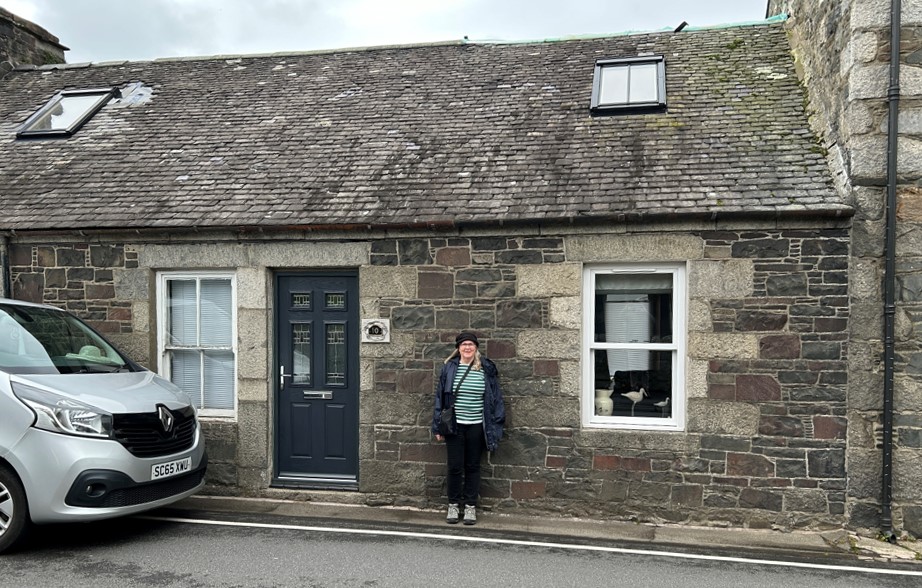
Susan outside ancestors home in Newton Stewart, Scotland

We had a couple of actual addresses and we visited these houses, knocked on the door, and had lovely conversations with the current residents. They were very interested to hear about the lives of people who once lived in those places.

Michael outside ancestors home in Sandwich, England

We also wanted to see as much of the UK and Ireland as we could in about six weeks, because the trip from Australia is awful, and a real deterrent and we doubt we will do this trip again. So, it really was a once in a lifetime journey for us. Well, second, as we had flown in and out of London back in 2008.

We spent a few days in London at the beginning of this trip and visited some places we had not last time. We had done the actual version of my armchair travel exercise and we were keen to get out of the city.
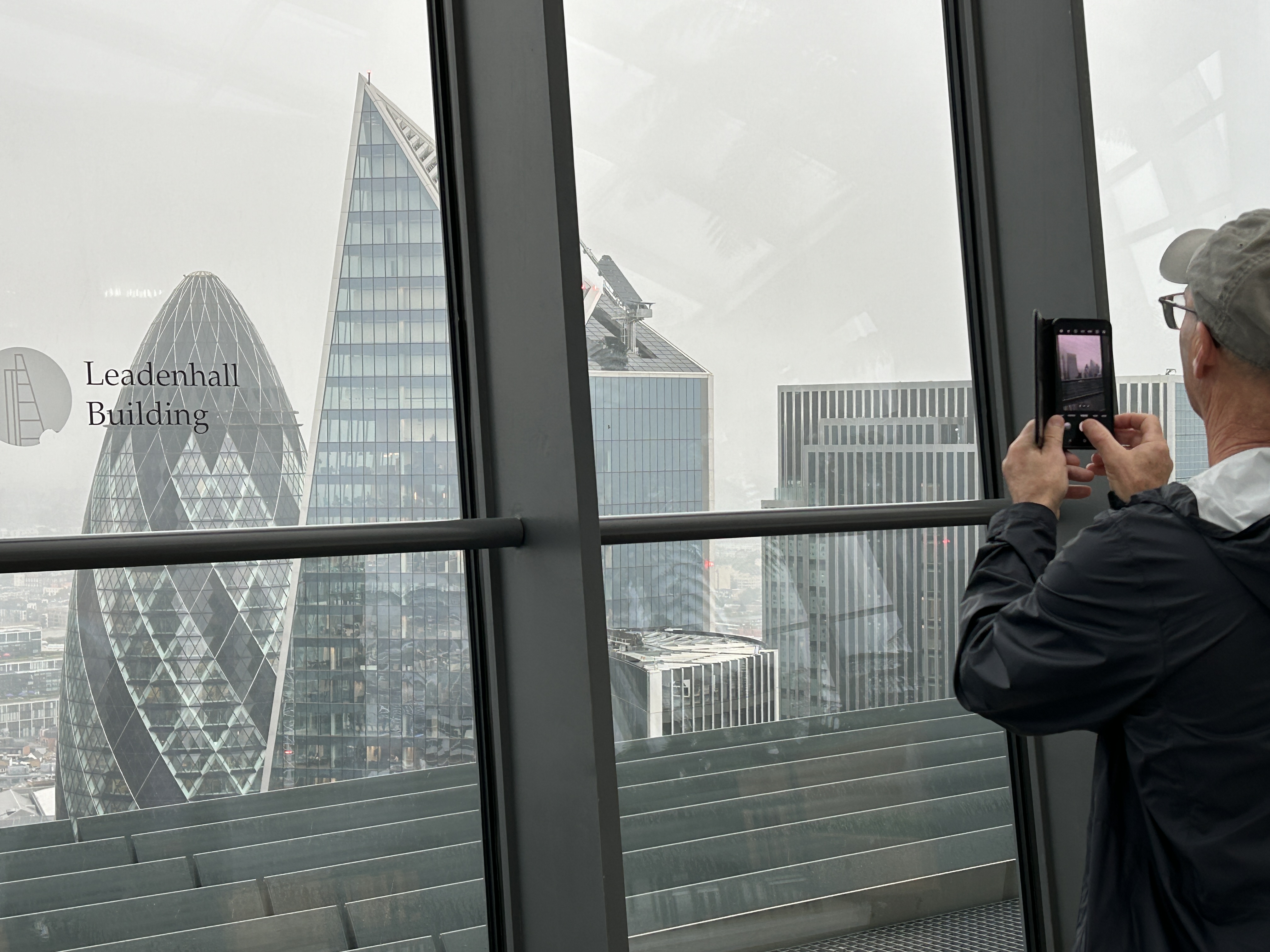
Michael at the Sky Garden in London.

I had formed a loose itinerary, noting the places we wanted to see. We aimed to visit possibly two castles; however, it is hard to avoid castles, and we ended up visiting eleven up close. The most impressive to us is Arundel Castle in England.

Arundel Castle in England

Here is a list of the castles we visited in the order that we were there: (Learning about the history of these castles is something else and I have provided the links for more information:

There were other places we wanted to see motivated by those gorgeous photos seen online, such as the Harry Potter train and bridge known as the Jacobite Steam Train and the Glenfinnan Viaduct, a particular curved street in Edinburgh, Portree and the Old Man of Stor on the Isle of Skye, Eilean Donan Castle, the Dark Hedges in Northern Ireland, to name just a few.

Jacobite Steam Train traversing the Glenfinnan Viaduct, Scotland

And while we did make it to see these places and to take another iconic photo, there is a lot the camera does not pick up. Such as full car parks, queues of gridlocked traffic, crowds and queues of people, bad weather obscuring the view, no place to stop the car, and other things.

Driving through the Scottish Highlands

And while those places are not to be missed, and we chased the touristy things like everyone else, we also found lots of beautiful places and experiences in other areas that are not earmarked for the tourists. Ballintoy Harbour in Northern Ireland is one of those, and we enjoyed scrambling around on the rocks looking out towards the Atlantic Ocean and the Isles of Scotland. By chance we discover that this is where they filmed the scenes for the Iron Islands in Game of Thrones.
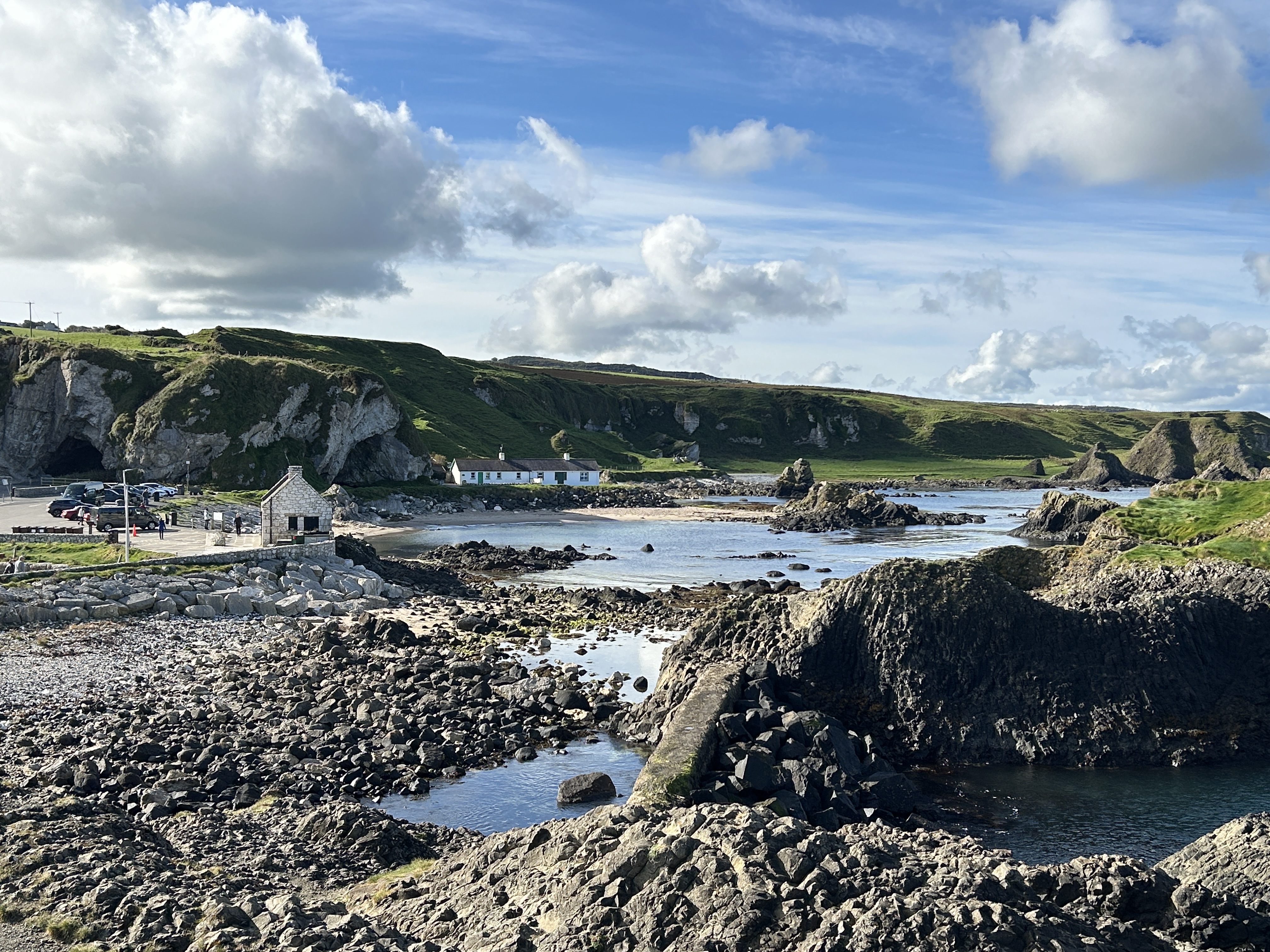
Ballintoy Harbour, Northern Ireland

We were blessed with beautiful Autumn weather. The sun shined, the skies were blue, and we often wore tshirts. I imagined striding across the Battlefields of Culloden with icy rain beating our faces, but it was a gorgeous stroll along the paths beside the grassy fields, under a blue sky.
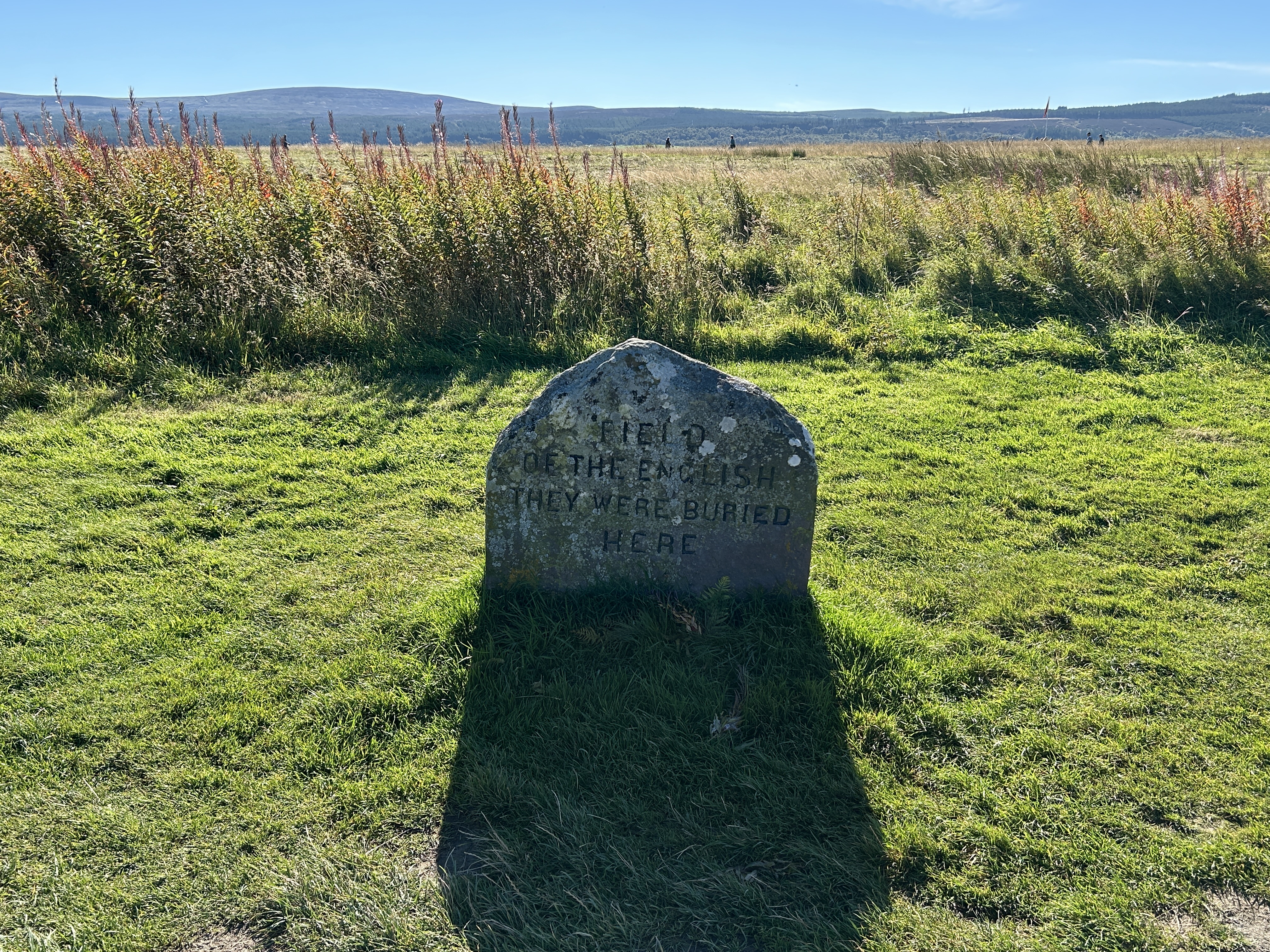
Gravestone at the Battlefields of Culloden, Scotland

These are some of the highlights of our trip:

We loved meeting and talking with local people, everyone always friendly. Although we were often mistaken as ‘British’ until we clarified that we are Australian.

I never got tired of the green fields and lush forests.  
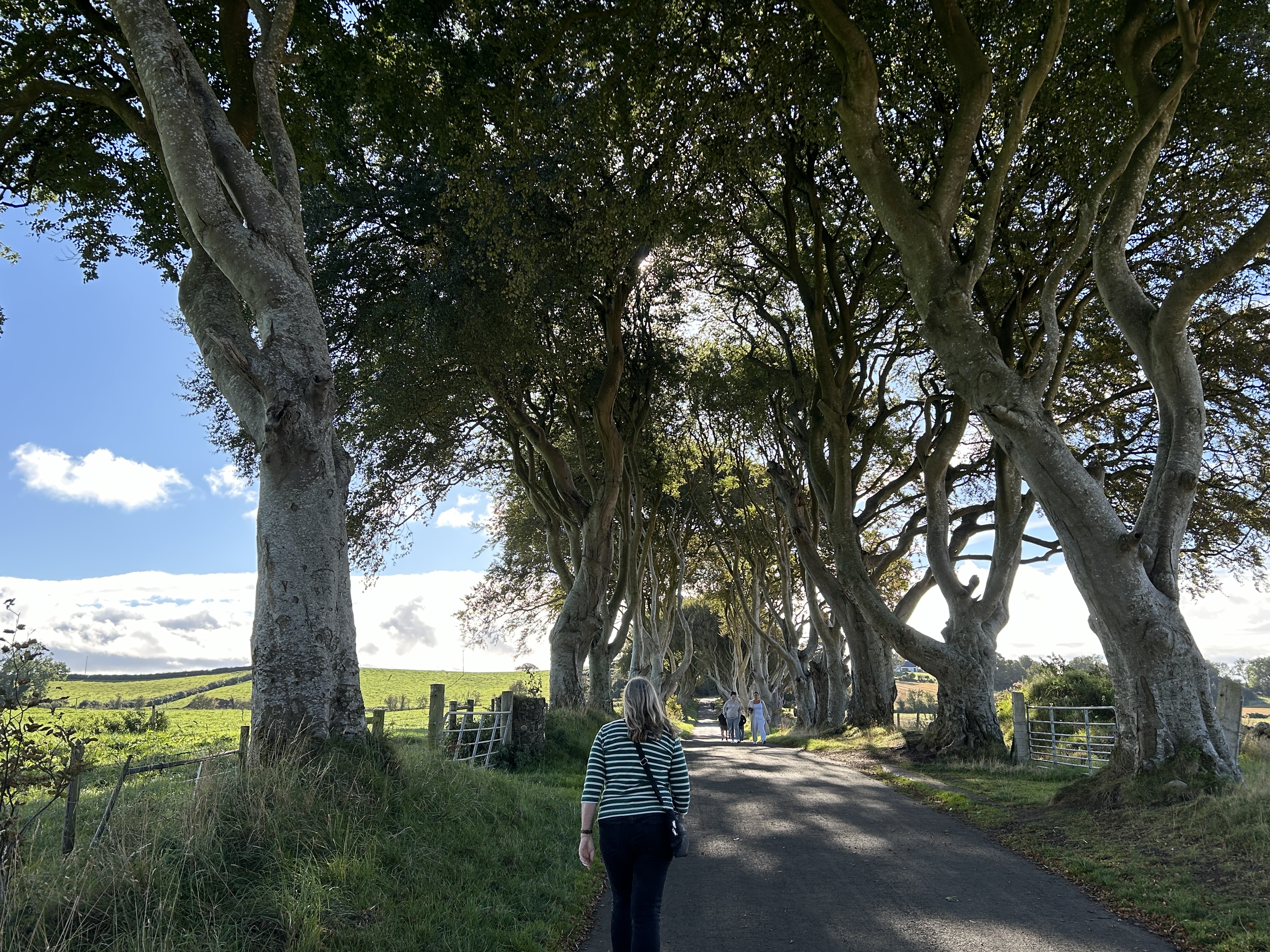
Susan walking along the Beech tree lined road of the Dark Hedges, Northern Ireland

Seeing squirrels in the beautiful city parks.

Hearing bagpipes in unexpected places in Scotland is a treat.

Looking for the Loch Ness Monster while aboard the cruise boat and hearing their theories.

Seeing the bold Harry Potter train chug happily across the Glenfinnan Viaduct.

Driving through the Scottish Highlands is breathtaking and tempts you to hike and explore.

Looking for quaint fishing villages and finding many.

Tenby Harbour, Wales

The Isle of Skye is reminiscent of New Zealand.

Walking up to the Old Man of Stor and not making it, but seeing the sea and lakes appear below the morning fog, reflecting the blue sky.

View from the trail to the Old Man of Stor, Isle of Skye

The beauty and smallness of Ireland and Scotland.
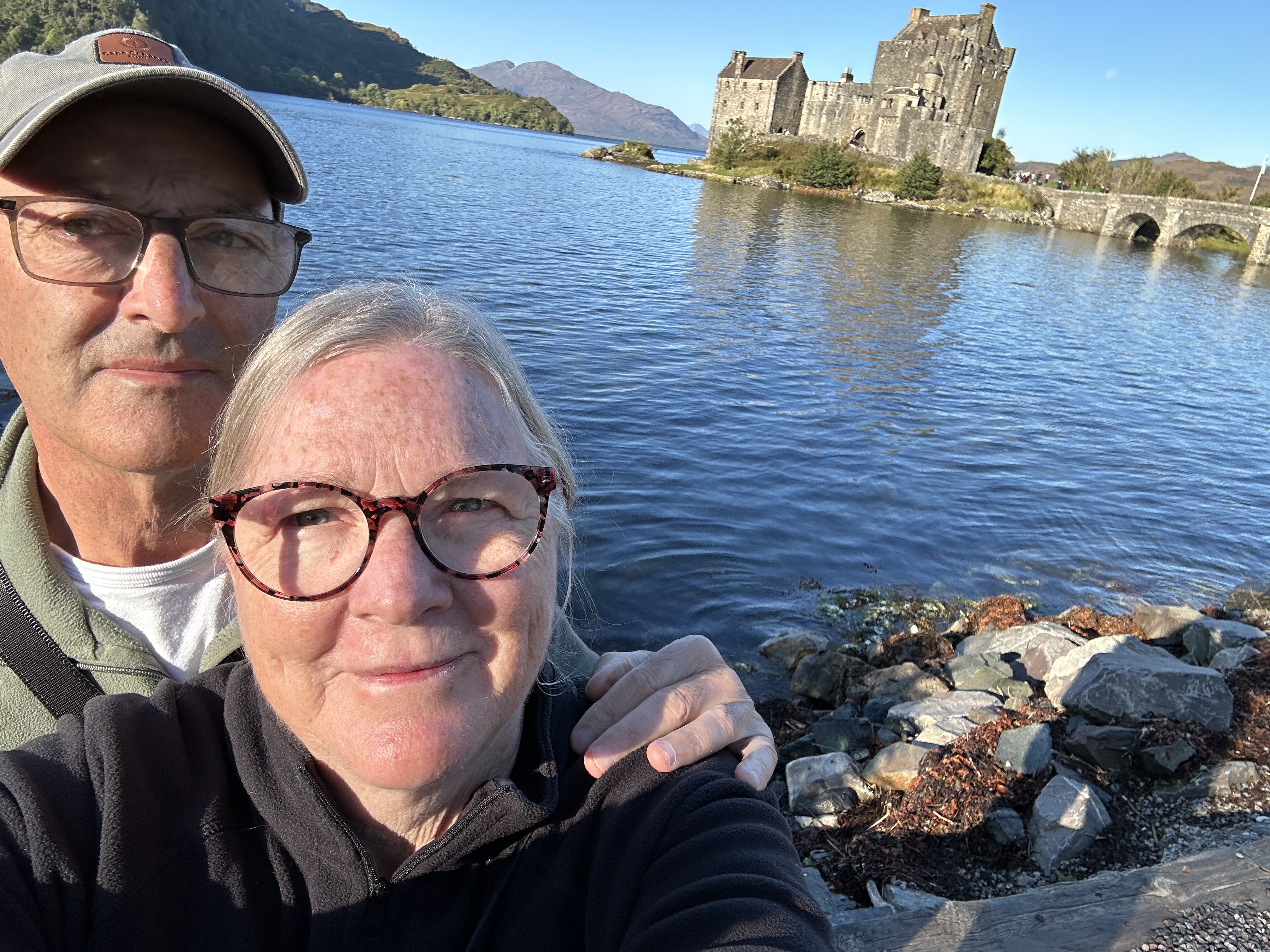
Michael and Susan at Eilean Donan Castle, Scotland

The sea ferry journeys between Scotland and Northern Ireland, and then Dublin and Wales.

We spent 37 nights staying in 28 different B&Bs or hotels, using Booking.com as our guide.
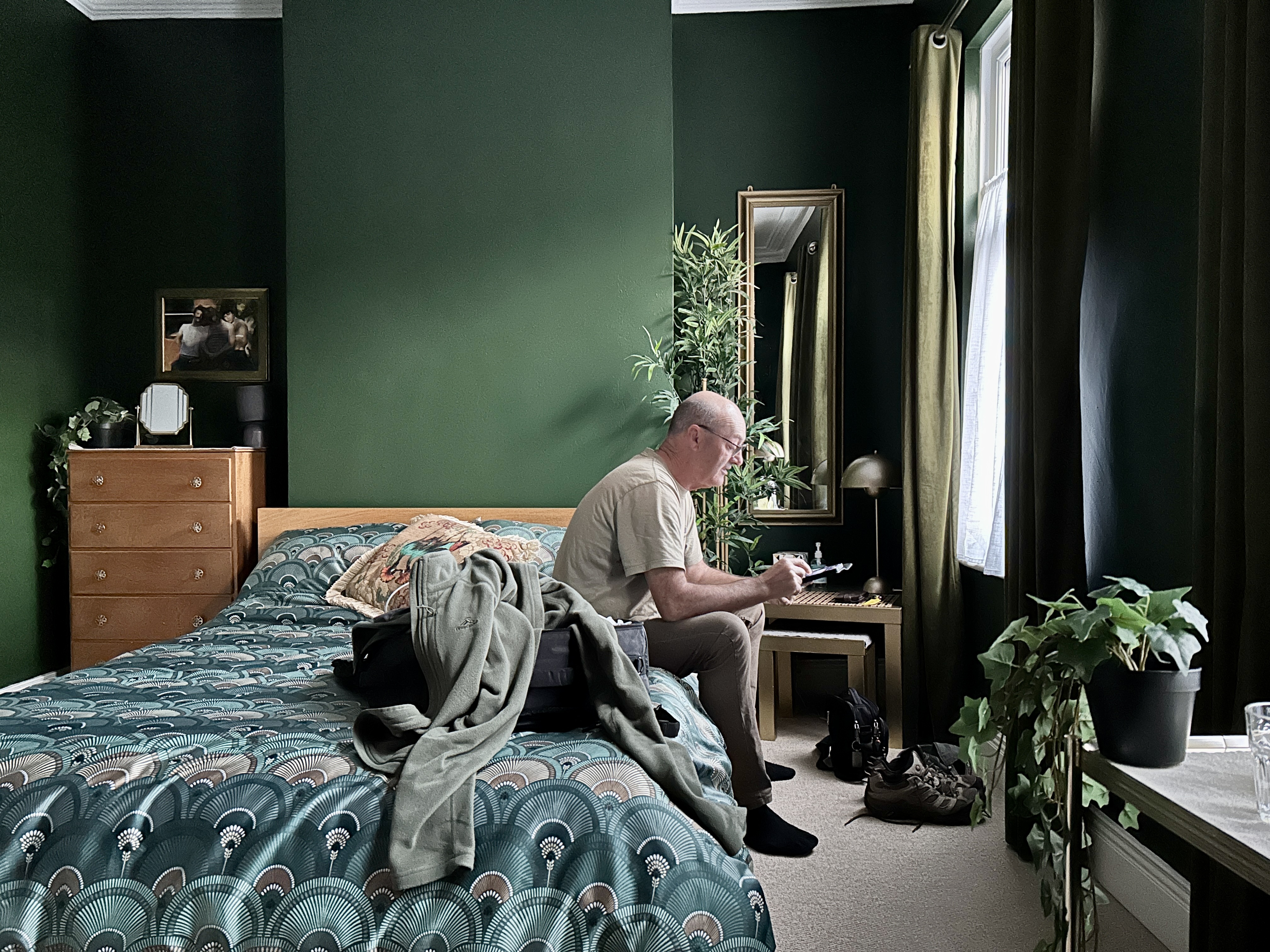
Michael planning the day ahead, Belfast, Northern Ireland

In Blarney Ireland we met a formerly unknown distant cousin who had reached out via Ancestry DNA Matches, and we spent a lovely time with him, sharing our stories, and chatting about history.

Distant cousins at Kanturk Castle, Ireland

We are exceedingly happy to be back home in Australia, glad of the experience, and we are still processing all that we have seen and what this means to us. We have so many photos and I am still sorting through them. I will probably make a few photo stories for our own reminiscing.

Stonehenge, England

As a personal pilgrimage it was invaluable and gives more meaning to our own family histories. I will add a chapter to my story.
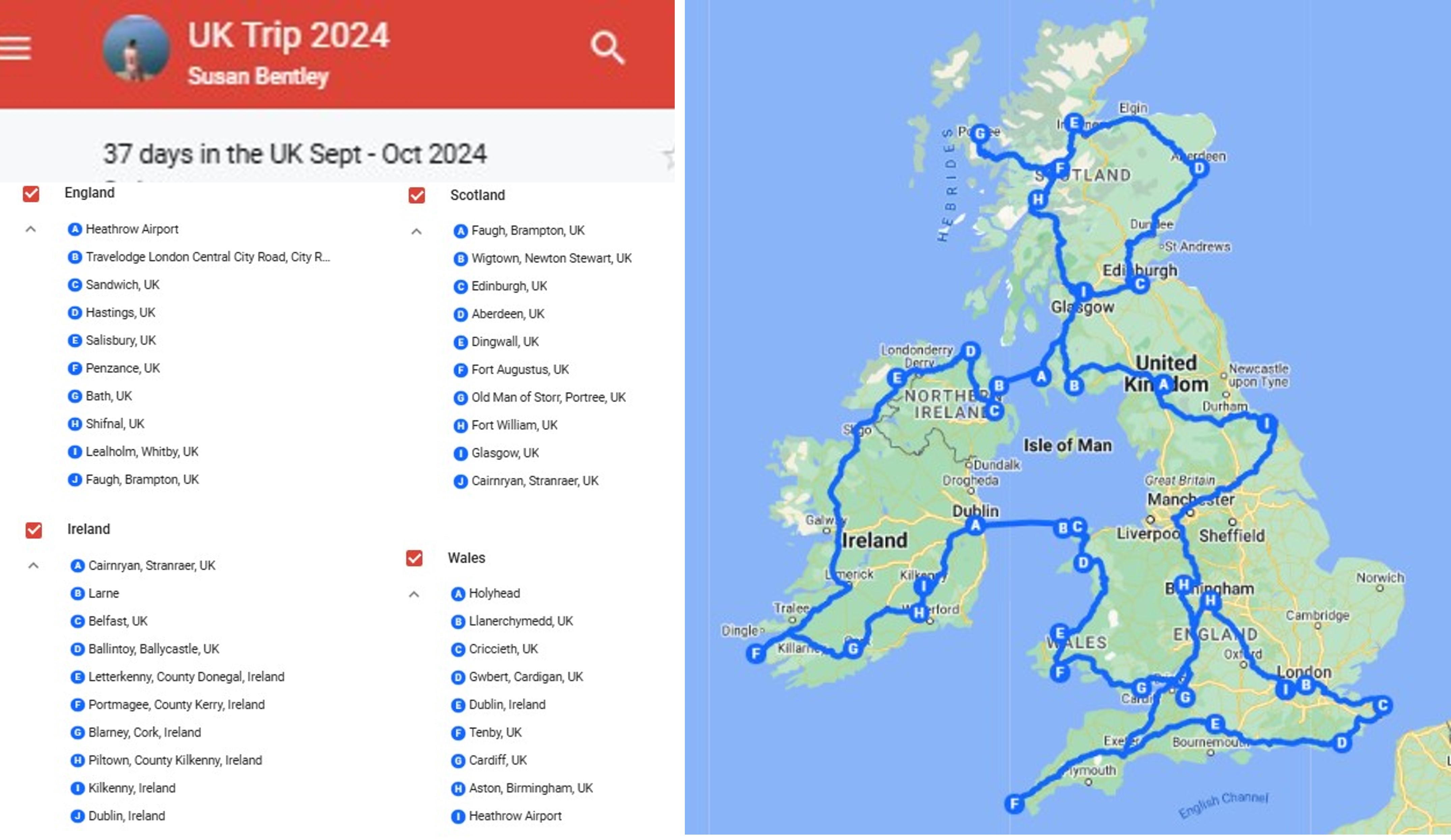
Map of trip route 2024

Grandma Can Vlog

Riza has a perfect face for vlogging. Through her YouTube videos, Life of Riza, she documents her life in her twenties. She aims for cinematic quality in her stories. These biographical vignettes look simple but when you analyse the sequences you realise how clever she is with her camera work, lighting, video-editing, and finished vlog. Kudos to her and thank you Riza for your efforts.

Is Casey Neistat the Master of the Art of Vlogging? Or have I missed an earlier influencer in this field? He published a vlog every day, and after 800 days got that out of his system. But he still offers informative, action-packed, and authentic vlogs about his life in New York city. I love the way he carelessly throws down his boosted skateboard when he comes into his workspace.

I discovered these vloggers this way:

Previously I have been intrigued with the Aussie caravan travelers, although there are so many that I favour just a couple. My current favourite is the delightful couple of Brad and Hayley of Our Australia Trip. Having travelled Australia in recent years it is nice to revisit (through their experiences) the many places we went and know. I appreciate the movie making work that goes into making the videos for YouTube.

I then discovered belatedly Nick and Mathilde of Next Meridien Expedition. Now these two young French travelers are REAL adventurers, having embarked on a worldwide trip with their Land Rover Albo. They were already two years into their adventure when I stumbled across their YouTube channel. Now in Australia I really admire their positive attitude despite repeated major setbacks, such as needing to install a new engine in Geraldton Western Australia. And they did much of this hard work themselves!

Some others I favour for their quiet simple peaceful videos are The Cottage Fairy and Valerie Lin. The Cottage Fairy lives a quiet rural life but has recently had a baby and is understandably taking a break from her vlogging. Valerie Lin is a young artist, and her paintings are exceptionally beautiful. Her careful videos show her lovely creative process and techniques. She sells her prints online and this helps to sustain this lifestyle.

So as someone with a creative urge that persists into my senior years, I decided to have a go at creating a vlog. And I learnt a lot from going through the process:

  • Firstly, there is the idea in the minds eye. So, do you story-board it like Riza, or just dive in like Casey?
  • Then the action to record the moment. This might take one or many shots. What gets in the way; unexpected movements; sounds of traffic, or birds, TVs, or people; weather, something else?
  • Then there is the expected quality of the image. Do you need formal photography lessons to understand this better? Or will you just wing it? I did take photography lessons before we travelled Australia, but I’m not sure much sank in.
  • Cameras! Which camera to use? Smart phone? Proper DSLR? Special video camera with extra lenses? GoPro? Underwater camera? Drone? This all gets daunting and expensive. Then there are the sticks, props, tripods, clamps, etc.
  • Once you have taken the shots you need, then you must save, store, transfer, consider, delete, name, organise, and manage these files. Well as someone with a Masters Degree in Information Management and a solid knowledge of digital preservation, this little exercise is the easy part for me. You’ll need some kind of hard drive and connection for storage and transfer of the files.
  • Then you load the video clips into the editing software. But which software? There are so many available. The editing process is complex and takes a lot of time. But I suppose the more you do it the faster you become.
  • You’ll need some music to give atmosphere to the vlogs. Will you need to pay for downloads, royalties, permission, subscriptions? Probably, but there are still some free databases out there. Remember to always cite the creator and source.

So, I plunged in. As it was an experiment, I was not going to spend money on anything. I used my iphone, handheld, didn’t use music tracks, and used iMovie on my iPad to edit it. I uploaded the video to YouTube and shared it with some friends and family.

Grandma’s Winter Vlog 2024

Then I wondered why I had done this. ‘Why?’ is probably the first thing you should consider. Afterall who wants to see some old bird going about her boring daily life? It’s not something I feel I can expand on, so the one vlog might be it.

It was good to go through the process and learn about how this is done. These young vloggers and digital natives make it look so easy.

Being retired from paid employment means I have a lot of time to spend doing these things. I am a strong believer in the Self-initiated Lifelong Learning experience, and being SiLLé, a concept I labelled back in 2015, and it is a remedy for aging well. I am in constant need of a new project to get my mind into. When I was working, I had no time to spare and making vlogs was far from my busy mind.

Anyway, I will continue to enjoy the vlogs of others, liking, sharing, and subscribing to help sustain them in their chosen lifestyles.

A Walk in London

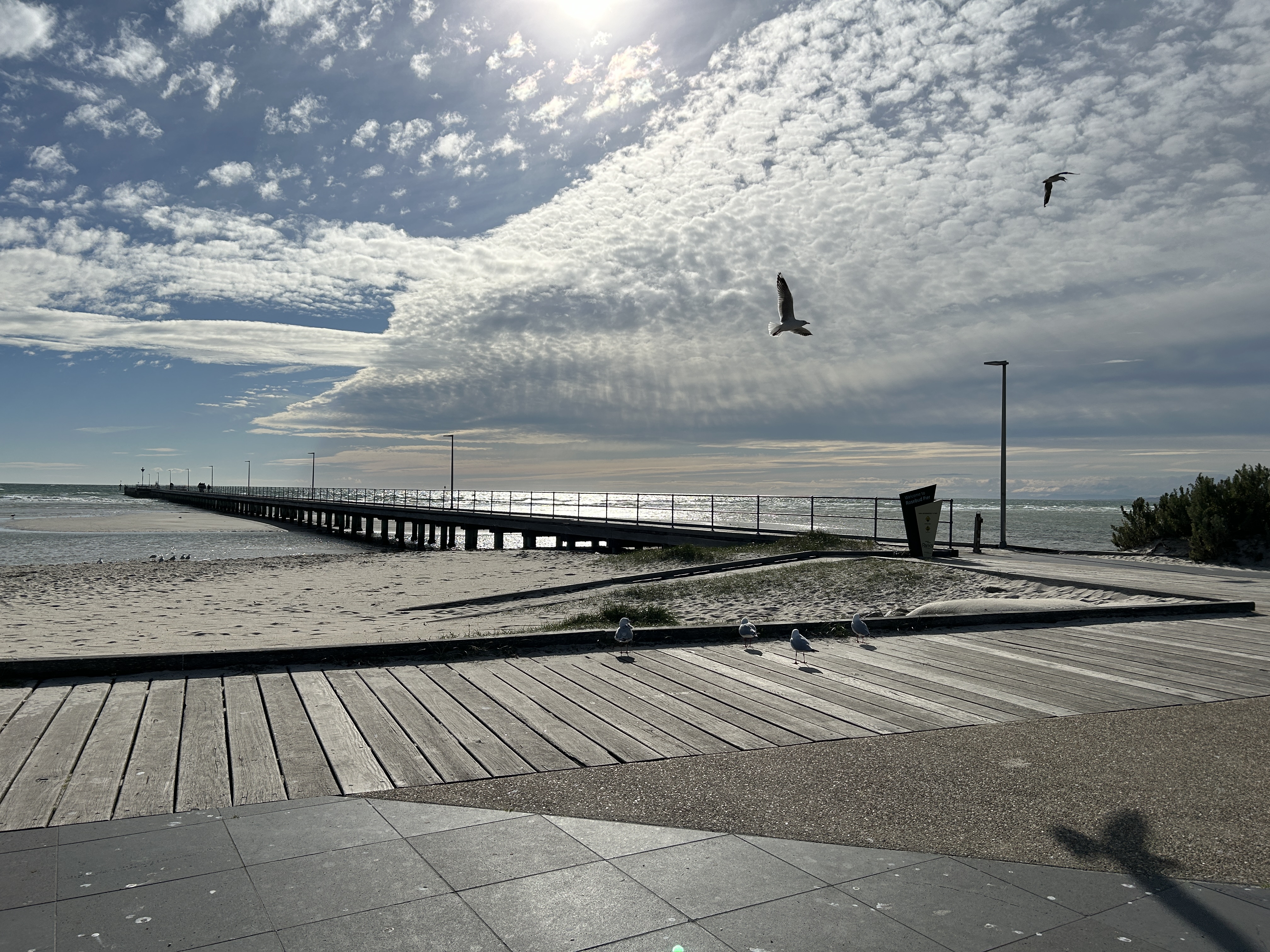
My daily walk looks like this:

Rosebud Pier, Mornington Peninsula, Victoria, Australia, Winter 2024

My virtual walk took me to the other side of the world, to London. We had visited London in 2008 and visited the well-known tourist spots such as Buckingham Palace, Trafalgar Square, the Tate Modern, Tower Bridge, and other places.

Mick and Sues in London 2008

So today I aim to wander, virtually, in another part of the city. I begin at Old Street Station north of the city.

Southwards down City Road I come to Bunhill Fields which is an old burial site. Therein lie the graves of William Blake who wrote Robinson Crusoe and died in 1827. Also, Daniel Defoe who wrote Pilgrim’s Progress and he died in 1731. It no longer serves as a cemetery and is now a public green space, and home to grey squirrels.

Cutting through the pathway of Bunhill Fields I head north to the City Road Basin in order to pick up the canals. The paths beside the canals are popular and wide and once were the pathways for horses that drew the barges along the canals ferrying goods to and from London. Joolz points out the evidence of this in his entertaining trip along the canals that he has published on his YouTube channel.

Nowadays many barges line the canals as living quarters and a lifestyle choice. No permanent mooring is allowed, so every two weeks the barges must move to another spot – a never-ending game of musical moorings.

I continue to follow the Grand Union Canal enjoying the city sights all the way to Camden Market. Here I spend hours looking at the diverse variety of goods for sale. I buy some local fare for lunch.

I hop on the tube at Camden Town and make the short trip to Kings Cross Station. Here I take in all the activity of the Coal Drops Yard, before admiring the stunning architecture of the new structure sitting alongside the old building. The new structure is over ten years old now and this informative video explains design and building process of the architecture.

Locating the site for the fictional Platform 9 ¾ I pass by the long queue of Harry Potter fans. What is there to see after all, but a brick wall with a sign on it?

Outside I walk next door to St Pancras Station This heritage building has been preserved, the highlight being the huge metal arches that form the structure for the station. I watch the interesting presentation with Tim Dunn speaking with Josie Murray about the history and architecture of the building.

Next along Euston Road I visit the British Library, a must for any authentic Librarian of course. By comparison, the modern brutalist external façade pales beside its railway neighbours.  It is a relatively new red brick building opened in 1998 and houses many collections of National importance. Beyond the open courtyard, the multilevel interior space is light inviting exploration and browsing. Of course, most of their collected items are stored in a robot-controlled warehouse in another part of England. If you want one of these items you need to give 48 hours’ notice, then you can read it in one of the Reading Rooms of the British Library.

Ancient texts and rare illustrations are on display, providing insight into how some of these precious ideas were created.

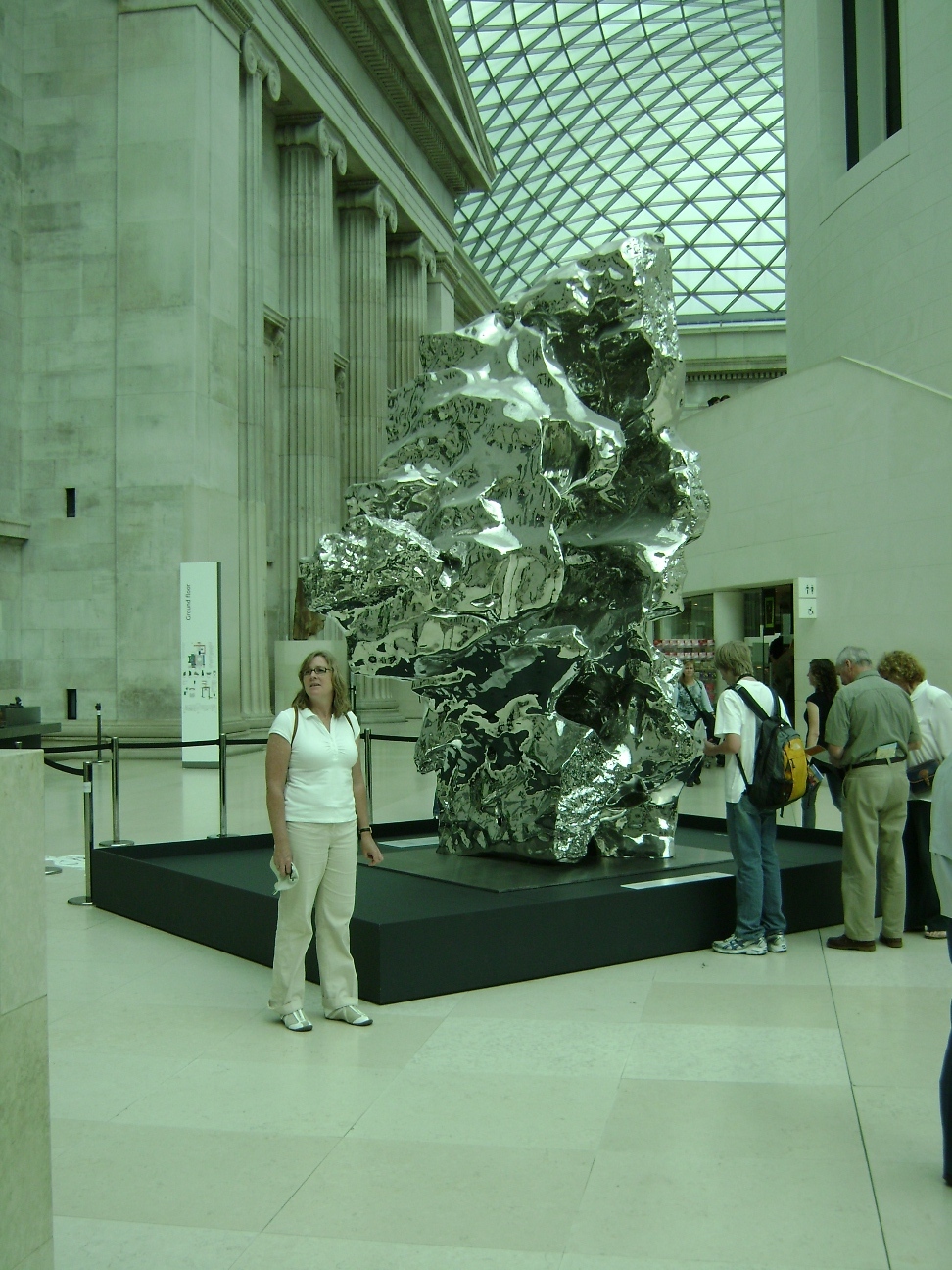
Further south I visit the British Museum that once housed the library collections. We had visited this place back in 2008.

Me at the British Museum, London 2008

This museum opened in 1759 welcoming visitors from around the world. “The Museum is driven by an insatiable curiosity for the world”, and the collections and displays support our vast human history.

Inside the Great Court of the museum is light filled atrium that surrounds a central circular domed Reading Room that was built from 1854 – 1857. Unfortunately, this room is now closed to the public.

Exploring some of the many galleries, the Egyptian history exhibition never disappoints. A virtual tour provided by Google Arts & Culture takes me back to my visit in 2008 and is a fantastic experience for the Armchair Traveller.

Screenshot of the Egyptian Collection at the British Museum from Google Arts & Culture experience

With a head full, stimulated by visual and mental images and information I complete this virtual wander through part of London. In researching this virtual wander, I enjoyed being taken along with Joolz and A Lady in London. Hopefully this virtual walk will become a reality soon.

Visiting Le Louvre

I visited the Musée Du Louvre today. It didn’t cost me $35.72 Australian Dollars entry fee because I did a virtual tour from my home in Australia. (Although perhaps the same amount in Internet access?)

Back in 2008 I did visit in person and loved the fleeting visit that was provided by the Trafalgar Tour.

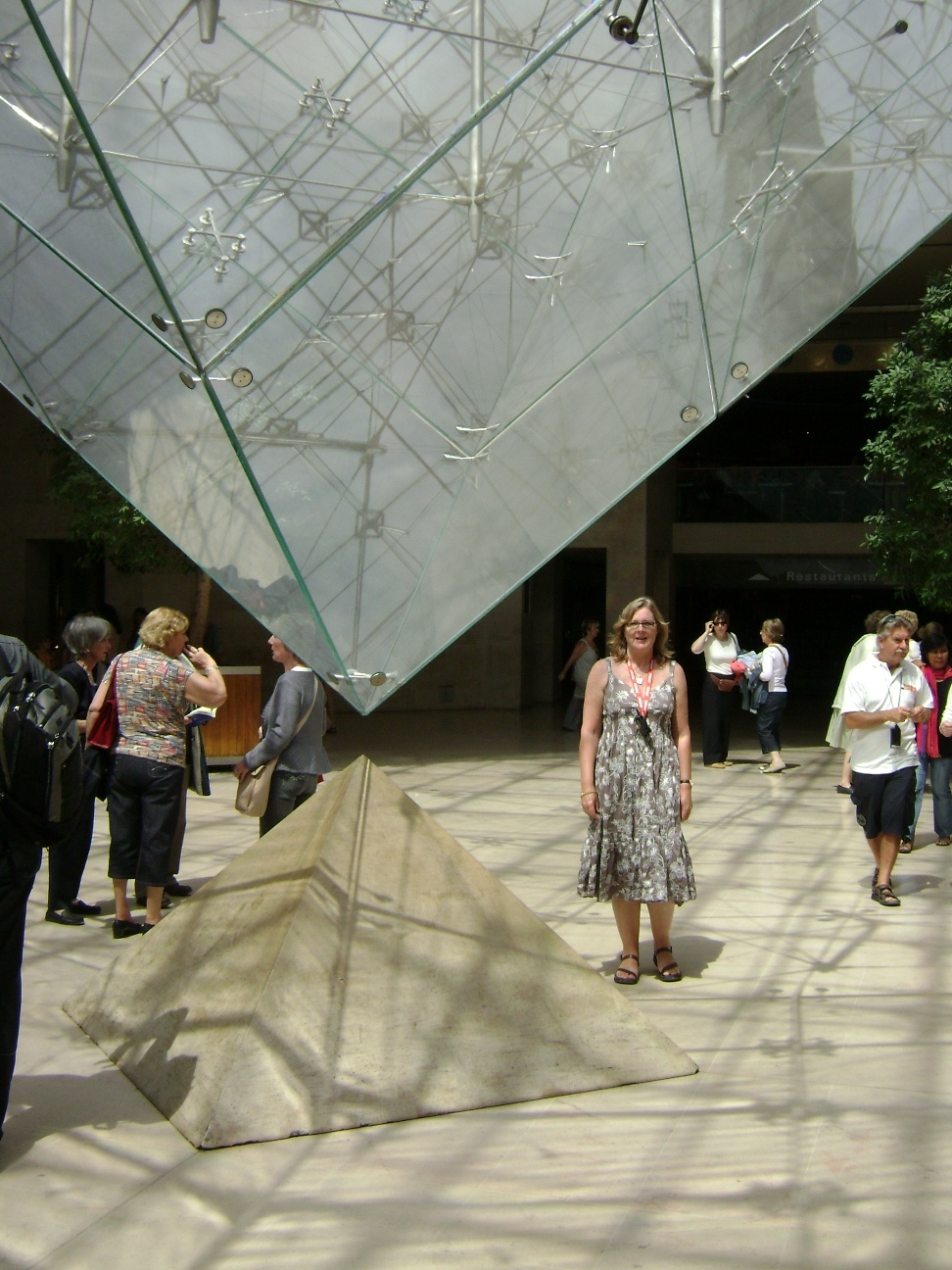
Me standing beside the inverted pyramid at Le Louvre July 2008

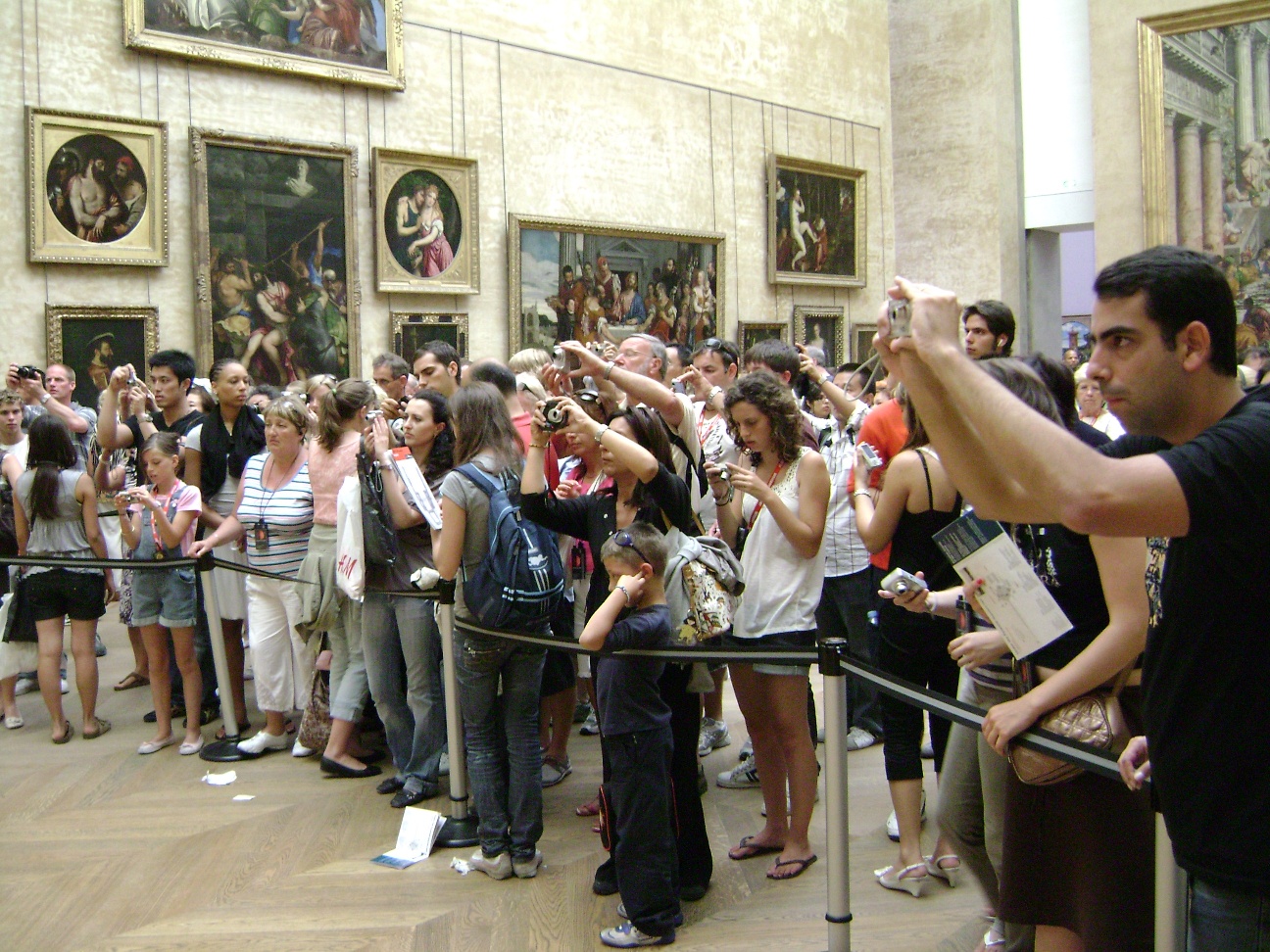
We bunched to see the famous Mona Lisa painting of 1503 to 1506 by Leonardo Da Vinci.

Crowd admiring the Mona Lisa painting at Le Louvre July 2008 (photo by me 2008)

But I was enthralled by the large painting on the opposite wall, The Wedding Feast at Cana by Paolo Caliari 1562 – 1563. The detail on this epic painting stopped me in my tracks.

I think my favourite piece though is The Winged Victory of Samothrace, the Greek Goddess Nike. She commands her place and guards the Art.

The Winged Victory of Samothrace (photo by me 2008)

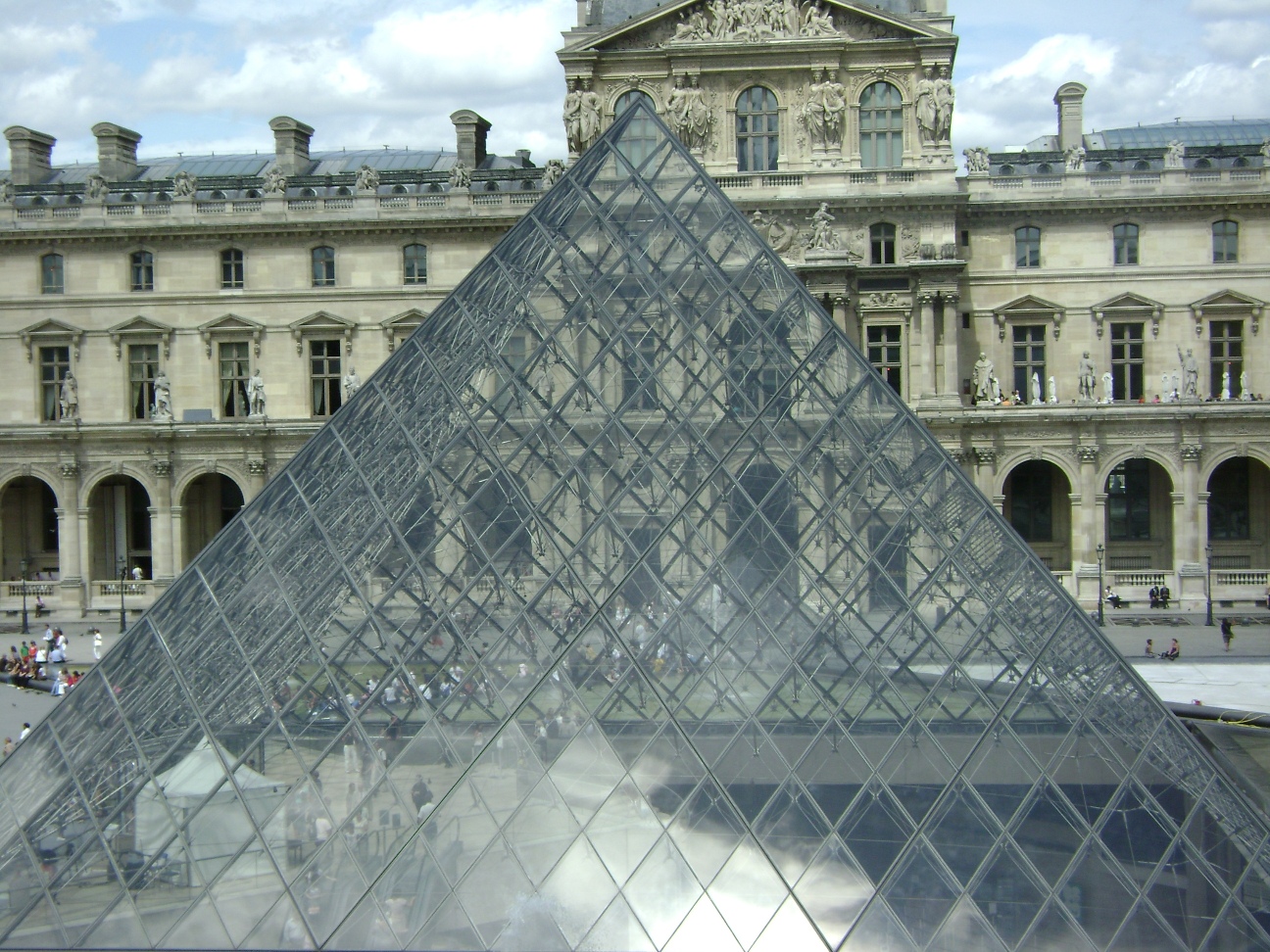
As a lifelong student of art, design, and architecture, I admire The Pyramid of Ieoh Ming Pei that was completed in 1989. Not only does it sit perfectly in the courtyard amidst the old buildings, the underground structure is genius. Standing beside the inverted pyramid below street level I paid homage to the architecture while also being excited to recall the fictional movie of The Da Vinci Code.

Pyramid structure at Le Louvre by Ieoh Ming Pei completed in 1989 (my photo 2008)

Via Google Earth I descend to the courtyard and view the 360-degree images of others.

Musee Du Louvre image screenshot from Google Earth 2024

I follow one of the Visitor Trails provided on the Musée Du Louvre website. I’m happy to choose Beyoncé and Jay-Z’s Louvre Highlights from their music video of 2018. This music video has always captivated me. I love the music, the soundscape, and the juxtaposition of new performance art beside old masterpieces. So, I watched their music video again from my favourites list on YouTube. And of course I followed the Art Trail reading about each artwork.

I delve deeper into artworks via the official website, absorbing more. On the Musée du Louvre YouTube channel, I find more information about the restoration of artworks and the Arc Du Carrousel in the courtyard. I look at the images on their Instagram site.

Musee Du Louvre on InstaGram

Then I stumble upon a magical piece of work featuring Le Louvre in 2020 through the eyes of Flo. I join him as he walks alone through the Louvre. He whispers impressions in French that float on a quiet backdrop of imagined sounds. It is poetic, and art appreciation at its finest.

It’s been a great way to spend a cold winters day at home. I wonder where I will go next on my Armchair Travel adventures.

The travel blog resumes

Very soon Mick and Sue’s Aussie Adventure resumes with Part Two of our Big Lap of Australia.

During 2020 and 2021 I enjoyed writing the travel blogs of our trip and some of these were picked up by other organisations for inclusion in their publications. This gave me added impetus to continue to write about our trip.

So once again I am embarking on this endeavour to write about our travel; for the love of finding expression through writing, and to chronicle and share those experiences. I enjoy reading about and observing the travels of others who are exploring this beautiful world in a myriad of ways. I hope my humble attempts lighten someone’s day.

Ancestors Arrivals in Australia

Our ancestors arrived in ships during the 1800’s and early 1900’s. They came from England, Ireland, Scotland, Germany, and the United States of America, hoping for a better life in the new colony of Australia.

During these past months of lockdown in Victoria Australia I have continued to research and compile the family history for myself and my husband.

As Caucasian Anglo’s we knew our ancestry originates in the United Kingdom. The first ship I was aware of was the Hampshire that brought my grandfather and family to Australia in 1887. Although he was just a toddler at that time, he remembered the name of the ship and told me many times when he was alive, and I was a girl.

He ignited my curiosity that has stayed aflame all of my life. So began my family history research journey.

As I delved further into each branch of the family tree, I discovered more ships that brought our ancestors to Australia. Here is a list of those ships and the ancestors that sailed on them:

  1. 1819 Prince Regent departed London 17/9/1819 Plymouth to Sydney. Richard Roberts was convicted at Old Bailey for stealing one coat to the value of 5 shillings belonging to William Payton. Sentenced to 7 years transportation. Occupation noted as ‘Whitesmith’.
  2. 1826 Sir Charles Forbes departed from Plymouth to Van Diemen’s Land. Hannah Holland was convicted in Stafford for larceny of cloth and 4 shawls. Transported for 7 years. She was a member of the “Pottery Gang of Thieves”. The ship departed on 31/8/1826. Hannah gave birth to a daughter Mary Ann Plant while on board the ship. On 6/1/1827 they were hospitalised in Hobart Town. The baby died on 17/1/1827.
  3. 1827 Asia I London to Van Diemen’s Land. John Wesley was convicted for burglary at Nottingham on 15/3/1827. He was sentenced to life and transportation as a 19-year-old.
  4. 1829 Lord Melville II departs London on 5/1/1829 and arrives in Port Jackson 6/5/1829 with 170 convicts Dublin Ireland. John Higgins from Dublin, Ireland, was convicted on 5/11/1827 at Lancaster Quarter Sessions for a sentence of 14 years.
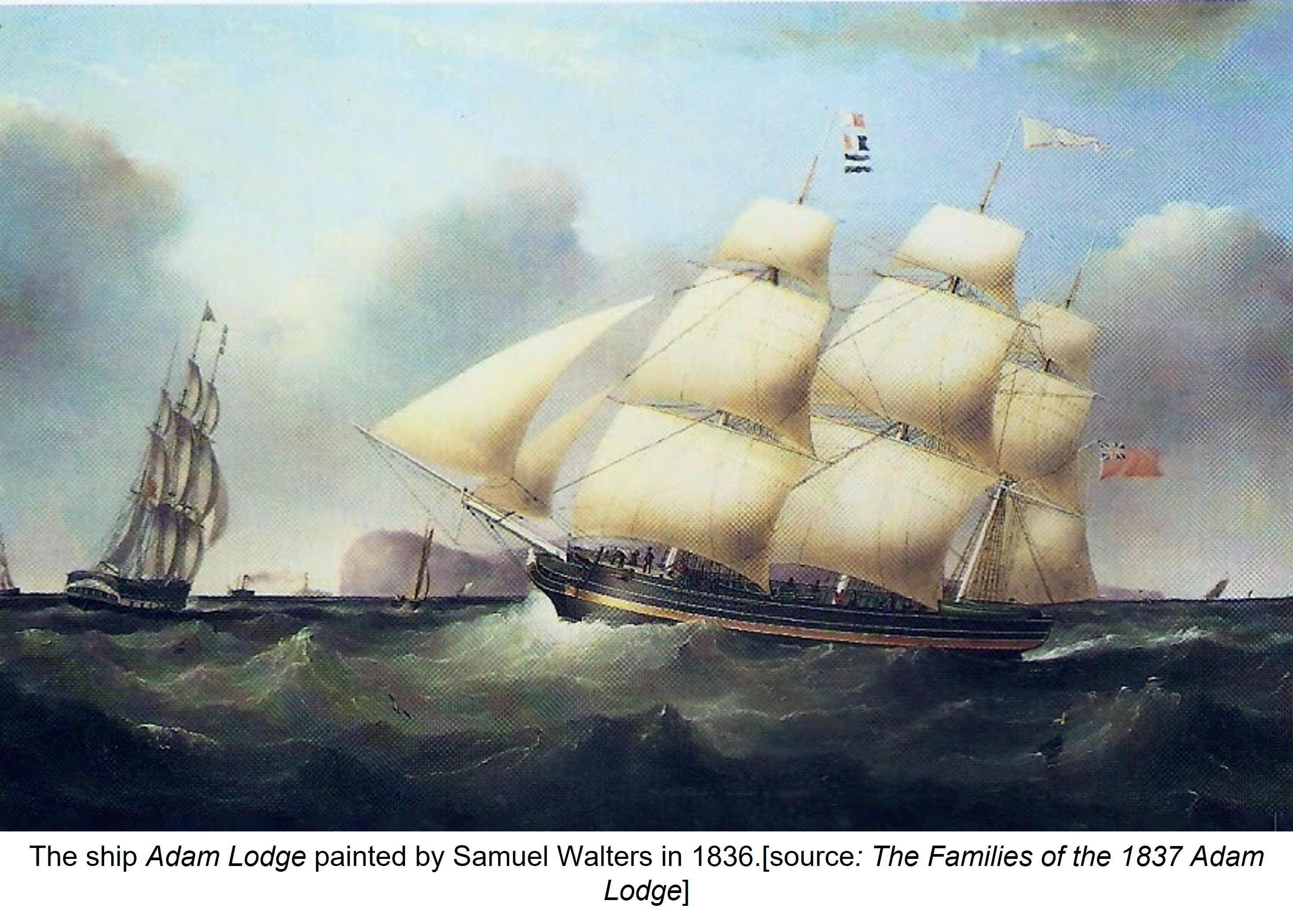
  5. 1837 Adam Lodge departed from Londonderry Ireland to Sydney arrived on 13/7/1837. James Morrow was a 12-year-old boy from County Tyrone, Northern Ireland, and travelled with his parents Joseph Morrow and Phoebe (nee Jamieson), and one other sibling.
  6. 1838 Palmyra England to Sydney 26/9/1838. On board were John Parker 38 (carpenter) and wife, Hannah Parker 38, and children Tryphena 11, Jane 15, Miriam 9, Keziah 5, another 3, and Mahala 1. They were from Brede, Sussex, England.
  7. 1841 Helen departs Liverpool on 4/4/1841 and arrives in Port Jackson on 21/7/1841. On board were Jonathan Weir (34-year-old carpenter) and Ellen Weir (29) with 7-year-old daughter Eliza.
  8. 1842 Robert Benn departed Greenock Scotland 20/9/1841 and arrived in Melbourne on 26/1/1842. Nathaniel Simpson travelled with wife Dorothea and daughter Ann and son William. They were from Downpatrick, Ireland.
  9. 1842 Arab London 7/11/1841 to New Norfolk Tasmania 31/3/1842 George Burt was 17 years of age travelling with his father, mother, and five siblings. They were from Walton, Somerset, England. They then travelled aboard the Shamrock to Melbourne on19/4/1849.
  10. 1844 Elizabeth departs Liverpool on 3/10/1843 and arrives at Port Jackson on 20/1/1844. Aboard was Maria Morrow with her family, father George, mother Elizabeth, and siblings. They were from County Tyrone, Northern Ireland.
  11. 1848 Marchioness of Douglas departed from Greenock Scotland and arrived in Melbourne on 27/1/1848. James Fleming was 37 and arrived with his wife Margaret 34, and sons Peter 9, William 5, and James an infant. They were from Glasgow, Lanarkshire, Scotland.
  12. 1848 Aurora Plymouth to Geelong 7/12/1848. On board was William Hartley a 22-year-old laborer emigrating from Devon, England.
  13. 1851 Stebonheath Plymouth to Geelong arriving 16/12/1851. Mary Kerr was a 16-year-old girl travelling with her sister Flora who was 14 years old. They were from Inverness, Scotland.
  14. 1852 approx. Unknown ship. Henry Bentley was about 22 years of age when he travelled to Australia. He came alone leaving behind his family in Kent, England. It is not known the ship he arrived on or the exact date.
  15. 1853 Bride Plymouth to Melbourne 17/5/1853. Catherine Fitzgerald was a 23-year-old domestic servant from Tipperary, Ireland, and one of the many single young Irish women who came to Australia to become a bride. She married Henry Bentley soon after arriving in Melbourne.
  16. 1853 Helen Lindsay Plymouth to Melbourne arriving 17/7/1853. Edwin Hammond arrived with wife Elizabeth (25), son Edwin (3) and daughter Sophia (1). They were from Chichester, Sussex, England.
  17. 1853 Wilhelmsburg Hamburg to Melbourne arriving 24/8/1853. Aboard was the 29-year-old single man John Backmann from Stralsund, Germany.
  18. 1854 Ameer London to Melbourne 2/2/1854. William Catchpole was aboard travelling as an 18-year-old single man leaving his hometown at Aldgate, London, England.
  19. 1855 Shand Plymouth to Portland, Victoria 20/1/1855. Thomas Smith (a tailor) arrived with wife Sarah and five children from Gloucester, England.
  20. 1855 Epsom Plymouth to Geelong arrived 27/4/1855. On board was Mary Ellen Mullins (20-year-old) and Judith Mullins (22-year-old). Mary was the daughter of Patrick Mullins and Mary Higgins, and she was born in 1835 in Galway, Ireland.
  21. 1856 Ocean Chief departed Liverpool on 8/10/1855 and arrived in Melbourne on 25/1/1856. On board was the 20-year-old Edward Harris from Shepton Mallet, Somerset, England.
  22. 1857 Admiral Boxer arrived in Geelong on 9/3/1857 having departed from Liverpool. On board was the 26-year-old housemaid from Gloucester, England, Harriet Bushell.
  23. 1857 Beejapore London to Sydney 19/3/1857. Alexander Black arrived alone as a 23-year-old man. He left behind his parents and siblings in Kinross, Scotland.
  24. 1858 Parsee arrives in Melbourne on 14/5/1858. Matilda Colee arrives with her younger children, to meet up with her husband Henry who had arrived six years earlier. They were from Shoreditch, Middlesex, England.
  25. 1861 Prince of Wales London to Melbourne, 23/8/1861. George Newman 27-year-old arrived with Henry 62 (trader), brother James 20, and sister Sarah 24. They were from London, England.
  26. 1864 Champion of the Seas departed England 4/8/1864 and arrived in Melbourne 15/11/1864. 45-year-old Daniel O’Connor was aboard with his wife Mary 38, and children, Mary 22, Cornelius 21, Michael 17, Ellen 16, Kate 14, Hannah 12, Bridget 10, Daniel 8, and Patrick 6. They were from Cork, Ireland.
  27. 1871 Star of the Mersey Calcutta to Melbourne 25/6/1871. Aboard was the 37-year-old Henry Colee, son of Matilda and Henry Colee who had arrived earlier. They were from Shoreditch, Middlesex, England.
  28. 1887 Hampshire Portsmouth to Fremantle. John McKinna and wife Jane McKinna travel with six children to Fremantle. Then in 1888 they travel aboard the South Australian from Fremantle to Melbourne 6/2/1888. They left behind extended family in Newton Stewart, Wigtownshire, Scotland.
  29. 1908 Marama Vancouver to Honolulu then to Sydney. Arthur Gregory Duncalfe arrives with wife Beatrice. They left behind extended family in Spokane, Washington, United States of America.

These ships that brought our ancestors to Australia form just part of the story. From these arrivals I document the families as they settle here in Australia and become Australians. I feel humbled by these stories that show courage and tenacity. They left behind difficult circumstances, only to have to toil harder in a harsh developing colony.

Finally, after many years of gathering stories, photographs, and documents, I have finished compiling the Bentley-Smith family history. It is 280 pages in length listing as many facts that I could corroborate. I hope it is a lasting legacy for family members. But I will keep on looking for that ship that brought Henry Bentley to Australia.

2020 Year in Review – The Year of the Virus

The year of 2020 was great for me and my husband! Despite it being The Year of the Virus, we were able to do what we set out to do. It was to be our Gap Year and a year to travel Australia with our home-on-wheels.

In 2019 we sold our house, bought a caravan, left our jobs, and put all of our possessions into storage.

Our loose plan was to do the Big Lap of Australia in a figure of 8 route. First travelling west to Western Australia (WA), then north up the west coast to Broome, then east across to Darwin, then south down through the centre, to the Flinders Ranges in South Australia (SA), then home to the Mornington Peninsula for Christmas with the family. Then up the east coast into New South Wales (NSW) and Queensland (QLD).

Trip Plan A

So, although not quite retirement age, we decided the time was right. We wanted to be able to do all of those epic walks before we are too old.

We set off at the beginning of December in 2019. Pre-pandemic we had a nice time exploring the coastline from Melbourne to Perth, as well as the southern Goldfields of WA. In March 2020 we were in the desert of WA north of Perth when the first lockdown occurred, and the borders were closed. We dashed back across the Nullarbor Plain, back to regional Victoria where we spent three months parked on a relative’s farm still living in our caravan.

So, Plan A was scrapped, and Plan B became a creative exercise in random serendipity. We went where we could, crossing borders when allowed, staying put when there were no options. We went to places we had not planned to go.

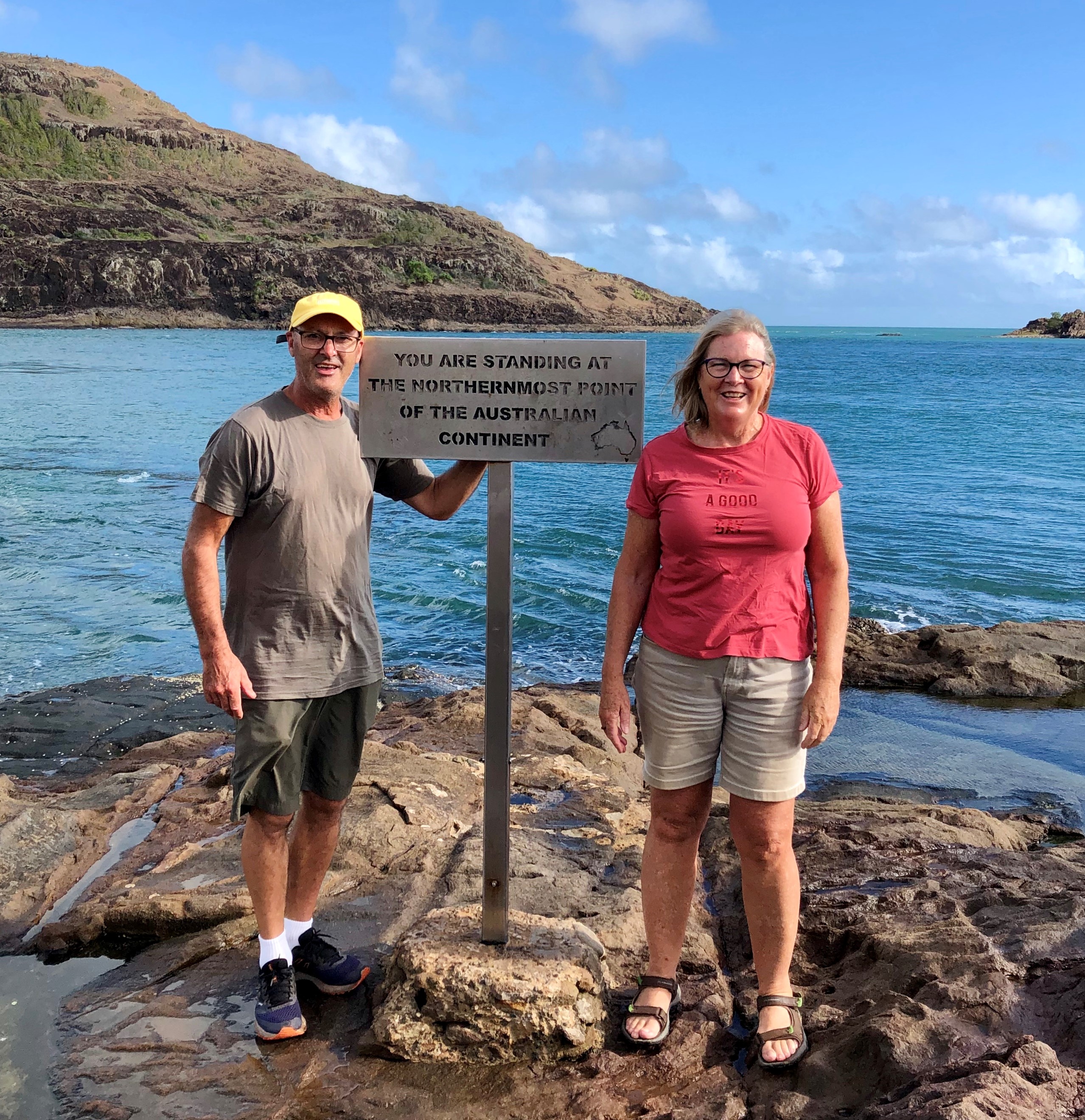
The Northern Tip of Australia – Cape York Peninsula QLD

We explored, camped, swam, walked, watched wildlife, snorkeled, went out to the Great Barrier Reef, and watched sunsets, sunrises, and stars. It was hot and we loved it. We lived in shorts and t-shirts and thongs. We drank beer, made new friends, and didn’t have to wear a mask until we returned to Victoria in December. We were lucky and we knew it.

I read less because I was travelling, exploring, walking, taking photos, sketching, and writing the travel blog. The books I did read were random and not worth mentioning, chosen from caravan parks, book exchanges, op shops, or an eBook borrowed from my local library then downloaded onto my iPad. I did buy a couple of books from book shops.

I was happy that my travel articles were regularly picked up by the online newsletter Camping News. And this validated my writing pursuit that I hope I can develop into a professional job.

Of course, we missed our family and friends and felt very sympathetic during the long hard second lockdown in Melbourne and Victoria.

Trip Plan B – Actual trip 2020

We spent 373 days travelling 41,175 kilometres of Australia. We stayed in 80 caravan parks, 20 of which were free camps. We visited every state except for Tasmania and the Australian Capital Territory.

We had a great adventure in 2020.