Kevin Bacon versus the Lone Cowboy

I recently watched a program on TV called How Kevin Bacon Cured Cancer. It was a really interesting documentary that followed some scientists and mathematicians as they tried to discover the mathematical theory and structure that supports networks. Kevin Bacon was of course the person who was the example used in the popular theory known as Six Degrees of Separation.

These networks apply to brain functions, cells, computer systems, viruses, the spread of disease, air traffic flight paths, and social networks like Facebook and Twitter, and many other systems or networks.

The concept of “hubs” enabled them to provide a richer and more comprehensive structure to the mathematical theory. Kevin Bacon would be the original celebrity “hub”. Heathrow Airport is a major hub in the air traffic systems. What makes a “hub” I wonder? When you think about people in social networks it can be due to popularity. In Facebook the number of “friends” you have is an indicator of this. But how many are manufactured and how many are genuine? Barrack Obama on Twitter would be a major hub in that system and a genuine one at that.

At the other extreme of this is what I have called “the lone cowboy”: the loner; the person who doesn’t want or need lots of people to validate your own identity in this world. It is someone who wants to opt-out of society and doesn’t want to be a part of the social network. This link in the network might be like a little regional airport, the less-used brain cells, or the person who lives a solitary existence.

I hope the mathematical theory does not conclude that the points with a small number of links are not any less needed or significant than the popular hubs in the network. My own tendencies move toward the less busy parts of the network.
What next?

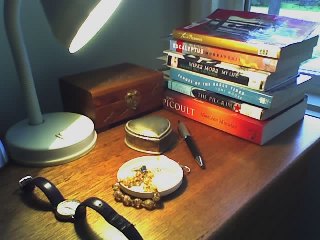
26-07-08_1132What next? What book will I read next? How do you get your hands on that next good read? Perhaps you have a stack waiting on your bedside table. But is there anything inspiring there that will capture your interest and attention?
Here are some ideas for when you may be short of something to read.

You can always look at the best-seller lists in the weekend newspapers, but often these will remain stagnant for weeks on end. Harry Potter dominated the top 10 sellers for so long it was ridiculous. Now the Twilight series by Stephanie Meyer are slow to be toppled from the top.

Your local bookshop will regularly publish catalogues that could whet your appetite.

Amazon is a good website to go to because you can sign in to get personalised recommendations. Your search results are retained and further recommendations are made to you based on your lists.

Library Thing is a great social networking website for readers. You can catalogue your own library of books at home or use it as a place to list your favourite reads and based on this you can easily link to other books with the same tags or other readers with similar reading tastes. Go to their Zeitgeist to find a huge array of links and lists. You can also search by tags, for example, you might like to search for “France and travel”. This is my first point of call for finding new reading material for myself. Click here to find out what a Zeitgeist is, if you don’t already know.

Wikipedia has a list of best-selling books which may remind you of that classic you have always wanted to read.

WhatshouldIreadnext is a cute little website that attempts to answer this question for you. You have to register and then list books you have read and based on this list it will find other titles that may interest you. It is rather limited in its power and depth.

Read everything by your favourite author? “Who else writes like…?” by Roy and Jeanne Huse is a book commonly found in local libraries that can help you identify an author who writes in a similar style as your favourite author.

Who writes like from Coffs Harbour City Library offers links to websites to help you find authors.

Goodreading magazine is a great monthly magazine for Australian readers that offers reviews, excerpts, interviews and more great information.

Or you could go to your local library and ask a Librarian. They tend to be rather well-read and know current trends in reading and are more than happy to help you find a good book to read.

Another option is to join a local book club. This also prompts you to read books that you might not otherwise read.

The Aussie Fire Beast

One tiny spark from a cigarette butt thrown thoughtlessly from a car into drought-dried mulch, whipped by the winds from the Northerly furnace and in seconds the scrub is alight. The orange fire demon springs from the ground, licks then devours grass, shrubs, trees, fences, houses, cars. It grows, building smoke towers into the sky; brown and grey bulbous silos of smoke move like a Godzilla come to life. People flee or stay, trying to damp down the edges of the inferno. Fire-fighters arrive with all their gear, naively confident with well rehearsed drills. Helicopters circle, with TV crews filming the chaos, while others drop water from above. Frantic efforts follow the fire beast, trying to tame it and bring it to the ground.

I was holed up at home staying inside trying to shelter from the 45°C heat outside. I was concentrating, sorting through some papers, when finally the sounds of the sirens and helicopters registered in my awareness. I thought, “They sound close!” I immediately opened the blinds and looked at the ridge nearby – no sign of smoke. So I went to the front room and was stunned to see the familiar sight of an Aussie bushfire in full flight. Black, grey and brown towers of smoke billowed up into the blue sky. The orange flames leapt from treetops. Trees exploded. Three helicopters circled and hovered. Sirens announced the arrival of fire engines from all directions.

From my previous experience with the Ash Wednesday bushfires in 1983 I knew the first thing I had to do was change my clothes from the long loose cotton summer dress and bare feet to boots and full coverings. If you don’t change your clothes at the beginning there may not be another chance. Fighting fires in a cream office skirt and wedge-heeled sandals is not very practical (as I did in 1983). And we see too often refugees from these bushfires left with only the clothes they stand in.

I then phoned my husband to let him know. I organised buckets, hoses, mops, towels, and put the ladder to the roof. I climbed up to get a better view of the fire and cleaned out the recently fallen dead leaves from the gutters. It was a surreal moment as I relived the identical situation from 1983 when I stood on a different metal roof in another location with smoke billowing overhead, helicopters chopping through the smoke, and tress exploding. Luckily for me and my family on both occasions the fire past us by, but being in the ember fall means that you need to be on guard for spot fires and wind changes.

This recent fire happened one week before the massive and tragic fires that occurred on Saturday 7th February 2009. It was a day that reached over 46°C and the authorities had warned everyone and were on high alert. Unfortunately the fires erupted on many fronts across the states of Victoria and New South Wales. There were none near us on this day, but our son was attending a wedding at a winery in the Yarra Valley. He phoned us as the fire approached. They were surrounded by raging fires. He spent a worrying evening stranded inside the winery while helicopters water-bombed the building and surroundings. They were eventually allowed to travel home after the fires had passed.

Not all were lucky on that evening. The death toll sadly reaches towards 200. Yesterday the count was 173 with many still not found. Never before have so many people lost their lives in Australian bushfires. The speed and ferocity of these fire monsters seem to defy all plans of escape.

I heard a man on the radio today describe how the fire passed over their town: literally travelled over the town above them in the sky and landed further along to wreak its havoc. He said the sound of the fireball roaring overheard was extraordinary. His town was untouched. While meanwhile the townships of Marysville and Kinglake are completely devastated and nothing remains.

More information please

Three questions in one day had me at a loss recently:

1.    “I am looking for a particular book about the Sydney Harbour Bridge. I can’t remember the title and I don’t know the author. It was mentioned on a TV show I was watching recently but I can’t remember what show it was. Can you find it for me?”

2.    “I want to read a book I saw mentioned in a newspaper a while ago. I don’t know the title or the author. It is written by a roadie of a big rock band but I can’t remember which band.”

3.    “I want a book about living with a spinal cord injury with Australian content. I don’t have access to the internet at home and I won’t use it here at the library!”

Now I will do my best to try to help these people: I will do subject searches of the library catalogue; I will search probable TV show websites and newspaper resources; I will search Amazon and Google. I will think laterally trying to come up with some way to find what these people are looking for.

Of course I found many books about Sydney Harbour Bridge but not the one sought by this particular individual. I found many books written by roadies of rock bands but not the one the man wanted. I found many relevant and detailed websites pertinent to Australians living with spinal injury and these listed books that may have been of use, but since this person flatly refused to look at the internet this avenue of information was not an option.

It really does help to have a title or an author to begin the search. In each of these cases I sent the person away to perhaps find more information to help with the search. I felt like a failure. I continued to think and search long after they had gone trying to find the elusive book they sought. But it is really a lost cause without a little more information.

It is amazing how often someone will come in asking for a particular book saying “I don’t know the title or the author but it has a blue cover.” Or something similar. More often than not, through questions asked in the ensuing conversation, I can discover the book they mean and find it easily.

Juggling people

Working in a public library in a coastal beach community 80 kilometres from a major city means that during the summer holidays we are inundated with people wanting all sorts of things from us. When the weather is bad the campers take refuge in the library for some amusement. When the weather is too hot they still come to once again get some respite in the air-conditioned comfort and shade.

Here is a snapshot of the questions we get every day:

“Can you find me a book with the Australian citizenship questions? I have to sit the test before they take away my pension and deport me after living here for 50 years.” pleads the 80 plus year old lady with the walking frame and a plastic aqua wallet covered in scrawled pen notes to herself.

“I need more time on the computer!” stammers a smelly long-haired and balding unkempt 30-something male who visits every day.

“Have you got information about the XXth battalion of WW2? I fought there back in 19XX and I remember…..” reminisces the elderly digger with tears in the corners of his eyes as he settles in to recall the events.

“I have a few new titles I’d like to order.” asserts the well-dressed elderly woman as she unravels a long list with beautiful handwriting.

“I want to email photos directly from my camera. Can I use a computer?” says the holidaymaker with no identification and questionable IT skills about how to do that exactly.

“Can we join the library?” choruses the family group of mother, father, and four children as they swarm the counter en masse.

“Have you got the Twilight series? I want to order the first book. And the next one, and the next one…” rambles the young girl at the end of the telephone.

“I’ve lost a book. We’ve just moved. I must have returned it….” already on the defensive, the woman on the telephone has effectively jumped the queue of four people patiently waiting for attention in front of me and now she wants to persist with her excuses before anyone can get a word in.

“Can we use ze internet please?” a backpacker politely enquires in stilted English with some divine European accent, while showing a well-worn passport.

“I want information about dioxin and the effects on humans. I’d like references to the incidents of this in Vietnam and Northern Italy. I’m worried about the proposed pulp mill planned to be built on the Tamar River in Tasmania. Can you find this for me please?” asks a polite regular with a keen curiosity and social conscience.

I try to give my full attention to each and every customer and not only help to give them what they want, but also always try to give them that little bit extra whenever I can. It can be a challenge sometimes especially during summer when the people and questions come thick and fast. But I love it.

I regularly read a light-hearted comic strip about libraries at Unshelved. At present they are loaning out ukeles to the public and I suppose this reflects some of the crazy gimmicks that we have to embrace from time to time.

Fact or fiction

bb-23468_502

The lines can blur when categorising literature into fiction or non-fiction. There are many books in the ‘non-fiction’ section that are questionable in terms of truth and validity. I am currently reading about the Teachings of Abraham in a book by Esther and Jerry Hicks. The practical advice for living offered in the book was apparently communicated to Esther by entities not residing in this physical world.

This week I saw the movie “The curious case of Benjamin Button” starring Brad Pitt as Benjamin. It is so satisfying to go to the cinema and be treated to a fulfilling movie experience, and this movie provided that. It was so uplifting despite the topic primarily being about death. It is an improbable tale about a man who is born old and lives his life backwards, and yet it is convincingly portrayed and beautifully crafted. The make-up artists certainly had a challenge making this movie, and did it so well.

Brad Pitt was brilliant as the quirky and challenged character of Benjamin. He was also typically gorgeous during the prime years of Benjamin’s life. I swooned as Benjamin (Brad) took off on his motorbike and again when he set sail in his yacht!

This story of fiction, apparently originally an unpublished story by F. Scott Fitzgerald and made into this film by David Fincher, is an improbable work of fiction, and yet again the philosophical advice for living is clear.

Life can sometimes be stranger than fiction. Public libraries are havens for everyone everywhere and so you will see a broad cross-section of society there on any given day, seeking a diverse range of information. There are even ‘wizards’ who visit. This is a fact, although perhaps by name only and not nature – not proven anyway.

Holidaymakers being fined $113 for parking their cars in a loading zone, outside the library when the car parks are choking; now that’s a fact.

Zen and the Art of the Reference Interview

Recently I have been prompted to examine the procedure I follow when undertaking a typical Reference Interview. The Reference Interview is the enquiry process that occurs when a person asks a Librarian for some information. It is something I do without thinking about and I follow a procedure that is typical of all Librarians working in Information Services for customers. It is the nature of our work. It is the basis of our training and study. It is second-nature.

So the process is that the customer approaches (sometimes hesitantly) and I smile and ask “What can I do for you?” or “How can I help you?” The questions will vary from: being direct, well-defined, and fast and easy to accommodate, to vague, unsure, complex, deep and involved. They will often ask “Have you got the book “Such and such?” or “Have you got the latest book by “Whoshewhatsit?” or perhaps “Can I order the next DVD in the series “TV show?” I will check the library catalogue at the PC near me and advise the customer. If we don’t have it I will try to determine the age of the item and look online to see if it is still in print, check at other libraries via the Libraries Australia website or Libraries Link and advise the customer. I will order it in for them whenever appropriate and that is more often than not. I will use Google and Amazon as last resorts but most often I have located the information before that.

When a question is vague, general, or ill-defined I will often take the customer to the book shelves where we can browse together while continuing with the conversation and the “reference interview”. This helps the customer hone in on their needs and also introduces them to the arrangement and scope of the collection we offer.

Sometimes a question may go beyond the scope of the public library; questions like “I want to read the history of the Australian 15th Battalion in World War 2. Can you help?” Of course I will follow the same procedure of checking our resources, but inevitably I will end up at the Australian War Memorial website and search their online resources. In this case the gentleman had already visited the Australian War Memorial in Canberra and asked the staff there the same question, so he was way ahead of me. This came to light in the course of our conversation.

The point I wish to highlight is that each question is unique, as is each person who asks a question. I approach each question afresh and with the aim to open a conversation with this person; a conversation that is fluid, natural, flexible, unique, and engaging. I will follow my intuition and try to respond accordingly. There is no pat academic explanation to a process I follow by instinct, despite the fact that I do indeed loosely follow a procedure that is typical of all fellow Librarians or Information Professionals. I do not want to appear automated, stilted, academic, procedural, like I’m ticking all the boxes, robotic, bureaucratic, nor condescending. I merely want to engage in an exploration of resources with a fellow human being and in that interaction discover things together.

I relish the challenge and mental gymnastics required over the course of a days work helping people find the answers to their diverse questions. I love the thrill of the hunt that draws on my detective skills and lateral thinking ability. I enjoy the new things I learn by default from other people’s enquiries. And more importantly I feel my life is enriched by the small everyday relationships that develop along the way.

The Christmas spirit

I walked through the front door and was stopped in my tracks with the silent realisation “Oh My Gosh, it’s Christmas!  I first noticed on a sideboard in the entry a knitted nativity scene. It was so cute and made by the sister of the lady who lived there. I could not imagine ever spending the time to knit little individual sheep. This house, where our Book Club was meeting for the Christmas session, met all of the criteria of a warm, cosy, festive atmosphere. There were Christmas decorations everywhere; tastefully placed. A huge artificial Christmas tree filled a corner of a warm sitting area defined by wood paneled walls, antique sideboards, comfy leather lounge chairs and a fireplace adorned with conifer sprigs.


Christmas in the Australian summertime is usually a stifling occasion, but on this December evening it was raining, cool and misty, transporting us to a European Christmas. We shared a buffet dinner arranged on the dining table in the best Christmas crockery. We ate, drank sparkling wine, chatted, and then settled to discuss the book: Amy Witting’s “A change in the lighting. The discussion was brief and not as in-depth as the previous discussions of other books.


dsc010351The next day I decided to think about my own plans for Christmas. I put up our little artificial tree, made Christmas cards and sent them, planned the meal for our family get-together, and went and bought a cute little nativity scene. It is not knitted but cute nonetheless.


Our shared meal will be a typical Aussie Christmas lunch with various cold meats, salads, pavlova with raspberries, plum pudding, fruit punch, lollies, beer, and wine. No doubt it will be a hot day and I will set up tables on our back verandah.

‘Straya

Have you seen Baz Luhrmann’s epic Australia yet? I know that Aussies may feel compelled to see it, but my advice is to save your money. What a disappointment and embarrassment! And I love his other movies like Romeo and Juliet and Moulin Rouge.


It seems to me that Baz could not decide if he wanted to make a musical again, a comedy, an epic, a war movie, or some kind of Australian classic. He failed in all. Perhaps if he had indeed made if a musical the movie as it stands would have succeeded. It is full of cringe value for all Australians. The graphics are woeful. The dialogue is stilted, and the accents are overly exaggerated. The performances of some great actors are shallow and terrible. The only actor who was good was the young actor who was the narrator of the tale – Brandon Walters.


The scenes about the bombing of Darwin seemed to be over-the-top and aimed at a Hollywood audience rather than depicting the truth. But then I questioned myself and knew that my knowledge of the bombing of Darwin was scant. I did a little research in the library to try to discover what the facts were. The Australian War Memorial website has one short page devoted to the attacks. I found one book titled “Darwin’s battle for Australia: a history of Darwin’s role in the defence of Australian in WW2” by the Darwin Defenders and published in 2005. This 294 page book contains witness accounts and photographs from the events in Darwin at that time. Once again the local library manages to provide information that is relevant and of high quality content.


P.S. The power of the blogging world – very soon after I posted this I received the comment direct from the Australian War Memorial who pointed me in the direction of more of their resources. Thank you. My excuse is that it wasn’t because I was not being thorough in my research of their website, but because I had located the excellent book in my local library on the subject. I value their input and the power of Web 2.0.

The unanswerable

As a Reference Librarian in a busy public library I help people find the answers to their questions every day. I help them with questions big, small and everything in between; everything from research into medical conditions, to the location of the photocopier. Often the most urgent need is to know their placement in the reservation queue for the latest best seller.


In the last two weeks I attended a 90th and an 80th birthday celebration. These parties were both fun and emotionally moving occasions. Digital photo stories on display fleshed out the lives of these individuals and gave appropriate eminence to each. It is amazing what you learn about people at an event like this. It makes me realise how important each person is within their sphere of influence.


I joked about the fact that I went to these parties for old folk, but in truth I feel privileged to have been invited and present at these enjoyable and momentous events. The 90 year old lives independently, is relatively mobile, and in full use of their mental abilities and sense of humour. The 80 year old is a friend who cycles in the group I also cycle with, and also swims in the sea regularly, runs, and much more.


Meanwhile the person in my life who has cancer was hospitalised. As someone who never smoked it seems ironic they have cancer in their lung. Bad luck perhaps. Is there no logic to living a long and healthy life?


These experiences help make me better at my job. I am more accepting, inclusive, and non-judgmental towards everyone. Paradoxically, all questions become both irrelevant and significant at the same time. Our shared mortality is the only defining characteristic. The meaning of life blurs in and out of focus.


The big questions remain unanswerable.