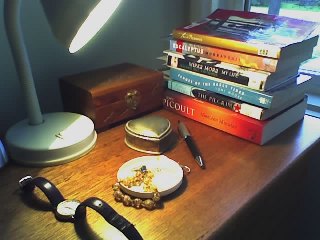
Escape

“And all I can do is read a book to stay awake,
And it rips my life away but it’s a great escape.
Escape, escape, escape. ~ No Rain by Blind Melon

The National Year of Reading theme for May is “Escape”

So what kind of “escape” are we talking about?

  • Escape from incarceration
  • Escape from oppression
  • Escape from a noisy mind
  • Escape for a holiday
  • Escape from the rat race
  • Escape from something else….

You can check out a great list of books on LibraryThing that have been tagged with “escape”.

To me “escape” means travel to exotic locations. Here are a couple of my favourite books about “escape”

  1. Eat Pray Love by Elizabeth Gilbert
  2. The Happy Isles of Oceania by Paul Theroux

This relates to my personal favourite genre – Travel with a twist

10 books to make you think

Think” is the theme for March on the National Year of Reading calendar and to support that topic I offer my shortlist of books that have made me think and changed the way I think. @love2read

Do you think? Or are you a slave to habitual thought patterns instilled in you from your ego, your body, your upbringing, society? Are you willing to challenge and change your thinking? Do you want to be an original thinker? Be the creator of your own life experiences? Or are you content to follow the herd?

I have always enjoyed challenging and testing my mind and feel a personal need to reach for greater awareness and understanding. Some would say I think too much. But I disagree and tend to think most people don’t engage their mind in original thought enough.

So here are some books that have been instrumental in raising my awareness from one level of thought to the next. They are in order of when I read them.

The Road Less Travelled: A New Psychology of Love, Traditional Values and Spiritual Growth by M. Scott Peck 1983

This is an oldie but a goodie and a “Number 1 International Bestseller”. Dr. M Scott Peck practised as a clinical psychiatrist and offers anecdotes from his psychotherapy sessions with patients to explain his thoughts about the concept of “love” and then provides meaning that is not what many of us think of as “love”.

When I read this book many years ago it certainly changed my thinking and gave me some new ideas to test. My old copy looks dated, and even some of the style, prose, and premises seem old fashioned now.

It was an important work at the time but maybe many of us “got it” and have since evolved. The concept of “love” continues to be pedalled through popular media with the same old neurotic premises though, so maybe it’s time for a new version on this topic prepared for a new audience.

Illusions: The Adventures of a Reluctant Messiah by Richard Bach 1977

As I have stated before this book rates as my Number 1 favourite of all time, and has never been knocked off that pedestal in the many years of reading since.

I like its simplicity, the gentle tone, the story about pilots and flying, the spiritual lessons, and the overall message that life is far more complex, mysterious, and full of possibilities than we can ever imagine.

The Master in the story teaches the student that all is not what it seems and that to see more you have to be able to see through the veil of existence. This requires a shift in thinking, perspective, and common notions of reality.

“Here is a test to find whether your mission on earth is finished: if you’re alive it isn’t.”

The idea about manifesting things – physical things – into our life I find magical and compelling. The image of the blue feather became a lovely experiment in manifestation that remains with me to this day. And this no doubt led me to look closer at the book A Course In Miracles when it appeared one day.

Zen and the Art of Motorcycle Maintenance  by Robert M. Pirsig 1974

Pirsig seduces the reader into an apparently simple tale about a father and son who go on a motorcycle trip with some friends across parts of the United States of America. To pass the time the father, who is the narrator considers the deeper meaning of concepts such as “quality” using examples they see along the way such as the geysers at Yellowstone National Park.

It forms an interesting gentle conversation that is soon disturbed by the returning fragments of memory of the narrator. Things are not what they seem at all. The narrator has a past that he is recalling bit by bit and this clouds the story with an unusual twist. He has had mental problems, a breakdown perhaps. He is drawn to discover his past with his son, reluctant now, in tow. And who is this Phaedrus character in this story?

A second reading of this book was necessary for me because I became lost the first time. Once understood though I loved the depth of discussion and the analysis of concepts that were cleverly woven into a simple tale of a motorcycle trip. The descriptions of practical motorcycle maintenance and how the right attitude can improve the overall performance and experience of owning a motorcycle, was the defining message that can be applied to all of life’s tasks.

The Celestine Prophecy: An Adventure by James Redfield  1993 and An Experiential Guide by James Redfield and Carol Adrienne 1995

The Celestine Prophecy: an Adventure is a simple tale of a quest to find some ancient manuscripts that contain the insights about human existence and how to steer humanity from its destructive path. It is a quaint and predictable story that has since been made into a movie.

The companion book An Experiential Guide guides the reader towards finding the deeper meaning of our lives and to discover our main life purpose. Using the nine insights as a framework questions are posed that assist us in examining our own life story. We can then understand the key issues within the context of our own life.

I like this tool for analysing and understanding why we behave and think the way we do. Our past, especially within the context of our upbringing and our families, has shaped us to be the person we have become. To really understand this in context helps to free us towards our own individual life experiences. It releases us from blaming our past and liberates us towards an original journey.

Echoes of the Early Tides: a Healing Journey  by Tony Moore 1994

Tony Moore wrote Cry of the Damaged Man after being involved in a near fatal car accident. Suddenly his work as an emergency room doctor ceased and he became the patient, like so many he had attended before.

Echoes of the Early Tides continues his personal exploration of the healing process as a sequel to the former work. It is a compelling, beautiful and sometimes abstract description of how he steers his mind from being drawn towards a black abyss of no return. He wanders the beach and coast seeking solace and healing; his seaside analogies enrich the explanations with elegance and reality.

He explores in depth “self-harm” and why some people seem powerlessly drawn to repeat behaviours they know will cause themselves and others further harm.

He concludes with:

“Human existence has moments of trickling ease, and other times of unmanageable chaos. Both are flows we must go with if we are to manage the tides of our lives.”

I have read this book many times and my copy has yellow highlighter marking passages on nearly every page.

A Course in Miracles by The Foundation of Inner Peace 1975

If I had never read Illusions then I would never have lifted this book off the shelf at the new-age style shop that sold books, crystals, incense, etc. For me it was Illusions that planted the seed of a thought of the possibility of manifesting things in one’s life. So the idea of undertaking an actual course in miracles seemed a way forward if there was one.

The copy I bought is a hefty hard back volume with light weight paper. It is divided into sections: I Text (669 pages); II Workbook for students (488 pages); III Manual for Teachers (69 pages). First published in 1975 it is now well known. Created originally by two doctors Helen Schucman and William Thetford, Professors of Medical Psychology at Columbia University’s College of Physicians in New York City, it was a response to “angry and aggressive feelings” associated with their field of work and a desire to find a “better way”.

I have not read the whole book. It is hard going. The 365 daily lessons for students are mind-changing and I have only ever made it to about Lesson 7 before I start to wonder if these exercises could really cause one to release ones grip on reality entirely. It certainly makes you think because it unhitches all habitual thought processes. The text is biblical in style and although the authors were “anything but spiritual” the presence of God is there in every passage.

Maybe one day I will read the book through.

The Power of Now: A Guide to Spiritual Enlightenment by Eckhart Tolle 2004

In recent years Eckhart Tolle has emerged as a leading voice in the quest for spiritual development and connection. His book The Power of Now is an exceptional exercise in urging us all to just live in the now.

Your mind is an instrument, a tool. It is here to be used for a specific task, and when the task is completed, you lay it down. As it is I would say about 80 to 90 percent of most people’s thinking is not only repetitive and useless, but because of its dysfunctional and often negative nature, much of it is also harmful.”

One paragraph in this book had that effect on my mind where it immediately raised my comprehension to a totally new level. At the time I clearly remember the “Ah-Ha!” moment as this new understanding became clear. Now, I can’t remember what that was, or where in the book it is. And I didn’t mark any passages with yellow highlighter or pen. I would need to re-read the entire book to find it again. I will. But sorry, for the timing of this blog post you will need to read it to find your own “Ah-Ha!” moment.

A New Earth: Awakening to Your Life’s Purpose by Eckhart Tolle 2005

Eckhart Tolle followed The Power of Now with a more urgent plea for us all to evolve spiritually for the sake of the future of humanity. He delves deeply into the ruling power of the ego and shows us how to break free from this tyranny.

He concludes with:

“The meek are egoless….They live in a surrendered state and so feel their oneness with the whole and the Source. They embody the awakened consciousness that is changing all aspects of life on our planet.”

He proffers that a purposeful shift in the way we think is not only self empowering but a necessity for the continued existence of our species.

Living as a River: Finding Fearlessness in the Face of Change by Bodipaksa 2010

Like many people who choose the Buddhist path Bodipaksa changed his name. He was born Graeme Stephen in Scotland and runs an online meditation centre Wildmind. Not that any of this has any bearing on his book that explores the overlap of science and spirituality.

I was introduced to this book at the meditation centre I attend. Anyone who has tried meditation knows the value and power of ceasing all thoughts and stilling the mind. So perhaps this book should be mentioned under “unthink” instead of “think”. I choose to list it under “think” because Bodipaksa challenges us to examine our habitual thought patterns and change them.

He begins:

“Here’s a very “queer thing” about life: sometimes the things we think will make us miserable actually make us happier….Ironically, when we do happen to experience the fragility of existence, we often find our appreciation of life enhanced rather than diminished.”

The overriding metaphor in this book is to consider your existence as if you are an eddy in a river. If you look at an eddy it appears to be an actual physical form, and yet we know that it consists only of the river flowing through, responding to the formation of the river bank and bed. The eddy changes in every instance. It may be transformed completely over time depending on the river flow, water levels, formation changes along the bank and river bed, but essentially the eddy is the river flowing through a point.

Just as our bodies/minds/selves are manifestations of Life flowing through the physical world. Of course Bodspaksa explains this far better than I. He invites us to try the Six Elements Practice which is a meditation that assists our thoughts towards a feeling of being alive as part of the river of existence.

Get reading about thinking now!

These books offer some answers to questions such as:

  • What is thinking?
  • Why do I think this way?
  • What are the methods to constructive thinking?
  • How can I change my thinking?
  • What keys or switches will assist my mind in this process?

Afterward: How could I leave out The Power of Positive Thinking by Norman Vincent Peale? This was the first book of this type I ever read. My father suggested it to me when I was a teenager. It is a classic and still relevant today.

#NYOR2012 Laugh

Laugh is the theme for February for the Australian National Year of Reading.

The truth is that not much makes me laugh out loud. Never has. And it’s not as though I don’t have a sense of humour because I do. So I set a challenge for anyone who reads this blog – all two of you – to recommend a book to me that is guaranteed to make me laugh out loud.

To refine the field a little I can tell you that I don’t find slapstick funny, nor humour at the misfortune of others. I don’t find expletives funny because to me they are just words and hold no power to amuse or deride. I find some amusement in the differences of people – you know the old Irish jokes? But is that more to do with discomfort than amusement? Men versus women jokes are not really funny to me because they are so often close to the truth.

I don’t find “Aussie” humour funny at all. I don’t find comedians like Judith Lucy funny. She can’t seem to get through one routine or interview without making mention of her vagina. Why she seems to think people find that funny or even worthy of mentioning is quite beyond my comprehension.

Animal humour can be slightly cute and will stir a smirk or giggle from me on occasion. Usually though this is in the form of video clips and I am not prone to read “animal” stories at all. Unlike nine year old boys, I am not amused by toilet humour.

I can tell you that I am a Monty Python fan and think that there have been no comedies to match them at all in the 40 years since they made their mark. The Life of Brian and The Holy Grail are classics. As you go through life being troubled by life’s typical problems you can always find a Monty Python quote to match the situation and lighten the mood with a sense of levity. And although their books remind you of their silliness I wouldn’t say they have made me laugh hysterically.

Brian: I’m not the Messiah!

Arthur: I say you are, lord, and I should know… I’ve followed a few.

I appreciate Fawlty Towers but it doesn’t quite do it for me the way the Monty Python team did.

The French sense of humour I understand and I don’t know why. Twice in my life I have laughed so much that tears rolled down my cheeks and both of these were at live performances. One was in Melbourne back in my art school days and I went with a friend to see a one man stand up routine by Chris Langham. He worked with the Monty Python crew and was one of the centurions in The Life of Brian. His career took a sad turn for the worst in recent years which is unfortunate. But nevertheless he did make me laugh back in the day.

The second time I laughed tears of hysteria was in Paris in 2008 at a cabaret show and one of the acts was a performance by a clown/acrobat/mime. I started laughing as soon as he came onto the stage because of his silly antics and it grew from there. I laughed all through his performance and I had sore cheeks, tears in my eyes and on my face and I was breathless by the time he finished his skit.

Perhaps I laugh at what is absurd and ridiculous. I like satire and comedy aimed at intellect.

So you see unfortunately I can’t recall one single book that has made me laugh out loud. I am sure there must have been moments in books that I sniggered at, but none stand out.

I would love a good laugh, so if you think you have something to match my narrow sense of humour then please provide your ideas in the comments section and I will definitely look it up and read it.

[The members of “The People’s Front of Judea” are sitting in the amphitheatre. Stan has just announced that he wants to be a woman and wants to be called “Loretta,” and is explaining why.]

Stan: I want to have babies.

Reg: You want to have babies?!?!

Stan: It’s every man’s right to have babies if he wants them.

Reg: But … you can’t HAVE babies!

Stan: Don’t you oppress me!

Reg: I’m not oppressing you, Stan. You haven’t got a womb! Where’s the fetus gonna gestate? You gonna keep it in a box?

Mindful ebooks

I borrowed the ebook Mindful Movements by Thich Nhat Hanh through  my local public library and downloaded it onto my iPod using the Library Anywhere app and the Bluefire app. I have a 21 day loan and then the gorgeously illustrated ebook will disappear from my iPod. All FREE. No fines for overdues. No cables. Just via wireless internet access directly onto my iPod.

OK so I did have to be a library member with a password, and register with the ebook supplier, and have an itunes account. But other than that…it proved to be seamless.

Contact Glenelg Libraries  for more information.

The weight of words

As a lifelong lover of books I can list many good reasons to support printed books as opposed to electronic books: the beauty of the printed book as an object is a view shared by many; the musty smell; the weight in your hand; the perfect size; the tangible delight of anticipation and discovery as you flick through the pages seeing sentences, thoughts and images at first glance; the sound of the pages turning. A whole library of these wondrous creations can keep your attention for days.

But I am being nostalgic. This may well be a vision from our past. Coffee-table books are more suited to these attention-deficit times. A quick flick through a glossy work of biblio-art is all our brief leisure time can afford.

Reading books is a lot more complicated now with the evolution and availability of ebooks and ereaders. Many of the things we love about the freedom of reading a book has finally been translated successfully to the ebook device: portability; visual ease of reading on a screen; choice of font size; finger-flick to next page; the sound of pages turning. Where once you might have carried one or two books in your bag for reading on trains, or in waiting rooms, or on the beach, your ebook device can carry that whole library of musty old books in the palm of your hand. Can it really? Theoretically – yes, but what books and how?

It depends! It depends which device you have, which distributor you choose, what format your device likes. Apple make it easy for even the most technologically- challenged amongst us – but at a price. You will be a slave to the proprietary nature of Apple products. Ipods, ipads, and iphones can do it all simply and quickly through the itunes software that connects your device with their software via the internet. But their software must be loaded onto your own pc initially for this all to work seamlessly. Apple has world domination in this field in the palm of their hands – apple-sized.

There are other devices suitable for ebooks but they also all have some kind of proprietary nature and problems associated with formats. If you try for a freely available format like PDF you will need further software that will reformat the PDF to be readable, scrollable, page-turnable, to suit your device. Software such as Adobe Digital Editions or Epub. Eyes glazing over now?

So the advantages of ebooks such as: portability, accessibility, immediacy, weight in hands (propability?), screen light, font size, library in your pocket; these advantages seem just out of reach for many. It’s easier to buy the book – if you can find the one you want in print.

Or go to the public library and borrow the book – for FREE! Now there’s an idea!! But chances are the latest new release by your favourite author is out on loan and you will have to reserve it and wait to be notified of its arrival for you. By then you might have bought it, or borrowed it from a friend. It might just be worth the cost of a quick download to your ereader afterall. Immediate gratification is sometimes not met well by public libraries. Whereas if you have your ebook/ereader format and subscription dilemmas sorted then you will be able to download that book you desperately want NOW.

While ebooks are cheaper per unit by comparison to the printed copy, you must factor in the other costs associated with your ebook convenience: the ereader, the internet access, the device plan, the credit card fees, etc.

The notion of the experience being “special” is also worth due consideration. The anticipation of waiting for that particular book is not to be dismissed. If I have immediate access to all and every book I want to read then not only am I swamped with too many things for my mind to manage, but that one special book loses some of its appeal if it is available to me straight away. This is a very fuzzy concept and needs further investigation, but book-lovers will know what I mean I’m sure. It’s like eating chocolate: if you eat it every day then you might get a bit sick of it, and it becomes common place and not the luxury special occasion item that it should be. Immediate impulsive download robs you of any anticipation. You are poorer for it. An article I read recently, “Can the book survive?” in the Good Weekend section of The Age on 15th January 2011, touches on this notion.

Further on in the same article is the idea that the “voice” of the author changes depending on the medium on which the text is being read. The layout of the text on the ereader screen can detract from the potency and importance of that text; while other books are more suited to being read on an ereader. I noticed this too when I read a free copy of Alice in Wonderland complete with old illustrations that I had downloaded onto my ipad. The artistic beauty of the serif-font laid out on the page was missing, and yet the small “original” illustrations were lovely captured on the small screen. This is where the book as beautiful object is most obvious, and in this case, lacking as an ebook.

This idea needs further research and I have the perfect title for a thesis – “The weight of words and how text and meaning are affected by format, display and availability”. Go for it.

So the advantages of ebooks and ereaders are disadvantages also. What they offer us in terms of portability and access robs us of the quality of the experience of reading in some obscure way. The delight of browsing, serendipity of discovery, and being exposed to a broad range of subjects that you might never have considered, amidst the shelves of books, narrows the experience to obtaining just the one book you seek. You might get what you want right now, but not what you don’t know that you might want.

Public libraries are the losers in this battle of the ebook/ereader formats. Publishers have tied up the ebook market into a knot. Ask at a public library if they have ebooks and you will get a bold “Yes” in response, followed by an uncertain “but…” What device? What format? Which book? Sorry but you can’t get fiction FREE in ebook format at a public library for download to your personal device. Well you probably can somewhere, but the latest titles? You will probably be able to easily read an ebook on the library pc or on your home pc if you are a library member. But ebooks mean portability, so what is the point of reading an ebook on your pc? Electronic notebook? Well maybe.

Most librarians will tell you about the many ebook collections available online, such as Project Gutenberg, Safari books, ebooks at the National Library of Australia, the ebooks supplied by Adelaide University, and many more. But this is not answering the problems associated with being able to borrow the latest novel for free from your library, or perhaps buying the ebook outright then being able to pass it on to a friend.

It is too soon for a conclusion of thoughts. These are uncertain times for book lovers. It is still evolving. Optimistically I think that public libraries and freedom of access will prevail. Fearfully I envision half empty shelves with old pre-loved books decomposing and awaiting the arrival of H. George Wells in his Time Machine. (Remember that scene from the classic movie where he is relieved to find the public library only to have the books fall to dust in his hands?)

Ultimately literacy, creative endeavour, the need to express ourselves, the desire to share our ideas, and discover new ones, and the pure and simple love of books as objects will ensure that public libraries continue to be valued as places for community narrative, history, wealth of knowledge, ideas, learning, gathering, sharing and for the free inclusive access for all.

How it feels

How it feels? I’ll tell you how it feels Brendan Cowell! It feels annoying, depressing, disappointing, shameful, hopeless, and puts me in a really bad mood, when I am trying to relax whilst on my precious annual leave. That’s how it feels to me. What are you trying to prove with this work of fiction Brendan? Attempting to be the modern version of J.D. Salinger perhaps? (OK I’ll stop talking directly to Brendan now.)

If you want to read a book with lots of sex, drugs, bad language and a life of wasted liberty, then this book may be for you, along with these others:

Indelible ink by Fiona McGregor

The Romantic by Kate Holden

How it feels by Brendan Cowell

These are not my usual choice for reading material that’s for sure, but as a Librarian in a public library I like to stay current with what is going around, and what is being mentioned and promoted in the media. I like to see what is new in contemporary Australian literature. I don’t choose fiction much and personally prefer travel writing and memoir, but not biography. I respect the diversity of choice by authors and readers, and it is with these things in mind I will share my opinion here – for what it’s worth.

Recently I read the three books in the order as listed above, and had read The Slap by Christos Tsiolkas a year or so ago. The three books above have similarities to The Slap, but the book by Tsiolkas stands apart in my view. Perhaps it is the forerunner to this genre of writing. 

My first thoughts are that with Melbourne and Sydney as the starting points for these stories, it makes me wonder at the culture. All of these books I found to be depressing, soul-less, crude, obscene, misguided, immoral, unintelligent and immature. The people in them are feral, egotistical, self-gratifying, immature, shallow, and without consideration to anyone but themselves. The behaviour and language by the people in the books (are they characters?) is appalling.

The “F” word appears as frequently as the necessary “the” and “and”. I read an article by Kate Holden where she bragged proudly about her frequent use of and love of the “F” word. Why? So?! What is intelligent about that? It is just a word and not an intelligent word at that. It is not helpful or descriptive. It is an arrogant and abusive word that halts honest and open communication. There are cleverer words to use in literature and everyday conversation.

Brendan Cowell uses the “F” word as well as the “C” word throughout his novel and really those two words are a good representation of the whole feel of his book. It is a base, soul-less, egotistical, troubled, feral, misguided, depressing portrait of a society I hope does not exist. 

These three books provide scenes of a culture in Australia that is low; unintelligent; lacking morality, class, substance, and beauty; immature; misguided; and without any social structure at all. Immediate self-gratification seems to be the only aim. Are these true representations of the society we live in? I would hope not. And why are these pieces of literature and authors applauded? I don’t understand that.

The Slap by Christos Tsiolkas was perhaps the successful forerunner to these three attempts to follow in his successful path. His book too was depressing and left me with a feeling of shame to even belong to the society he illustrated. But I found his book cleverly crafted. The way his story progressed through different characters in the aftermath of “the slap” gave a depth to the story that illustrated modern day multi-cultural Melbourne. 

The Romantic by Kate Holden holds no resemblance to anything romantic at all. She is a tragic immature lost soul with nothing to guide her aimless wanderings. She needs help. And unfortunately, if we are to believe the tales in these stories, modern Australian society is ill equipped to offer that help.

Neil Cronk, the main character in How it feels, is supposedly an actor, an artist, but the only glimpse we get of any “art” in the book is when Neil goes to the Tate gallery in London. His work in theatre is not evident except to create a veneer of an “artistic” type of character. He could be anything.

Indelible Ink is a book hardly worth reading at all, in my view. Empty of content, plot, character, emotion, and point, I do not recommend it. The title and the premise point towards a story about tattoos, which it is sort of, but it fails to reach any point to the tale.

If these three books are the best Australian contemporary work around then that is disappointing. If they represent the society in which we live then that is extremely worrying. Fortunately I don’t move in these tragic circles and I think these books misrepresent our culture in so many ways.

As far as literature goes, personally I prefer stories to be uplifting and with a point to the narrative. I look for beauty, spirituality, generosity and a gentle kindness that speaks of honesty, humility, openness, maturity and intelligence. The Elegance of the Hedgehog by Muriel Barbery is a perfect example of a great piece of contemporary literature. OK, so it is set in Paris and not Sydney for a start. But I can’t recall the “F” word being used at all. There was no need. The last scene stays with me as the author cleverly weaves some beautiful classical music by Satie into the scene, enriching the experience masterfully.

I implore contemporary Australian authors to get out of the gutter and for publishers to please find us some relevant Australian stories worth reading – something uplifting. Something that has the power to inspire a misguided culture to read, to be kind, and to lift itself out of this depressing, shameful culture portrayed in these dismal stories.

 “Because that’s what I see when I come home to Cronulla, a bunch of white people who believe what they want to believe and see only what they want to see – which is more white people who believe what they want to believe and see what they want to see.” ~ Neil Cronk in How it feels by Brendan Cowell

Perhaps there is some truth in this quote but when I read a book at my leisure I will not persist with it if I am not enjoying it. These three books I did persist with wondering if there was a point to the dismal story and hoping there would be some form of redemption or wisdom gained from the turmoil. I am disappointed to find none, and annoyed I wasted precious time reading to the end. More than that though, there is real power in the self creation of mood, environment, health, attitude, and ultimately lifestyle when individuals take responsibility for themselves. So perhaps I am guilty of only seeing what I want to see, but I understand the impact negative images, language, attitudes have on me personally but also to shaping the culture at large as we contribute to it.

Put that in your crack pipe and smoke it Neil (or Brendan)!

Book Audio Video

First there was the book Eat Pray Love. I read it long before the hype and loved it. It really spoke to me and I enjoyed reading about the spiritual journey of Elizabeth Gilbert after the collapse of her marriage.

In anticipation of the release of the movie I listened to the audio book to remind myself why I enjoyed it. I once again enjoyed the intelligent narrative written with brutal honesty. I could relate to the idea of her desire to learn the Italian language simply because of the beauty of it, and I admired her courage to go to Italy to immerse herself in that language and beauty.

Now I have seen the movie and I luxuriated in the stunning visual feast on the big screen at the beautiful old Rivoli theatre in Camberwell. Despite omitting significant parts of the story, it was still well over two hours long. Her depression within the context of living in New York City during the September 11 terrorist attacks was not mentioned and I think this was a major contributing factor leading to her marriage breakdown. Without this fact she was characterised in the movie as being more superficial than she portrays herself in her book. One can only assume that Elizabeth Gilbert agreed to the changes. There were other small changes that were not significant but robbed me of the same enjoyment I found in these details when I read the book. The delicious cinematography in magnificent locations compensated for the rich text that was edited out. 

Julia Roberts plays the role well despite my lack of enthusiasm to see her in this movie. Javier Bardem is perfect as the Brazilian Felipe.

The sequel Committed is another intelligent discussion about marriage through history and culture. It follows the love story of Elizabeth and Felipe as they negotiate their rocky emotional journey. It is definitely worth a read. Now for the soundtrack from the movie….

Travel with a twist

What is your favourite genre for reading? Romance novels? Crime thrillers? Biographies? Cook books? Sport? Chick Lit? Vampire Romance? History?

The genre I most like to read does not fit easily into a cute sticker-size description or book shelf. You will find these books interspersed amongst travel, self help, culture, adventure, biography, geography, fiction, poetry, health and well-being. I like to read personal accounts about people who set out from their known, safe worlds, and travel off with some purpose in mind – a quest perhaps. It is done with a spirit of adventure, challenge, and personal discovery. The single word that comes closest to describing this would be “exploration”. Or perhaps “journeys” – although the word “journey” has been cheapened in popular colloquialism.  Exploration of the world, life, culture, the individual.  It is travel with a twist.

In no particular order here is a list of some books I’ve read and loved that I think fit into this genre:

The popular response

We ran a survey. It was part of the requirement for establishing our “Collections Management Plan”. We had to ask our customers and community what they want their public library to supply in terms of resources. We intentionally made the survey brief and open-ended. We did not want to lead them into assumptions we might make. Some questions required a tick of a box, whilst others asked for comments. These were available online and in print. It was prepared and executed in a rush and only given eight days to run; not even the time frame of a loan period of three weeks.

Our response rate was 1.4% of members; not really a great field result for assessment and comparison. However, we can tick the box that requires “public consultation”.

Photo by Kristy Hill for the Portland Observer

Despite asking open-ended questions that asked specifically questions regarding our collections and resources, we received typical responses referring to services, staff, facilities, and programs. So it seems “everyone” wants to enjoy a leisurely cup of coffee while they read in the public library. And they want more large print books, and more DVD’s. We anticipated these responses. There are also niche areas of personal interest that always get mentioned – everyone has their niche. We were asked for more Christian books, more manga novels, specific car manuals, access to the latest copy of favourite magazines. We already offer all of these things, but like most public libraries, the latest copy of any magazine will either by “not for loan’ to be read in the library, or out on loan for at least the first two months after publication. Car manuals get borrowed once and never return to the library shelves unfortunately. We try, but a small minority of our community selfishly take hold of property that should be shared.

Managing a library collection is a fluid and dynamic process of attention that responds to the ebb and flow of the culture of the society it serves. So the request for more large print books reflects our increasing aging population; and the request for more DVD’s tells us that commercial TV is being ditched in favour of the freedom of viewing what our customers like and when they want to watch it. Perhaps also, that many people prefer to watch a video than read a book?!

The responses that we received that were outside our collections/resources questions requested a cafe, quiet study areas, and more children’s programs. It is my experience that the resources already applied to children’s programs in public libraries far outweigh the resources committed to all other demographic areas of our community. The importance of instilling a love of reading and books in children can’t be over-estimated, but I think libraries in Australia do that well already and how people can ask for more is hard to comprehend. And therefore “quiet study areas” are almost extinct in our busy public libraries. The “ssshhhh” factor disappeared with the popular acceptance of Dewey, hair-buns, and the ability of adults to discipline children running around noisily in public spaces. Mobile phones too have changed our culture for the worse, I think, and public libraries share the problems that many service industries experience with people speaking loudly and inappropriately.

Personally, as a Librarian, I love the DDC system. Without it we would be left with arbitrarily organised collections dependent on the quirks of the mind of the individual responsible; and that would vary 6 billion times – give or take a few billion. It would look sort of like the pile of documents called the Internet. (tongue-in-cheek)

The value of the free public library by the community can be weighed by the funding dollars provided to allow this service to continue and to continue to be well resourced with new and relevant items. Luckily in Australia, generally, we see the necessity for these services to continue in order to foster literacy, freedom of thought, speech and expression, self-development, and equal opportunities.

It is still a valued service and one comment across the board from our survey, to a question we did not ask, was about the “great staff” we have. And I agree. Libraries are full of them.

Delving into the book

What comes first; the book or the blog? The answer of course is neither. The inspiration for the central idea comes first. But then it is written and these days it could be either the book or the blog that precedes the other.

This piece of writing is about the process of reading not writing. How do you read a book? Do you read the book and then move onto the next? Or does your involvement and curiosity extend beyond the book? Do you delve further? Do the central ideas in the book excite and interest you to look further? Does it make you want to investigate new ideas and learn new things?

A successful book for me is one that I read with interest, learn new concepts, then go on to investigate more on the central themes of the book. So I search online for the author to see if they have a website. I read their biographical details either on their website or on Wikipedia. I look at the other books they have written. I read on the see if they have a blog or if they are on twitter. I follow the links provided on their website for further investigation.

For example: The Buddha, Geoff and Me by Edward Canfor-Dumas prompted me to locate this website and his bio and other links. The book had made me curious about the chant mentioned but not described. I found the notes about the chant nam-myoho-renge-kyo, and then wondered what it sounded like. So I searched online for the audio of the chant and found this one on Youtube and this one by Tina Turner.

So then to the further reading: Edward Canfor-Dumas is the ghost writer for The Buddha in Daily Life by Richard Causton. I could not find a copy of this book available through public libraries so I bought a copy online. Returning to the important but under-valued library catalogue I did a cross-referenced search by subject entries from the original book The Buddha, Geoff and Me. This led me to Everyday Zen by Charlotte Joko Beck that I am reading now. Her discussion of zazen has intrigued me and provided me with new avenues for investigation.

This process happens whenever I read a book that I enjoy. Frances Mayes books lead me to learn more about Italy and Art and Architecture and The Renaissance and poetry and more. Reading Gluten Free Girl led me to investigate eating and cooking with a gluten free premise and to her blog.

I will also continue on to see if there may be audio or video versions of a favourite book which can sometimes enhance the content of the story, but other times detract.

As a life-long lover of reading I thrive in the online world and the opportunities there are to expand my mind.