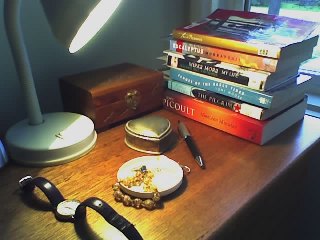
My Big Red Book

Apparently when I was just a little kid when asked what I wanted for Christmas I asked for “a big red book”. It appears that at a young age I was impressed with the importance and value of books and reading, and so began a lifetime love that has sustained me through the years.

Now I find I have My Big Red Book! And it comes in the form of an iPad. Oh the joy I find with this technology. Not only can it hold a library of books I love, but it allows me to create my lists of reminders, has space for reflections and journaling, accesses the Internet for instant answers, holds photos and images I love, music, podcasts, movies, whatever. I can forward my work appointments that automatically appear in a beautiful diary with pages that turn like my paper version. I can log my walks, eating, yoga sessions. I can download professional resources from ALIA. I can study, organise and connect online for the Masters degree. I can borrow library books from my local library. I can organise and have instant access to all those blogs by Australian librarians that I read, and food blogs, and blogs about leadership, and more. How did we ever manage before this technology arrived?

I already have an iPod and an iPhone that I use constantly everyday and so was reluctant to invest in another product with ongoing costs attached. But the thing that finally convinced me to buy one was a conversation I had with someone at a Conference. She was busily typing away on her iPad as the Conference was underway, and in a break I asked her about her connection plans. She told me that she used her iPhone as a modem when she needed Internet access. She set up her Personal Hotspot and so used her existing mobile phone plan! Why did I not know this important little piece of the puzzle? So many of you reading this (well the one or two) probably already know this small detail but for those of you who don’t I hope this sharing of information helps you as it has me.

How does your library grow?

In keeping with the National Year of Reading, I continue to write about the monthly themes, and for September it is “grow”. My focus is on public libraries.

Many people assume that public libraries keep all of their books, and when not being borrowed, they sit on the shelf or are kept in storage somewhere. However this is a myth. In reality public libraries have very limited space and books don’t often remain in any one spot for very long at all. It is a dynamic process of purchasing, processing, sorting, shifting, distributing, displaying, shelving, re-shelving, retrieving, loaning, issuing, returning, re-shelving, repairing, evaluating, sorting, boxing, and at the end of its use – selling in a book sale or sent on to some other need. There is often not a mysterious “stack” of old books preserved for prosperity, unless the library is the National or State Library.

Public libraries attempt to manage this dynamic process with a Collection Management Plan that addresses the demographic of their users to try to predict demand. This plan offers guidelines to manage donations, weeding, purchasing, and when used in conjunction with a clever Marketing Plan, should maximise the collections full extent.

Often people generously offer their pre-loved books thinking the public library will cherish them as much as they have, whilst in reality they are often boxes of dog-eared, smoke-saturated, food-stained paperbacks that only add workload and obstacles to an already jam-packed library work space and work load. The local public library does not have the capacity to “grow” to this extent. There are exceptions of course, and sometimes the books donated are real treasures.

Direct request from customers for popular books and other resources proves to be a useful way to grow the collection while responding to local demand. But it can’t be the only driver because often there are fantastic things that exist that people aren’t aware of, or know that they want – yet. This is where the librarians craft comes into play and they can shape the collection with their expertise, worldly knowledge and creativity.

The Long Tail is a concept coined by Chris Anderson in 2005 and when applied to the library collection is easy to understand. If a library were to buy copies of the latest popular release in quantities to supply the demand and responded each time to every best seller, the shelves would soon be lined with multiple copies of last year’s bestsellers and little else, and look like a short stumpy tail. It would be like a drinks refrigerator filled with one brand of beer, or just beer. Which might be fine for beer drinkers, but not so for those who prefer champagne or tea or green smoothies. The Long Tail theory shows that by offering an array of many different titles on a diversity of subjects that often the quirky niche subjects get a space on the shelf that will be justified when it is inevitably matched with the diverse and quirky interest of a customer. And to paraphrase Tim Flannery, “The continued existence of the species depends on diversity.” When you apply this to humans then our existence depends on a diversity of attitudes, interests and knowledge that can only be gained by offering a wide range of topics for investigation. A browse along the shelves of the non-fiction section  will show books about beekeeping, how to work a room, bushcraft, Hagar, heavy metal music, the cats pyjamas, work abroad, survival, ideas, Shakespeare (of course), Henry Lawson, travel, art, architecture, computer help, languages, pregnancy, health issues, etc, etc.

The serendipity of browsing library shelves is a well-known and enjoyable pastime and many have commented on this human behaviour. Bryan Loar of Brave New World says that by using the online catalogue and reserving items ahead of time then “self-directed discovery has been lost”. Professor Todd P. Olson of Berkeley in California values the experience of browsing the library’s shelves so much that he has launched a fundraising campaign towards the “continuation of library collections to ensure that the joy of discovery will continue for generations into the future”. Steve Penn talks about how “you walk around the shelves and suddenly find something that you weren’t looking for but seems just right for you.”  Maria Popova of Brain Pickings worries “that we are leaving little room for abstract knowledge and for the kind of curiosity that invites just enough serendipity to allow for the discovery of ideas we didn’t know we were interested in until we are, ideas that we may later transform into new combinations with applications both practical and metaphysical.” And I could go on…

So eBooks and other electronic resources seem to offer a solution to the problem of relieving limited physical spaces in libraries, but restrict the valuable and enjoyable experience of browsing for the serendipitous find. Again I try to imagine the library space where much is only available as an electronic file or online. An electronic collection can grow beyond imagination, storing and preserving every book forever! Of course the preservation of electronic files is another complex issue altogether. But as Seth Godin tells us “Librarians who are arguing and lobbying for clever ebook lending solutions are completely missing the point. They are defending library as warehouse as opposed to fighting for the future, which is librarian as producer, concierge, connector, teacher and impresario.”

Well Seth Godin doesn’t have to convince me that libraries are not just warehouses for books, but if our buildings are not growing with new physical materials, and our collections are “hidden” in the “connected” cyber-world, then who and what is in the building? And how can the average Joe Blow discover, develop and grow with that serendipitous ah-ha moment of stumbling across that book that will change his life? I think it was Og Mandino who told the story about how he was destitute, homeless and was on his way to buy a gun to kill himself when he stumbled into a public library and this “saved” him and turned his life around. That weird unkempt, smelly, apparently homeless person who visits your public library every day might just stumble across his/her saving grace.

In the past I have thought that perhaps the library could display images or video on large screens of these hidden resources. Libraries do this now and have been for some time. And although it might create visual interest, it is just another screen in a world where screens proliferate. And the images would be limited and could not portray the full extent of the collection. And these have tended to be rather static displays even with the inclusion of video segments. Library catalogues could be (and perhaps are being) developed whereby the screen is used to display current catalogue items in a way that is more dynamic and interactive, uses multi-media, and has the ability to display at random or by selection, when not in use by a customer.  Perhaps the items displayed could be recommendations that respond to the person who passes by based on their past loans. I am sure the current technologies in Library Management Systems and RFID could already do this, however then we get into the murky waters of intrusion and privacy.

Question: Libraries in 2030?

The theme for August from the National Year of Reading 2012 is “question”.

So my questions relate to “What will the library look like in 2030?”

What will a library look like when all the books are eBooks? Will physical books survive the tsunami of eBooks?

Will the prophesized vision of the library from the original Time Machine movie be our reality? I recently tried to remind some colleagues about the scene from this movie where the dusty books in the Grand Old library disintegrate at the Time Travellers touch, and they all looked at me with blank stares alarmingly similar to the blank stares of the future human race in this movie!

When searching YouTube for a clip I found this Lego version:

How will serendipitous discoveries occur?

How will the curious readers find great reading material unfettered by firewalls, logins, advertising, and Big Brother watching?

Will the “library as haven” as quoted by Alan Bennett become a quaint memory of a bygone era? This article reports Alan Bennett and others campaigning against library closures in the UK last year.

The Library Book is a collection of short stories about libraries offered by Alan Bennett. One story The Defence of the Book by Julian Barnes provides a vision of one possible future if library closures occurred.

This image from The Time Machine of the library of the future has always stuck in my mind:

Dream

When we think about the topic of dreams we can go in two ways: the dreams we have when we are asleep; or the dreams we have when we are awake.

The dreams of our sleep consciousness tend towards the surreal that can stir our emotions in all of their complexity. We know they are not real. and have no control over them. Alice’s Adventures in Wonderland by Lewis Carroll is a perfect example of a weird dream. Psychologists try to interpret dreams in an attempt to know the human psyche. Books on this subject vary from superficial to a far deeper enquiry. The work of Sigmund Freud and Jung has led this field.

The dreams of our waking hours are what interest me. What are they? How do we cultivate them? Why are they important? This stream of enquiry reveals our hopes, desires, inspirations, and what we do in order to bring them into reality. There are many authors who choose this topic as their mainstay of material, and there continues to be a hungry readership for this work as it continues to sell well and often. I immediately think of Deepak Chopra, Joseph Campbell, and Wayne Dyer. Their books serve to inspire us, instil the notion of possibility, and show us practical steps that we will make our dreams our reality.

A whole army of self-appointed gurus have followed this trend and spruik the message of self-actualisation. If it works then why do we need to keep hearing it? I suppose that our daily routines bring us back to reality. The bills need to be paid. Our employed work might not be fulfilling. Our personal life might be challenging and/or in disarray. So our dreams get a back seat. We remind ourselves that “one day” we will be able to realise that dream. One day…

In the meantime we can read those books that maintain our dreams. That trip to France, the time to paint, the space to develop, the freedom to find stillness or creativity, that yacht to go sailing off into the sunrise untethered.

Whatever your dream might be the local library is the place to go to fuel your passion. @love2read #NYR12  National Year of Reading 2012.

#NYOR2012 Laugh

Laugh is the theme for February for the Australian National Year of Reading.

The truth is that not much makes me laugh out loud. Never has. And it’s not as though I don’t have a sense of humour because I do. So I set a challenge for anyone who reads this blog – all two of you – to recommend a book to me that is guaranteed to make me laugh out loud.

To refine the field a little I can tell you that I don’t find slapstick funny, nor humour at the misfortune of others. I don’t find expletives funny because to me they are just words and hold no power to amuse or deride. I find some amusement in the differences of people – you know the old Irish jokes? But is that more to do with discomfort than amusement? Men versus women jokes are not really funny to me because they are so often close to the truth.

I don’t find “Aussie” humour funny at all. I don’t find comedians like Judith Lucy funny. She can’t seem to get through one routine or interview without making mention of her vagina. Why she seems to think people find that funny or even worthy of mentioning is quite beyond my comprehension.

Animal humour can be slightly cute and will stir a smirk or giggle from me on occasion. Usually though this is in the form of video clips and I am not prone to read “animal” stories at all. Unlike nine year old boys, I am not amused by toilet humour.

I can tell you that I am a Monty Python fan and think that there have been no comedies to match them at all in the 40 years since they made their mark. The Life of Brian and The Holy Grail are classics. As you go through life being troubled by life’s typical problems you can always find a Monty Python quote to match the situation and lighten the mood with a sense of levity. And although their books remind you of their silliness I wouldn’t say they have made me laugh hysterically.

Brian: I’m not the Messiah!

Arthur: I say you are, lord, and I should know… I’ve followed a few.

I appreciate Fawlty Towers but it doesn’t quite do it for me the way the Monty Python team did.

The French sense of humour I understand and I don’t know why. Twice in my life I have laughed so much that tears rolled down my cheeks and both of these were at live performances. One was in Melbourne back in my art school days and I went with a friend to see a one man stand up routine by Chris Langham. He worked with the Monty Python crew and was one of the centurions in The Life of Brian. His career took a sad turn for the worst in recent years which is unfortunate. But nevertheless he did make me laugh back in the day.

The second time I laughed tears of hysteria was in Paris in 2008 at a cabaret show and one of the acts was a performance by a clown/acrobat/mime. I started laughing as soon as he came onto the stage because of his silly antics and it grew from there. I laughed all through his performance and I had sore cheeks, tears in my eyes and on my face and I was breathless by the time he finished his skit.

Perhaps I laugh at what is absurd and ridiculous. I like satire and comedy aimed at intellect.

So you see unfortunately I can’t recall one single book that has made me laugh out loud. I am sure there must have been moments in books that I sniggered at, but none stand out.

I would love a good laugh, so if you think you have something to match my narrow sense of humour then please provide your ideas in the comments section and I will definitely look it up and read it.

[The members of “The People’s Front of Judea” are sitting in the amphitheatre. Stan has just announced that he wants to be a woman and wants to be called “Loretta,” and is explaining why.]

Stan: I want to have babies.

Reg: You want to have babies?!?!

Stan: It’s every man’s right to have babies if he wants them.

Reg: But … you can’t HAVE babies!

Stan: Don’t you oppress me!

Reg: I’m not oppressing you, Stan. You haven’t got a womb! Where’s the fetus gonna gestate? You gonna keep it in a box?

The weight of words

As a lifelong lover of books I can list many good reasons to support printed books as opposed to electronic books: the beauty of the printed book as an object is a view shared by many; the musty smell; the weight in your hand; the perfect size; the tangible delight of anticipation and discovery as you flick through the pages seeing sentences, thoughts and images at first glance; the sound of the pages turning. A whole library of these wondrous creations can keep your attention for days.

But I am being nostalgic. This may well be a vision from our past. Coffee-table books are more suited to these attention-deficit times. A quick flick through a glossy work of biblio-art is all our brief leisure time can afford.

Reading books is a lot more complicated now with the evolution and availability of ebooks and ereaders. Many of the things we love about the freedom of reading a book has finally been translated successfully to the ebook device: portability; visual ease of reading on a screen; choice of font size; finger-flick to next page; the sound of pages turning. Where once you might have carried one or two books in your bag for reading on trains, or in waiting rooms, or on the beach, your ebook device can carry that whole library of musty old books in the palm of your hand. Can it really? Theoretically – yes, but what books and how?

It depends! It depends which device you have, which distributor you choose, what format your device likes. Apple make it easy for even the most technologically- challenged amongst us – but at a price. You will be a slave to the proprietary nature of Apple products. Ipods, ipads, and iphones can do it all simply and quickly through the itunes software that connects your device with their software via the internet. But their software must be loaded onto your own pc initially for this all to work seamlessly. Apple has world domination in this field in the palm of their hands – apple-sized.

There are other devices suitable for ebooks but they also all have some kind of proprietary nature and problems associated with formats. If you try for a freely available format like PDF you will need further software that will reformat the PDF to be readable, scrollable, page-turnable, to suit your device. Software such as Adobe Digital Editions or Epub. Eyes glazing over now?

So the advantages of ebooks such as: portability, accessibility, immediacy, weight in hands (propability?), screen light, font size, library in your pocket; these advantages seem just out of reach for many. It’s easier to buy the book – if you can find the one you want in print.

Or go to the public library and borrow the book – for FREE! Now there’s an idea!! But chances are the latest new release by your favourite author is out on loan and you will have to reserve it and wait to be notified of its arrival for you. By then you might have bought it, or borrowed it from a friend. It might just be worth the cost of a quick download to your ereader afterall. Immediate gratification is sometimes not met well by public libraries. Whereas if you have your ebook/ereader format and subscription dilemmas sorted then you will be able to download that book you desperately want NOW.

While ebooks are cheaper per unit by comparison to the printed copy, you must factor in the other costs associated with your ebook convenience: the ereader, the internet access, the device plan, the credit card fees, etc.

The notion of the experience being “special” is also worth due consideration. The anticipation of waiting for that particular book is not to be dismissed. If I have immediate access to all and every book I want to read then not only am I swamped with too many things for my mind to manage, but that one special book loses some of its appeal if it is available to me straight away. This is a very fuzzy concept and needs further investigation, but book-lovers will know what I mean I’m sure. It’s like eating chocolate: if you eat it every day then you might get a bit sick of it, and it becomes common place and not the luxury special occasion item that it should be. Immediate impulsive download robs you of any anticipation. You are poorer for it. An article I read recently, “Can the book survive?” in the Good Weekend section of The Age on 15th January 2011, touches on this notion.

Further on in the same article is the idea that the “voice” of the author changes depending on the medium on which the text is being read. The layout of the text on the ereader screen can detract from the potency and importance of that text; while other books are more suited to being read on an ereader. I noticed this too when I read a free copy of Alice in Wonderland complete with old illustrations that I had downloaded onto my ipad. The artistic beauty of the serif-font laid out on the page was missing, and yet the small “original” illustrations were lovely captured on the small screen. This is where the book as beautiful object is most obvious, and in this case, lacking as an ebook.

This idea needs further research and I have the perfect title for a thesis – “The weight of words and how text and meaning are affected by format, display and availability”. Go for it.

So the advantages of ebooks and ereaders are disadvantages also. What they offer us in terms of portability and access robs us of the quality of the experience of reading in some obscure way. The delight of browsing, serendipity of discovery, and being exposed to a broad range of subjects that you might never have considered, amidst the shelves of books, narrows the experience to obtaining just the one book you seek. You might get what you want right now, but not what you don’t know that you might want.

Public libraries are the losers in this battle of the ebook/ereader formats. Publishers have tied up the ebook market into a knot. Ask at a public library if they have ebooks and you will get a bold “Yes” in response, followed by an uncertain “but…” What device? What format? Which book? Sorry but you can’t get fiction FREE in ebook format at a public library for download to your personal device. Well you probably can somewhere, but the latest titles? You will probably be able to easily read an ebook on the library pc or on your home pc if you are a library member. But ebooks mean portability, so what is the point of reading an ebook on your pc? Electronic notebook? Well maybe.

Most librarians will tell you about the many ebook collections available online, such as Project Gutenberg, Safari books, ebooks at the National Library of Australia, the ebooks supplied by Adelaide University, and many more. But this is not answering the problems associated with being able to borrow the latest novel for free from your library, or perhaps buying the ebook outright then being able to pass it on to a friend.

It is too soon for a conclusion of thoughts. These are uncertain times for book lovers. It is still evolving. Optimistically I think that public libraries and freedom of access will prevail. Fearfully I envision half empty shelves with old pre-loved books decomposing and awaiting the arrival of H. George Wells in his Time Machine. (Remember that scene from the classic movie where he is relieved to find the public library only to have the books fall to dust in his hands?)

Ultimately literacy, creative endeavour, the need to express ourselves, the desire to share our ideas, and discover new ones, and the pure and simple love of books as objects will ensure that public libraries continue to be valued as places for community narrative, history, wealth of knowledge, ideas, learning, gathering, sharing and for the free inclusive access for all.

Book Audio Video

First there was the book Eat Pray Love. I read it long before the hype and loved it. It really spoke to me and I enjoyed reading about the spiritual journey of Elizabeth Gilbert after the collapse of her marriage.

In anticipation of the release of the movie I listened to the audio book to remind myself why I enjoyed it. I once again enjoyed the intelligent narrative written with brutal honesty. I could relate to the idea of her desire to learn the Italian language simply because of the beauty of it, and I admired her courage to go to Italy to immerse herself in that language and beauty.

Now I have seen the movie and I luxuriated in the stunning visual feast on the big screen at the beautiful old Rivoli theatre in Camberwell. Despite omitting significant parts of the story, it was still well over two hours long. Her depression within the context of living in New York City during the September 11 terrorist attacks was not mentioned and I think this was a major contributing factor leading to her marriage breakdown. Without this fact she was characterised in the movie as being more superficial than she portrays herself in her book. One can only assume that Elizabeth Gilbert agreed to the changes. There were other small changes that were not significant but robbed me of the same enjoyment I found in these details when I read the book. The delicious cinematography in magnificent locations compensated for the rich text that was edited out. 

Julia Roberts plays the role well despite my lack of enthusiasm to see her in this movie. Javier Bardem is perfect as the Brazilian Felipe.

The sequel Committed is another intelligent discussion about marriage through history and culture. It follows the love story of Elizabeth and Felipe as they negotiate their rocky emotional journey. It is definitely worth a read. Now for the soundtrack from the movie….

Travel with a twist

What is your favourite genre for reading? Romance novels? Crime thrillers? Biographies? Cook books? Sport? Chick Lit? Vampire Romance? History?

The genre I most like to read does not fit easily into a cute sticker-size description or book shelf. You will find these books interspersed amongst travel, self help, culture, adventure, biography, geography, fiction, poetry, health and well-being. I like to read personal accounts about people who set out from their known, safe worlds, and travel off with some purpose in mind – a quest perhaps. It is done with a spirit of adventure, challenge, and personal discovery. The single word that comes closest to describing this would be “exploration”. Or perhaps “journeys” – although the word “journey” has been cheapened in popular colloquialism.  Exploration of the world, life, culture, the individual.  It is travel with a twist.

In no particular order here is a list of some books I’ve read and loved that I think fit into this genre:

Delving into the book

What comes first; the book or the blog? The answer of course is neither. The inspiration for the central idea comes first. But then it is written and these days it could be either the book or the blog that precedes the other.

This piece of writing is about the process of reading not writing. How do you read a book? Do you read the book and then move onto the next? Or does your involvement and curiosity extend beyond the book? Do you delve further? Do the central ideas in the book excite and interest you to look further? Does it make you want to investigate new ideas and learn new things?

A successful book for me is one that I read with interest, learn new concepts, then go on to investigate more on the central themes of the book. So I search online for the author to see if they have a website. I read their biographical details either on their website or on Wikipedia. I look at the other books they have written. I read on the see if they have a blog or if they are on twitter. I follow the links provided on their website for further investigation.

For example: The Buddha, Geoff and Me by Edward Canfor-Dumas prompted me to locate this website and his bio and other links. The book had made me curious about the chant mentioned but not described. I found the notes about the chant nam-myoho-renge-kyo, and then wondered what it sounded like. So I searched online for the audio of the chant and found this one on Youtube and this one by Tina Turner.

So then to the further reading: Edward Canfor-Dumas is the ghost writer for The Buddha in Daily Life by Richard Causton. I could not find a copy of this book available through public libraries so I bought a copy online. Returning to the important but under-valued library catalogue I did a cross-referenced search by subject entries from the original book The Buddha, Geoff and Me. This led me to Everyday Zen by Charlotte Joko Beck that I am reading now. Her discussion of zazen has intrigued me and provided me with new avenues for investigation.

This process happens whenever I read a book that I enjoy. Frances Mayes books lead me to learn more about Italy and Art and Architecture and The Renaissance and poetry and more. Reading Gluten Free Girl led me to investigate eating and cooking with a gluten free premise and to her blog.

I will also continue on to see if there may be audio or video versions of a favourite book which can sometimes enhance the content of the story, but other times detract.

As a life-long lover of reading I thrive in the online world and the opportunities there are to expand my mind.

Why write

Why write at all? I find I am asking myself this question often these days. How about you?

Writing blogs has become so popular that it is almost impossible to search for information online without getting any blogposts in your search result; even if you try to be clever and refine your search to prevent them. Someone should invent a search engine that can do this – if they haven’t already. If you know of one, let me know.

I love reading blog posts. I find them, in general, to be creative and inspirational. I enjoy reading the ideas of others. The short expression of an idea seems to be enough. If the post is too long I fall victim to #tl:dr (too long: didn’t read).

In fact my time is so full of activity that I have no time to read blogs. My Reader is full of unread posts and I only seem to be steered to read a blogpost via twitter, and even then it requires a clever hook to get me to click on the link. I’d prefer to read people’s blogs but I have to attend to the barrage of emails I receive. Please spare me the email telling me the photocopier in a distant office has a large job – I don’t care and resent the effort required on my part having to delete it.

So why do we write at all? *to communicate *to share *to educate *to change * to amuse *to record *to understand *to create *to set guidelines *to try to make money *to promote *to develop *to learn *to express *to discover *to question *to connect *to ask *to vent *to coerce *to be read *to practice *to improve *to perfect *to explore *to inform *to make people feel…

Solar by Ian McEwan put me in a foul mood last weekend. I hated it. I loathed the main character. I was disappointed with the pathetic inclusion of the scientific concepts. I hated the style of moving the story forward whilst simultaneously backtracking to fill the narrative of the character. I hated the way the story moved on quickly from one scene to the next with no break (or chapter) to indicate this change in the flow. I persisted because I have loved other works by Ian McEwan. Saturday is one of my favourite books. By the end of Solar I despised the main character and felt depressed and uninspired. I expect that loathing the character was the point. Was this the aim of Mr. McEwan? Then don’t bother. I prefer to read literature that is interesting, uplifting, generous, teaches me something, inspirational, innovative, intriging, challenging, clever, or beautiful.

I realise writing a book is a completely different experience compared to writing a short idea or essay for a blog. And reading books too is a completely different experience that requires some commitment. Asking the question “why write?” applies here too though, perhaps more so. What do you want to be your legacy as a writer?

Julia Cameron wrote The Artists Way some time ago now and by following her prescribed three month program, it instilled in me the practice of writing “morning pages”. I think she has inspired many people to do this. So I use the morning pages as first stream-of-consciousness venting. It has had a profound effect on my wellbeing. It is a useful tool to be able to write any junk without concern for being correct in any way. It helps me sort out my thoughts and gets rid of the neurotic junk. I record my dreams sometimes. I plan. I vent. I try to understand. Writing for my blogs is more considered and I try to pick topics to explore and share that I think may interest others. But I keep asking myself why I bother – why any of us bother at all.