Library reading programs

I was lucky to attend the Reading Agency Seminar held at the new Library at the Dock in Melbourne.

Debbie Hicks, Director of the Reading Agency, opened the seminar with a presentation about the reading programmes offered in the UK. They offer UK public libraries tools for reading activities under a sustainable strategic framework that is benchmarked nationally for ensure continuity.

Their programmes include:

  • Summer Reading Challenge
  • Chatter Books
  • Reading Activists with volunteering opportunities for youths.
  • World Book Night
  • Reading Groups
  • Books on Prescription
  • Mood Boosting Books

Dr. Jacinta Halloran talked about the gap between the early stages of anxiety and depression and the need for prescribing drugs. She talked about the sinking feeling she gets when she prescribes drugs for depression, knowing that bibliotherapy could help at this early stage. Jacinta is the author of two novels: Dissection, andPilgrimage. Jacinta works with Susan McLaine and more information about their work can be found at the Bibliotherapy Australia website.

Lisa D’Onofrio showcased the ‘Go Goldfields project. Part of this included a Literacy Strategy “read all about it”, that involved collaboration across sectors using the National Numeracy and Literacy Framework in order to adopt a common language.

Bec Kavanagh spoke eloquently about the Stella Prize which seeks to highlight gender inequality in literature for children and teens.

Rosie Cirrito from Brimbank Libraries talked about their Reading Buddies program that matches volunteers with readers. A reward system uses stickers, etc , to acknowledge milestones.

Sarah Hopkins and Karyn Siegmann of Bayside Libraries talked about the reader experience in libraries. They aim to support a reading culture by maximising library spaces, displays, and collection usage trends (Collection HQ). “The book is the hero.”

Sue Wootton of Eastern Regional Libraries talked about their Read with the Reading Dog program that incorporates dogs for reading practice for children identified as needing extra help by local schools.

Robyn Childs from Moreland Libraries talked about their Read More program that encapsulates all of their reading activities: from author talks, displays, writing competitions, workshops, etc.

Shirley Bateman of Melbourne City Libraries facilitated some reflections on the presentations. These were:

  • Value of partnerships to be “courageously collaborative”.
  • National Literacy and Numeracy framework
  • The value of families in the reading journey
  • Diversity of content and the danger of the single story. This story was referenced and I recall loving it when I first watched it: 

Paula Kelly, Library Manager of Melbourne City Libraries reminded us about the SLV/PLVN Statewide project READ (yet to be completed).

Debbie Hicks of the Reading Agency said that “libraries are unifque community spaces for the delivery of interventions for wellbeing.” Books on Prescription offers a book list of self-help books that are professionally selected using a book selection protocol, and made available through public libraries in the UK. A user leaflet is also provided that offers further information.

Susan McLaine talked about the power of literature to move and heal, saying that “in the library is healing for the soul,” and that “there is often wisdom within the story. Our aim should be to enrich life quality, life spirit, and nourish connection.” Susan’s website is Words That Heal and she is currently working on her PhD at RMIT on the topic of “creative bibliotherapy” while continuing to facilitate session within a prison.

Dr. Louise Roufeil is a psychologist that provided an overview of mental health in Australia. 45% of Australians experience some form of mental illness in their lifetime. 20% had a diagnosed mental health disorder in the last 12 months. The high prevalence of anxiety impacts on productivity across the board. Early intervention is not readily available. Bibliotherapy can fill this gap and libraries are well positioned to do this.

Lisa Lang of Melbourne City Libraries read an excerpt from a Tobias Wolff novel that left us hanging… A great example of their Story Lounge programme that runs monthly at Library on the Dock.

We finished the day with a practical planning session that only served to reaffirm the need for collaboration amongst library services in order to provide similar programs. What do we do already? What more can we do?
An afternoon with ALIA

I was fortunate to be able to attend the final afternoon session of this year’s ALIA Conference in Melbourne.

Here is my summary:

eSmart Libraries Sallyanne English presented an overview of the Esmart Libraries program. Hume Libraries have recently been accredited. The eSmart program offers a framework for libraries so they can work towards incorporating cyber-safety into policies, procedures, training and technology use by staff and customers.

The Big Projects – update From the successful National Year of Reading in 2012, the Love2Read brand continues as a nationwide marketing effort. The Reading Hour is a current effort they  promote. They invite stories and stats from Australian libraries to spread the message.

Return On Investment Demonstrating the value of libraries is an ongoing need and there are many reports and advocacy tools available on the ALIA and PLVN websites. Of note in Victoria are these reports: Libraries 2030Creative Communities Cultural Benefits: and Dollars and Sense. These reports can be found here. NSW libraries offer this report for future planning.

ALIA PD Scheme Judy Brookner talked about the value of becoming a certified professional through the ALIA PD scheme.

IFLA update Marian Morgan Minden talked about the Lyon Declaration which highlights the need for open access to ICT. IFLA invite people to nominate a must-see library to the list of 1001 libraries to see before you die.

Digital Capability An overview of digital capability of libraries was presented by Sarah Slade of the NSLA Digital Preservation Group. This project has allowed an shared understanding of the needs and capabilities of libraries to manage digital materials.

It was also great to catch with colleagues/friends from across the State.

Book Club Lists

One of the joys of my job is being able to choose books for the book clubs to read. The existing Book Club Collection I work with has currently almost 150 titles. And there are about twelve book clubs using this service.

My job in recent months has been to trim the existing list by analyzing whether titles were unpopular and not likely to be read, as well as what titles were already read by our clubs. I decided on ten titles that I offered to other library services and these were all gratefully accepted and moved on.

At the same time I began a new list of possible contenders for the 2015 list. This list grew to about 25 titles that we read and debated about, although we didn’t get time to read them all. One is not yet published. So there is an element of educated guesswork and relying on published reviews.

My colleagues and I agreed on ten titles and these we have ordered to add to our collection for 2015. We also add ten titles from the SLV Summer Read from last season. Add two titles that we picked up through the library swaps, and we have 22 new titles to add to our Book Club Collection. You can see the list here.

Now all I have to do is find time to continue to read the ones I haven’t yet read.

Back to busyness

I have been back working in public libraries for a few weeks now and it’s great to feel useful and able to help people with their questions. In general the level of sophistication in regard to technology related questions is notable. Many in our population have become quite adept at using and navigating the Internet and all of the associated technologies. The days where it was assumed that the older generation did not ‘get’ this stuff are behind us. Many people are curious about things like ebooks and will ask about them, even if they decide not to give them a try – just yet.

The busy libraries where I work require an agile mind that can handle a day of mental gymnastics, able to negotiate the barrage of unique questions in quick succession.

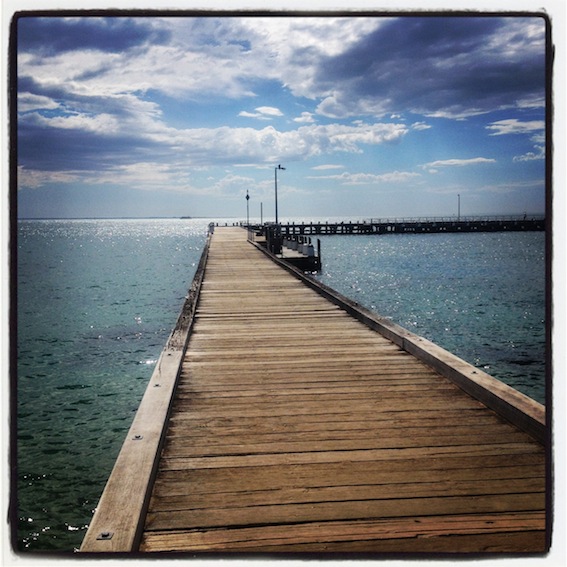
portsea_pier_01042014This week I was lucky to work some shifts on the mobile library truck. I took this photo near one of our stops, during a short break.

I have been reacquainting myself with the different Library Management System, as well as the different procedures and work-flows associated with a large and multi-branch public library service. I feel very much welcomed back and I am appreciative of that.

Job hunting

Life is funny isn’t it? You think and plan and work diligently towards improving your own circumstances as well as those that employ you, but then life throws you a curve ball.

So I now find myself in the aftermath of quitting a perfectly good job where I was feeling satisfied and fully utilized, in order to care full-time for my ailing father. But that need has now vanished as he has moved beyond this earthly plane.

Now I find myself back in the job-hunting market with all the other over-qualified, experienced and competent folk.

I utilize as many information refining and gathering techniques for this task as I can:

  • I subscribe to many career news feeds via my Feedly account.
  • I subscribe to industry-specific enewsletters.
  • I bookmark employment webpages for organisations where I’d like to work and I check these regularly.
  • I keep an eye on career ads in print and online.
  • I use LinkedIn to connect with professionals I know and others in the industry.

I have been applying for relevant positions as they arise. It takes me about six hours to write a job application answering the requirements fully.

I worry that at my age my resume looks a little long, but it is what it is, and personally I know that means I am experienced in my field, stable in my work attitude, mature in my emotional intelligence, and at the peak of my ability to contribute in a meaningful and practical way.

I also worry about the mistaken view that the younger one is the better they are to adapt to technology. The ability to handle technology varies from person to person, regardless of age. Some people, like me, have a natural inclination and understanding about technology, and this translates readily across all types of devices, software, databases, utilities, and emerging media. I have the kind of brain that has always understood and enjoyed maths, physics, engineering, technology, manufacturing, database structure, etc. That ability does not deteriorate with age, in fact an ability to laterally link those ideas to new trends and emerging technologies increases with age and experience.

kitchen_garden

So I use this valuable time to read, listen to podcasts, learn new things, update my eportfolio, write, take on some new projects, exercise, grow vegetables, and prepare healthy meals.

My ‘to-do’ list is still a mile long and there are only so many hours in the day.


EOM

Don’t you love acronyms? They are useful if you know what they mean and if you are communicating with others who know the same ones. They exist across the range of human subjects and are specific to their own topics. If you don’t know what an acronym stands for then they are as useful as if someone spoke to you in a foreign language.

EOM is commonly used in emails in the local government organisation where I worked for the last four years. And in that time I never knew what it meant. It’s significance seemed unimportant, so I was never prompted to ask.

End Of Message! Superfluous perhaps. It was commonly used in the subject line of an email when there is no content in the body of the email. For example, “Email subject: Leftover sandwiches in staff room. EOM”

On my last day I received a phone call from a local newspaper reporter asking me questions about why I was leaving. I told him that it was because I was going to care for my father who is failing quickly with Mesothelioma. I reminded him that he needed to go through the usual Council communication channels. Prompted by his enquiry I wrote a media release and sent it through to the Council media person. It had not occurred to me that this would be of any interest to the local community. It was published in the newspaper under the cute heading “Portland Library Manager turns the page“.

EOM

20131130-095255.jpg

42 Aussie Librarian Bloggers in 2013

In 2011, I began an investigation into Australian Librarian bloggers: how many could I locate online; who were they; what sector did they work in; the topics they posted about; and the overall look and feel of their blog. I was interested in individuals and did not want to investigate the blogs of library organisations. So I narrowed the field to the personal blogs of Australian Librarians. While I did include librarians from tertiary academia, I narrowed the field by not including the blogs by teacher librarians situated in primary or secondary school libraries. I also added 14 Librarian bloggers from overseas just to provide a measure of comparison.

After a quick and dirty Google search I located Libraries Interact where there is a list of Australian Librarian bloggers. Of these, in 2011, many were already inactive after running out of steam following the 23 Things training. There were other lists and indexes I stumbled across and I soon listed 66 active Australian librarian bloggers. Although my list did include many of the active bloggers from the Libraries Interact list, it also included others not on that list. I looked for the names of the bloggers and their twitter links. I tried to ascertain the library sector that they worked in. I read about their favourite topics and attempted to evaluate the content by gauging them against a content rubric that I created for the task.

Some bloggers like to write book reviews; some like to talk about their experiences answering customer’s questions; others like to pass on information about technology; some vent; some show their creative talents in the kitchen or with crafts; holidays are popular topics; most were personal; and many were superficial. My five-smile rating 🙂 🙂 🙂 🙂 🙂  was a rare gem indeed on my incomplete list.

I was searching for relevant, interesting, deep, and meaningful content. I wanted to hear opinion. And while there is much great content from our bloggers, one stood out – It’s Not About The Books by Hugh Rundle. Good on you Hugh! Hugh continues to boldly post thought-provoking and challenging articles that are written with excellence. He embeds relevant links thoughtfully. He sets the bar high and is a fine example for anyone wanting to lift their own efforts to a new level; myself included.

So I have once again reviewed the list on Libraries Interact. Of the 58 bloggers listed under personal blogs of Aussie Librarians only 27 are still active (46.5%). Of the 66 Aussie Librarians on my list that were active in 2011, 46 bloggers have posted content in the last year; and only 36 in the last 4 months. (69% still active). Of the 14 blogs from overseas all are still active.

Here is my list of Aussie Librarians who are active bloggers:

1 A Chivas Regal Moment @CatyJ
2 Alyson in Library Land @alysondalby
3 A work in progress @fionareadersrr
4 Ballarat Library Chick @gemmas1980
5 Better than cheesecake @susannenewton
6 Biblio Turismo @Biblioturismo
7 Blog Fest at Tiffany’s @LibrarianCat
8 Book boy @bookboy
9 Bronwyn’s Library Blog @pivotalbooks
10 Connecting Librarian @michelleamclean
11 Digital Collaboration @SusanMyburgh
12 explodedlibrary.info @explodedlibrary
13 Feral Library Tales @kalgrl
14 From Melbin @malbooth
15 Girl in Landscape @wateryone
16 Hecuba’s Story @polyxena
17 HeyJudeOnline @heyjudeonline
18 Hmmm @Kridwyn
19 Inn0vate @petahopkins
20 It’s not about the books @HughRundle
21 JayGee Library Log @jaygee35
22 Jenelle Net @jenelle
23 Langridgep @langridgep
24 Librarian Hoi @librarianhoi
25 Librarians Matter @libsmatter
26 Library Dreamings @VesnaC
27 Macaronic @jobeaz
28 Opinions from an OPL @newgradlib
29 Pixelated Mushroom @pixelmushroom
30 Ramblibrarian @boycetrus
31 Ramblings from yet another Librarian @katejf
32 Read Watch Play Participate @ellenforsyth
33 reeling and writhing @mulberry_road
34 Ruminations @flexnib
35 Shallowreader’s Blog @VaVeros
36 Shelterit @shelterit
37 snail @snailx
38 Stained Glass Waterfall @warrencheetham
39 Sues Bent @suesbent
40 The Land of the Surprising Pun @librarianidol
41 There she goes @stephmcg
42 Thoughts and Reflections @shewgirl

And the list of Library bloggers from overseas:

1 Annoyed Librarian @LibraryJournal
2 Circulating Ideas @circideas
3 David Lee King @davidleeking
4 Free Range Librarian @kgs
5 Librarian by Day @bobbinewman
6 Librarian in Black @TheLib
7 Librarian Net @jessamyn
8 Phil Bradley @Philbradley
9 Self-plagarism is style @daveyp
10 Stephen’s Lighthouse @sabram
11 Swiss Army Librarian @SwissArmyLib
12 Tame the Web @mstephens7
13 The Shifted Librarian @shifted
14 Virtual Dave @rdlankes

P.S. This list is not complete in an online world that is constantly changing, but if you are an Australian Librarian who writes a blog and your blog is not listed here and you would like it to be, then please leave a comment below.

Survivor for Bureaucrats

The 2012 Local Government Rural Management challenge was held at Renmark in South Australia. I was part of a team of six people representing our organisation. Seven teams competed – six from South Australia and one from Victoria. Our team consisted of: Mr. Les Al Dance, Miss Ima Hugga, Ms Heaven Lea, Mr Doug A Trench, Mr Al Grandé, Ms Ginger Plum and the Team Coach Dr Tor Mentor.

We travelled the 800km in a mini bus and got to know our team mates a little better as most of us had not worked together before. We appeared to be a fairly reserved and quite bunch. We had been briefed and prepared for the challenge. So we had a logo, a flag, a motto, a vision and values, team rules, banners, and team t-shirts; as well as a heap of stationery, documents, laptops, printer, lollies and music.

We were all nervous on the day but keen to set up our designated room. We moved beds, put up posters, set up the banners, made our work areas, set up the laptops and printer, and prepared the customer service area complete with fresh flowers, sign-in book, picture of The Mayor, and welcome sign.

Then the whirlwind hit. After a briefing with all the teams, we started work on the four tasks that were delivered, with two more undefined tasks expected to arrive at any time. We brainstormed as a group, wrote up the task schedule on the whiteboard, divided the tasks accordingly, and got our heads down.

Three reports, one briefing paper, a meeting, a flowchart, and two customer service actions with file notes later and it was lunch time. PHEW! I felt dehydrated, headachey, stressed and overwhelmed. After lunch it was straight back into it with three more tasks to complete. Another report, a media release, and a presentation and we were done. Our presentation was a group effort and we kicked off the seven presentations to finish the day. FRED formed the basis of our Staff Code of Conduct Training Overview.

The scenarios and tasks formed an interesting and descriptive narrative for the District Council of Galeforz, so much so that I felt as if I knew the place and the people. Rather than dry tasks, the tasks proved to be interesting, challenging, relevant and realistic. Two women acted some parts during the day in order to provide some “real life” action. This added a further dimension to the scenarios and was well executed.

Our team performed like a Bathurst Pit Crew. There were no conflicts or power struggles. Just a team of equals working together: collaborating, supporting, sharing, suggesting, and swapping. It was a thing of beauty. Our Coach worried that we ignored the morning tea of cakes and drinks. And by lunch time we were dehydrated, tired and a bit worse for wear. The afternoon session was shorter and less intense. The seven group presentations formed a perfect way to complete the day. I was quick to volunteer our team to present first just to get it over with. FRED formed the basis of our presentation.

Back at the motel our Coach de-briefed us and provided words of encouragement and pride. We were glad she was glad.

Dinner and presentations were enjoyed at the Renmark Club on the banks of the Murray River. The winners – six young gorgeous women from the Yorke Peninsula were the stand out performers on the day. We won an award for the Best Dressed Room and so our badging and arranging efforts were recognised.

The long bumpy return trip in the mini bus was a quiet journey with the team feeling totally spent and mentally exhausted. It was an excellent experience that condensed a year’s worth of training and team building into a single day. If you get the opportunity – dive in.

Signing off: Ginger Plum, Group Manager Human Resources.

Life lessons

Strange how life seems to take us two steps forwards then one step backwards. Why is this? I try to be philosophical and positive. Is it just life? Is it life lessons, challenges, and tests we must face in order to grow, understand, and become wise and enlightened?

I have made positive decisions and steps forward with my career choices. I was happy with my progress. I had bravely stepped out of my comfort zone, stepped into new environments, joined new teams, stepped-up in terms of delivery of information services, and learnt many new systems and work flows.

All was great. My service to all customers was outstanding I believe. So what happened? I was recommended. Now I find myself back where I was before. I am back in a school library, minding the desk, supervising teenagers, and trying not to get bored and fill my day somehow. I am not a teacher so my usefulness in this situation is limited. I long for the satisfaction of meeting the numerous questions posed by a demanding public in a busy community library. I want to get back to helping committed adult students in a diverse tertiary organisation. I was there and now I’m not again!

This step “backwards” or “sideward” is temporary and I hope I don’t lose the ground I had covered and was enjoying. Yawn….zzzzzzzzzzzzzzzzzzzz. Huh?! Was that a bell?

In my quest to understand life’s little lessons, I read self-help books and go online to research. I read blogs from people who write about inspiration, creativity, freedom, and self-actualization. Zen Habits, Marianne Williamson’s JournalUnshelved, Someday Syndrome, Creative Liberty, The Happiness Project, and many blogs by people who love France.

Summertime

Melbourne Cup Day, together with a strong North wind, heralds the summer season on the Peninsula. I pause in my garden amidst a riot of colourful blooms and the squawking Minors and Wattle birds in the Eucalypt branches above. It will be another hot dry summer. How long is it now since we have been allowed to water our gardens or wash our cars?


The summer time is the busiest for our local libraries because we are a major tourist destination. The influx of visitors begins during Melbourne Cup Day weekend, builds steadily towards Christmas, comes to choking point for 4 weeks into January, and then continues on until after Easter. It is a long haul and we locals need to draw on our stamina to survive the onslaught.


January is the busiest month of the year for our libraries. We are swamped with visitors who want to join and borrow things for their holiday reading and viewing. It is easier to work through this period rather than try to enjoy a holiday yourself. Everything is difficult; from shopping, parking and going to the beach.