Don’t you love acronyms? They are useful if you know what they mean and if you are communicating with others who know the same ones. They exist across the range of human subjects and are specific to their own topics. If you don’t know what an acronym stands for then they are as useful as if someone spoke to you in a foreign language.
EOM is commonly used in emails in the local government organisation where I worked for the last four years. And in that time I never knew what it meant. It’s significance seemed unimportant, so I was never prompted to ask.
End Of Message! Superfluous perhaps. It was commonly used in the subject line of an email when there is no content in the body of the email. For example, “Email subject: Leftover sandwiches in staff room. EOM”
On my last day I received a phone call from a local newspaper reporter asking me questions about why I was leaving. I told him that it was because I was going to care for my father who is failing quickly with Mesothelioma. I reminded him that he needed to go through the usual Council communication channels. Prompted by his enquiry I wrote a media release and sent it through to the Council media person. It had not occurred to me that this would be of any interest to the local community. It was published in the newspaper under the cute heading “Portland Library Manager turns the page“.
I have just studied the subject Creating and Preserving Digital Content through Charles Sturt University for the successful completion of the Master of Information Studies. And it has got me thinking….
All of those family photos held in a variety of forms in a variety of containers need some sorting. There are old printed photographs in photo albums and in boxes. There are digital photographs that reside in cameras, phones, devices, SD cards, CD’s, and computers. There are digital copies of photos sitting in random digital file folders on computers. And we keep producing more each day adding to the digital heap.
So now I know how to go about organising all of this stuff, I need the time to actually sit down and apply myself to the mammoth task of sorting it out.
Once I comprehend the enormity of the task I begin to ask myself – why? For what purpose? Who cares? How many photographs of wind-swept beach scenes are too many?
Then there is the question of the integrity of the captured image: if a filter is applied to an image from a Smartphone app then this should be noted in the metadata or description. But that adds another level of tedium to the task, and yet if it is not done then what does that say about the authenticity of the resulting image. Is it then art or photography? Or both?
The notion of transience emerges too when considering the purpose of such an exercise. With ease and speed of connected social media channels through smart devices, a photo shared across networks among friends and family is enjoyed for the moment, in the context of that moment, and then swept into the ever-moving stream of data creation. Sure it is still ‘there’ somewhere in the digital ether, waiting to be retrieved for future embarrassment; like a baby photo shown by smirking parents at their child’s 21st birthday party. Other than for nostalgic amusement, is there value in spending so much time and effort in sorting out the family photos for ‘the future’?
I can hear the archivists and historians stirring on their leather chairs, leaning forward, fingers cracking, ready to post a heart-felt reply. I welcome it because I need a good reason to justify this effort.
The term ‘digital dark age’ was used in Creating and Preserving Digital Content to illustrate a possible scenario where data is lost through poor preservation techniques. I get it. I wrote an essay about it, elaborately describing the scenes from the original movie version of The Time Machine, where the vacuous stares of the future Eloi people are the result of lost knowledge from crumbling pages in books left to decay.
I appreciate the words of former Prime Minister Harold Holt at the Stone Ceremony March in 1966:
“We cannot understand the present or plan for the future without the knowledge of the past.”
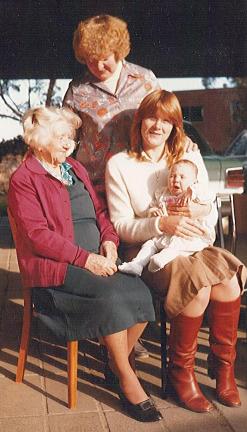
And yet significant family portraits containing four females spanning four generations might be worthy of preservation for sharing amongst immediate and future family members, but how many “selfie’s” must we have to delete before we gain a representative portrait of one individual.
My thoughts are a jumble between process, content, and value. The process is complex and needs to be worked out to establish some kind of system that works and fulfills preservation standards. The content contains so many variables and raises questions about authenticity. The value is difficult to judge because it is not easy to project into the minds of some future person and decide if this image is worth the effort of the time invested in preserving it.
This article about one family’s preservation project describes some of these issues with a heart-warming narrative and a positive outcome, but concluding that it is “never done.”
My aim is to begin. I have the relevant information about how to approach the task. I have a large external hard-drive. I will gather the photos in all forms. I will start sorting, naming, describing, storing, backing-up, and hopefully one day in the future I will have some kind of result that’s purpose will be apparent.
“Why do I keep this voluminous journal? I can hardly tell. Partly because life appears to me such a curious and wonderful thing that it almost seems a pity that even such a humble and uneventful life as mine should pass altogether away without some record such as this.”
Cox, R. J. (2009). Digital Curation and the Citizen Archivist. Digital Curation: Practice, Promises & Prospects. pp. 102-109. http://d-scholarship.pitt.edu/2692/
In 2011, I began an investigation into Australian Librarian bloggers: how many could I locate online; who were they; what sector did they work in; the topics they posted about; and the overall look and feel of their blog. I was interested in individuals and did not want to investigate the blogs of library organisations. So I narrowed the field to the personal blogs of Australian Librarians. While I did include librarians from tertiary academia, I narrowed the field by not including the blogs by teacher librarians situated in primary or secondary school libraries. I also added 14 Librarian bloggers from overseas just to provide a measure of comparison.
After a quick and dirty Google search I located Libraries Interact where there is a list of Australian Librarian bloggers. Of these, in 2011, many were already inactive after running out of steam following the 23 Things training. There were other lists and indexes I stumbled across and I soon listed 66 active Australian librarian bloggers. Although my list did include many of the active bloggers from the Libraries Interact list, it also included others not on that list. I looked for the names of the bloggers and their twitter links. I tried to ascertain the library sector that they worked in. I read about their favourite topics and attempted to evaluate the content by gauging them against a content rubric that I created for the task.
Some bloggers like to write book reviews; some like to talk about their experiences answering customer’s questions; others like to pass on information about technology; some vent; some show their creative talents in the kitchen or with crafts; holidays are popular topics; most were personal; and many were superficial. My five-smile rating 🙂 🙂 🙂 🙂 🙂 was a rare gem indeed on my incomplete list.
I was searching for relevant, interesting, deep, and meaningful content. I wanted to hear opinion. And while there is much great content from our bloggers, one stood out – It’s Not About The Books by Hugh Rundle. Good on you Hugh! Hugh continues to boldly post thought-provoking and challenging articles that are written with excellence. He embeds relevant links thoughtfully. He sets the bar high and is a fine example for anyone wanting to lift their own efforts to a new level; myself included.
So I have once again reviewed the list on Libraries Interact. Of the 58 bloggers listed under personal blogs of Aussie Librarians only 27 are still active (46.5%). Of the 66 Aussie Librarians on my list that were active in 2011, 46 bloggers have posted content in the last year; and only 36 in the last 4 months. (69% still active). Of the 14 blogs from overseas all are still active.
Here is my list of Aussie Librarians who are active bloggers:
P.S. This list is not complete in an online world that is constantly changing, but if you are an Australian Librarian who writes a blog and your blog is not listed here and you would like it to be, then please leave a comment below.
What do zombies have to do with the future of libraries you may well ask? In ‘reality’ if there was a zombie apocalypse, libraries would perish along with all of humanity. And being zombies, one would hardly expect them to have an active interest in the future of libraries or indeed any intellectual pursuit.
Like many librarians I have been thinking about the future of libraries a lot lately. It is a hot topic in the library world, mainly due to evolving technology, the proliferation of internet-connected personal devices, and the cheap and easy access to eBooks. The spread of the World Wide Web did not result in the end of libraries, but it has reduced our physical non-fiction collections substantially. Now with the second wave of internet-enabled technologies, does anyone need to go to a library at all to get hold of the reading material they want and need? Perhaps that end is in sight and this has resulted in a lot of talk amongst library professionals. So what are we here for?
The Victorian Public Libraries 2030 Strategic Framework was published in 2013 after 18 months of intensive collaborative discussions by public library staff in Victoria, of which I was privileged to be a part. Future scenarios were discussed in detail, how these scenarios might unfold, and what might be the key drivers to certain future scenarios. The drivers were identified as: technology, environmental issues, commuting, economic problems, health, increasing ageing population, cooperative endeavours, education and lifelong learning. The final stages of these discussions allowed us to add public libraries into the scene, thereby discussing how best to address and take full advantage of some new unfolding situations. Two future scenarios emerged: the creative scenario; and the community scenario. Both of these scenarios described the future public library as a community space.
Library as ‘community space’ has already had a whole lot of verbiage. Isn’t that what public libraries have always been? Perhaps I am not old enough to remember the places of shush, where reading books was done alone and in silence. There is value in the concepts of place-making, maker-spaces, and community collaboration. This has been, and continues to be, my experience of the library. The only quiet library space I can recall is the reading room of the State Library of Victoria; otherwise libraries are full of conversation, activity, people traffic, meetings, entertainment, coffee, and laughter. Oh, and books!
Personally, I am typically bookish, introverted, nerdy, and self-motivated. I like to explore notions on my own. This is the main reason why I love libraries. I enjoy following a pathway through literature that is entirely determined by me and as a result of my reading. I have described this as ‘delving into the book’; it is an entirely unique journey that begins and ends with the book, with regular forays online when new information is needed. I concur with the words that Nancy Pearl wants as her epitaph, “I’d rather be reading.”
The IFLA/UNESCO Public Library Manifesto 1994 does not mention the book at all, despite being written pre-internet. The manifesto defines public libraries as “the local gateway to knowledge”, and is essential for “fostering peace and spiritual welfare through the minds of men and women.” Key mission number two, “supporting both individual and self conducted education”, validates my own habits. Public libraries are seen as fundamental to democracy, prosperity and knowledge, so how can anyone consider a future without libraries?
At the recent ALIA Future of the Profession SummitMark Pesce urged those librarians present to share their knowledge in order to plan a future for libraries. He reminded them that “the culture of sharing has its origins in the library.” And while “the light of knowledge shines more brightly than ever before, from two billion smartphone screens”, this is an opportunity because it is librarians who are the experts “in an environment of informational hyperadundance.” While the librarians in Victoria did just that last year, the resulting framework is one interpretation of possible future scenarios. The trick is in being able to recognise the triggers and apply the strategies at the right time.
Neil Gaiman is an enthusiastic supporter of libraries and he explained recently that “everything changes when we read”, that “libraries are the gates to the future”, and by closing libraries “you are silencing the voices of the past and you are damaging the future.” A dire warning indeed!
In an interview with Corin Haines he talks about his approach to attracting people into the library. By choosing a theme that excites the imagination of a particular audience, he uses the activity to enhance the literacy experience within the library. I’m sure lots of librarians and teachers do this already, but this is a good example of how to do it well and to instill the learning opportunity into the activity. It is more than just a trendy promotional hook; it is immersive learning through role play and self discovery.
My mother’s garden is sustaining me at the moment while staying over to keep my father company and help him as he fights his own battle with cancer. For four years he cared for my mother while she was in and out of chemotherapy, hospitals and various other treatments. He was at her side the whole time. Now he is burdened with the same demands: chemotherapy, doctor’s visits, and other treatments.
While I take my turn in the family care roster, I spend a lot of time in the garden. And it is a beautiful little garden. There is a pond with a fountain in the centre, and two gold fish live on despite neglect. A shady fernery. Another small bird bath lower in the garden. Roses, a lemon tree, various Australian native shrubs, and other small flowering shrubs. The veranda is sheltered from the weather and is a lovely spot to sit and watch the birds as they flit about. In the afternoons they plunge into the fountain, then alight on the rose arbour to shake themselves vigorously, before another plunge, shake and happy chirp.
I pick flowers and put them in a vase on the kitchen table as Mum would have done. She collected small ornamental elephants and also blue and white patterned crockery, so I place the little blue and white elephant beside the vase of flowers as a memento to her. And I sit in her house surrounded by her treasured things, while Dad sits in fortitude against the ensuing internal war.
Brene Brown has risen to the surface of noticeability in recent times. She is known for her entertaining talks on TED. One is about ‘shame‘ and the other is on ‘vulnerability‘. She is a researcher by trade and provides context around these topics with charming self-depreciation. Her catch-cry is “dare greatly“. She has several books on these topics.
Her theory that all of us suffer from a deeply rooted sense of shame, stirs the soul and makes one consider the source. I have taken my torch on the dark journey of introspection only to find the cobwebs of life’s complexities.
So having experienced the Brene Brown effect, enjoyed some new perspectives, liked her viewpoints, and her apparent lack of need for fame, the next thing I notice she is standing alongside Oprah. And I experience ‘the Oprah Effect’. Not the way that it is commonly known with 1000% increase in sales, but the same feeling that I would get if I saw Brene Brown standing beside Ronald MacDonald. That impression! It immediately robs Brene of all credibility, in my mind. Oprah grabs on like a needy parasite, jumping on to the latest cause and sucking the life and goodness out of a really good idea.
When trying to examine why I get that immediate impression, I realise it is the commercialisation of the process of which Oprah is Queen. I acknowledge the good work Oprah achieves. But it is her cheap pop-culture, and dumbing-down for the masses, that diminishes the message and makes the messenger look like a money-grabbing opportunist, starting to believe their own self-importance. Brene willingly grabs Oprah’s hands as she hoists her up to onto the wobbly pedestal.
In my opinion people like Brene Brown only do themselves a disservice when they willingly jump on to the Oprah bandwagon. I know the dollars speak volumes. But is it worth it? How much is your professional integrity and credibility worth? Brene? I can’t watch or listen any further. I might read another of her books but that allows me space for proper consideration minus the bright shiny distractions that come with show business, and without the simplification and cheese you get dished up with the fake Oprah teenage tears.
Sorry Brene Brown but you are now officially ‘unliked’ on all my social media channels, and all it took was one image of you with Oprah. I wonder if other people experience The Oprah Effect similarly to me? Or is it just me?
After thinking about this today, I found this blog post by Brandon Pearce – Living Beyond Labels. It seemed to synchronistically answer my train of thought. “It’s just putting on a show of intellectualism and causes separation between us and others.” He tells us to look beyond the labels we assign to feelings. He says to feel and appreciate the emotion (such as shame), notice how the emotion makes our body feel, then “when we move beyond words we experience the world in a whole new way.” Our life experience becomes more authentic. Thanks @brandags
So I was in Melbourne at Southern Cross Station filling in some time before my train trip home and I was taking photos using Instagram when a vivid rainbow appeared before me as I walked across the concourse. I stopped to take this photo:
As I looked around me I noticed a few other people doing the same thing while rushing for their trains.
Later on while looking through the images on Instagram there were people ‘liking’ my rainbow photo and they also had a photo of the same rainbow from a different viewpoint.
I tagged my photo with #melbourne but not #rainbow!! How does this happen? Are they just looking at a stream of the latest image uploads?
It really does make you think about controversial incidents or dramatic events or especially political or criminal situations. Who saw what?
2013 is turning out to be a very challenging year for me and that is why my blogging has dwindled lately. I plan to continue on here but it might still be a little while yet. So stay tuned…
On a positive note I am having a lot of fun with Instagram and I took this photo today while sheltering in a local coffee shop out of the Winter cold and rain.
.
INF443 Creating and Preserving Digital Content is the final subject for my study for the Master of Information Studies that I am doing online through Charles Sturt University.
The first module of readings made me realise that while I thought I had a good grasp of this topic, in reality, there is much to know and learn. And in a field such as this where the technology changes are inherent and a determining factor, it is a swift intellectual pursuit.
After week one I was so interested and engrossed in the readings that I realised what a true geek I am, and I had found “my people”. As if it isn’t enough to be bookish and proud, now to admit out loud that I am also a lover of technology – bookish + techno = Geek. BUT it is SO interesting.
And it is more than just about the containers: the books and the files. It is really about the content and what the possible loss of that content means to us all. Did you know that the original NASA film images of man walking on the moon are gone? Conspiracy theorists calm down. But what a catastrophe. How could that happen?
So I feel like someone coming out saying: “Hi. My name is Susan Bentley. And I am a geek.” Probably no surprise to the people who know me.




 Sues Bent