Changing landscapes in the library world

As part of the Public Libraries of Victoria Network Libmark group I was privileged to be the photographer at the seminar held in Melbourne – Changing Landscapes.

It was a great line-up of guest speakers hosted by the expertise and good humour of Brett de Hoedt of Hootville Communications.

Brett de Hoedt

Brett de Hoedt

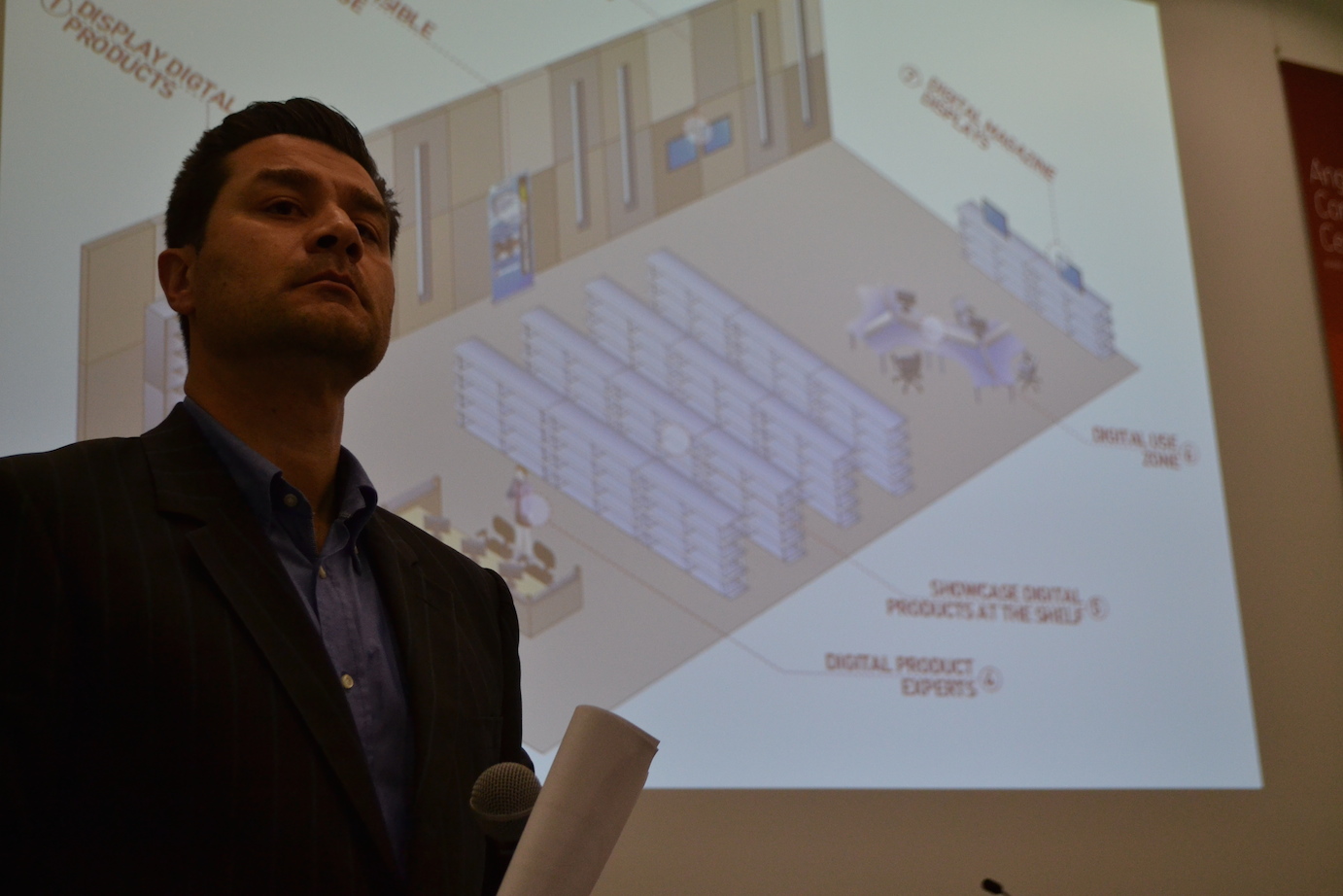
Richard Sarr of Wavesound started the day with a presentation about how to showcase digital resources within the physical space of a library. He really didn’t say anything that most librarians hadn’t already thought of already in this digital world.

Two CEO’s of two of Victoria’s Public Libraries, Karyn Siegman and Chris Kelly, presented an overview of the Libraries 2030 planning and subsequent documentation that will hopefully lead libraries forward into the future.

Sarah Kelly and Indra Kurzeme of the State Library of Victoria talked about their approach to social media and library programs. The richness and variety of their collections allow them to present a multitude of interesting and unique stories.

Matt Jones of Federation Square spoke fast and furiously about their approach to events planning. This presentation stood out to me as the most interesting of the day. Matt had a lot to say and it was all relevant, rich in detail and ideas. His explanation of the structural engineering of the site in Melbourne was slightly worrying.

Julie Rae from the Australian Drug Foundation told us how they reinvented the small old dreary library full of books to a sparkly new digital office space, thereby increasing their collection, access and loans by some ridiculous figure.

To finish the day Suzie and Celia, two library professionals presented their findings about ‘pop-up’ libraries providing case studies of both successful and unsuccessful experiences.

You can find the PLVN Libmark group on Facebook and Twitter.

Pretty pictures

Like so many of us, I love art. I love to look at artworks created by artistic souls. I appreciate the creative process and the results of that pursuit. My first academic study was Art & Design. I have drawn and painted my share of artworks, but don’t call myself an artist.

I am lucky that in today’s libraries art is considered an authentic way to showcase the creativity of those in our community. The last public library service I worked in had a successful and inclusive local community art program that invited and encouraged anyone to submit works into the program. The library became a gallery that showcased new works every three months. Beginning artists had a place to try out their talent and successful pieces were often sold to art appreciators.

I am lucky again in my position at the public library where I now work, as I currently look after the Art for Loan Program. This program differs in that artists can include their works in the program and people who join the program can loan artworks and take them home to enjoy for 2 months. Then change them over for other works. The library again becomes a gallery where artworks are showcased and we all get to enjoy the creative efforts; and pretty pictures.

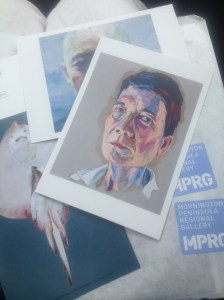
archibald_proze_showToday I visited the Mornington Peninsula Regional Gallery to see this year’s entrants for the Archibald Prize. It was busy with many other interested people keen to see these works. My favourite was the work by Anh Do of his father Tam Do. I didn’t realize Anh Do has this amazing artistic ability. I love the thick rough swathes of paint. The bold ‘unreal’ colours expertly and yet roughly placed to give form and light to the portrait. This photo of a postcard does not do it justice. The other portrait I loved was by Qiang Zhang of Yang Li. It shows a similar approach with bold thick imprecise brush strokes that give form to a large headshot.

My husband loved the portrait of Nick Cave, Citizen Kave by James Powditch. It intentionally looks like a movie poster and suggests a great movie with a cast to excite movie-lovers: Johnny Cash; Debbie Harry; Robert Mitchum; Tom Waits; and others.

Choose Your Own Library Adventure

In this exciting politically incorrect episode you get to Choose Your Own Library Adventure based on two possible scenarios:

Scenario 1 – The Community Lounge Room

The automatic doors open on time and in you hustle with the crowd of others from the community: seniors; pensioners of all ages; those needing care and their carers; the unemployed; homeless people; parents; children; babies; toddlers; teens; students; the aimless; business people; travellers; visitors; group members attending meetings; and the curious.

The people carry bags, phones, backpacks, coffee, water, food, shopping, books, DVD’s, CD’s, coats, laptops, hats, toys, and not a pen amongst them.

Many arrive on wheels: strollers; walkers; motorized scooters; shopping trolleys; wheel chairs; and skateboards.

This community library is inclusive, caters for all, is paid for by taxpayers, and welcomes everyone without obstacles, barriers, judgment or discretion.

Everyone makes themselves at home settling in for a few hours or the day. There is shelter, warmth, comfort, food, hot and cold drinks, and others to interact with. Everyone is free to eat, drink, talk, read, play games, surf the Internet, laugh, gamble online, shout, scream, run, dance, play music, run a business, study, research, argue, and put their feet up without concern or bother. Indeed they are entitled to do so.

This is The Community Third Place; the lounge room for the town; a makerspace; the library of the present, hopefully morphing into some similar version of the Library of the Future where community wellbeing predominates.

Personal hygiene in this community lounge room differs notably and is commented upon by customers and staff. What to do about this while remaining ‘pc’?

Random screams punctuate the day with too much frequency. These erupt from over excited children, and unfortunate adults forever anchored with the minds of toddlers.

Derelict and homeless people shuffle to their daily corner, rummage through their plastic bags for snacks, before sleeping the day away.

Damaged and disappointed people approach the library staff for assistance with a mixture of fear, bravado, entitlement, envy, and try to persuade or bully their opinions, complaints, and excuses, to further bend the flimsy policies to suit themselves. The “SHUSH” disappeared and the avalanche of guidelines for good behavior followed. Do what you want – make this space.

Custodial protection of our precious printed and digital words and knowledge is deemed to be of no real worth or value. Come take it – it is yours afterall.

Scenario 2 – The Quiet Study

This unassuming small shop/office has small quaint signs to let you know this is a “Library”. It is unapologetic in the retro feel that values books, ideas, and knowledge. It requires a membership application to join; beyond the usual personal ID with current address, a questionnaire is filled in, a deposit for the annual membership payment is made, and then the potential member must wait until the application is successful on approval by the management. A typical question might be: Name the title of your favourite book when you were a child. And: Name ten of the books you read in the past year, and please provide a short review of each. Etc.

Once approved, paid-up, signed the agreement to the terms and conditions, and have your library membership card, you are free to use the services. So you enter, sign in at the front desk, leave your bag, phone, and all belongings in a locker-room. There is water available in the foyer, but no drink or food is allowed in the Library. You are allowed to bring in a notepad (print or digital) and that is all.

The inner library has shelves full of books. There is no WiFi. There is not Internet access, other than pc’s with the digital resources provided by the library. There are no DVD’s, no music CD’s. There are pc’s for the library catalogue. There is a separate room for the printer, photocopier, fax machines available for the usual fees to library members. There are desks and seats scattered around for research, reading, writing, and study purposes.

There is no talking allowed. SHUSH reigns supreme. Talk and you are out. Repeat offenders have their memberships cancelled with no refund. Conversations with Master Librarians are done in whispers at the front desk.

The Library closes at lunch-time for everyone to go and have an unhurried meal. The Library reopens in the afternoon and then again in the evenings.

Although just offering books for browsing and borrowing, these include fiction, the classics, non-fiction, beautiful coffee-table books, books in a variety of languages as well as English, journals in print and digital format, and small collections for children and teens.

This is a place for quiet study and reflective practice. It is for personal enquiry and discovery. The resources are cared-for and protected. If you run, destroy property, speak loudly, act with entitlement, not pay your dues, or interfere with others, your membership will be cancelled for the year with no refund.

Choose Your Own Adventure Library

So do you want the maker-space, community lounge room complete with screaming people, for random, multi-purpose, entertaining, every person, public library/asylum?

Or are there some quiet unassuming people out there who want to return to the days of library shush, for a quiet space to study, learn, read great literature, and formulate new knowledge? And you would happily pay the annual membership?

Perhaps there is another alternative that I have not considered, apart from our excellent Academic libraries where students are the members.

What do you think?

An afternoon with ALIA

I was fortunate to be able to attend the final afternoon session of this year’s ALIA Conference in Melbourne.

Here is my summary:

eSmart Libraries Sallyanne English presented an overview of the Esmart Libraries program. Hume Libraries have recently been accredited. The eSmart program offers a framework for libraries so they can work towards incorporating cyber-safety into policies, procedures, training and technology use by staff and customers.

The Big Projects – update From the successful National Year of Reading in 2012, the Love2Read brand continues as a nationwide marketing effort. The Reading Hour is a current effort they  promote. They invite stories and stats from Australian libraries to spread the message.

Return On Investment Demonstrating the value of libraries is an ongoing need and there are many reports and advocacy tools available on the ALIA and PLVN websites. Of note in Victoria are these reports: Libraries 2030Creative Communities Cultural Benefits: and Dollars and Sense. These reports can be found here. NSW libraries offer this report for future planning.

ALIA PD Scheme Judy Brookner talked about the value of becoming a certified professional through the ALIA PD scheme.

IFLA update Marian Morgan Minden talked about the Lyon Declaration which highlights the need for open access to ICT. IFLA invite people to nominate a must-see library to the list of 1001 libraries to see before you die.

Digital Capability An overview of digital capability of libraries was presented by Sarah Slade of the NSLA Digital Preservation Group. This project has allowed an shared understanding of the needs and capabilities of libraries to manage digital materials.

It was also great to catch with colleagues/friends from across the State.

Book Club Lists

One of the joys of my job is being able to choose books for the book clubs to read. The existing Book Club Collection I work with has currently almost 150 titles. And there are about twelve book clubs using this service.

My job in recent months has been to trim the existing list by analyzing whether titles were unpopular and not likely to be read, as well as what titles were already read by our clubs. I decided on ten titles that I offered to other library services and these were all gratefully accepted and moved on.

At the same time I began a new list of possible contenders for the 2015 list. This list grew to about 25 titles that we read and debated about, although we didn’t get time to read them all. One is not yet published. So there is an element of educated guesswork and relying on published reviews.

My colleagues and I agreed on ten titles and these we have ordered to add to our collection for 2015. We also add ten titles from the SLV Summer Read from last season. Add two titles that we picked up through the library swaps, and we have 22 new titles to add to our Book Club Collection. You can see the list here.

Now all I have to do is find time to continue to read the ones I haven’t yet read.

Books as life rafts

A library in the middle of a community is a cross between an emergency exit, a life raft and a festival. They are cathedrals of the mind; hospitals of the soul; theme parks of the imagination. ~ Caitlin Moran

Forlorn and adrift on the sea of life; I flounder.

No longer daughter, mother, sister, granddaughter, daughter-in-law; my ego plunges into the classic existential crisis – if not that, then who is this ‘I’? The identities that gave the ego a firm structure where it could reside with comfort and confidence, vanish into the whirlpool of the relentless hunger of “life’s longing for itself”.

Stripped bare, languishing with the flow, the ego in abeyance, waiting, watching, wondering.

I recall the story told by Og Mandino. Reading books in a public library saved him. Homeless, destitute, and about to end his miserable life, he walked into a public library to pass some time before the gun shop next door opened. He sat and started to read, then came back the next day, and the next, turning his life around to become an author, speaker and motivator.

Lovers of books and reading know the power of the written word and that’s what keeps our noses inside books. But why are the words of others more influential than the words we might string together ourselves? They aren’t! The thing is that when we find ourselves in a state of despair or confusion, often due to circumstances not of our making (such as the death of a loved one, or two), then we might be incapable of making our mind do anything beyond grieve.

This is when the words of others offer a lifeline. Throw us a book and we will use it as a life raft. It doesn’t matter what book. Some might say it needs to be a religious book and that would be fine. But really, it could be anything. Works of fiction are perfect because they allow our mind to escape. It gives us a holiday from our own dismal and repetitive interior and whisks us away to another land and time.

As a long time reader of self-help books I can attest to the fact that this genre does not help at these fragile times.

As I steer my life raft to safer waters, these are the books that buoyed me over these past few months: 

*   A New Earth by Eckhart Tolle

*   Radical Forgiveness by Colin Tipping

*   The Gospel of Joy by Amanda Gore

*   Into Thin Air by Jon Krakauer

*   Maya’s Notebook by Isabel Allende

 But really they could have been anything. I would have liked to have re-read Echoes of the Early Tides by Tony Moore but my copy is packed away in a box somewhere still. I am about to plunge into Under Magnolia by Frances Mayes.

Strength in curiosity

It is telling when you still pursue information about a field of interest even when you are not currently working in that field. Of course this is what a true career path is all about. It also applies to hobbies, and passions.

Over these past few months (when I haven’t been designing our new house) I have been spending my time reading, watching, and listening to information about libraries. It is an interesting time for libraries worldwide, with the vast amount of resources now available online. Add to this the prevalence of personal devices, wide connectivity, and the sophisticated ability of the user to find and access that resource, then it is no surprise that library professionals are scurrying to remain relevant and required.

The biennial VALA Conference was held in Melbourne in February and I was disappointed that I was not able to attend this year. However, I readied myself to read and review the presentations when they became available online. And now they are; but it is so satisfying to find the whole multi-media experience available online. The audio, video, slides, and twitter-feed all on the one screen. So thank you to the VALA team for providing this amazing resource. I have been able to bathe like a duck in rainwater enjoying the torrent of inspirational presentations.

The keynote speakers were: Johan Bollen; Christine Boroman; Joe Murphy; Mia Ridge; Gene Tan; and Matt Finch.

Johan Bollen spoke about big data and how to use twitter posts for data visualisation and to analyse for predicting social trends. He pointed out that not only can one see what is happening as it is happening, but it is possible to see how people are feeling about what is happening. And this information is valuable.

Christine Borgman also spoke about big data and open access to data repositories, explaining in detail what that means in reality, especially for academics and research.

Joe Murphy talked about the future of libraries; his main point being that libraries will have a robust future if we all encourage curiosity.

Mia Ridge talks about libraries as maker-spaces for cultural heritage; making the point that libraries have always provided this service opportunity. For example: people writing their family history using the library and resources is using the space for making something that has value for cultural heritage. 

Gene Tan talked about the Singapore Memory Project, and organising multiple perspectives of moments in life with a random approach. Of significance is the project that gave every Singaporian a personal account for their memories, from which the library would organise, and store for prosperity. “Giving your past a present”. Gene has a unique and endearing style that really gets to the heart of people. Don’t skip the Q&A session at the end.

Matt Finch took off his clothes and redressed in another outfit on stage, to make the point that libraries are not just for hipsters but for everyone – even those dressed in regulation fluoro stripes.

I was validated by the comments made by Joe Murphy; that the librarian who encourages curiosity in her self and others is strong and will persist and thrive into the unsure future of libraries. I am that person who always wants to discover new things, and I am as yet unsatisfied with the answers to my questions about life, the universe and everything in it.

Using SlideShare

I have been using SlideShare for many years now as it is a perfect tool for presentations, showing people how to do things, and explaining concepts – on the run. Of course this list is not a complete list of my presentations to date, as I have presented others for a purpose, but not for public access.

suesbent_on_slideshare_2014

Each presentation here served a specific purpose and was created at a particular moment in time. So you might notice that some of the online tools explained no longer exist or have developed into a slightly different version.

Here is a list of my presentations in order of date creation:

  1. How to create a wiki (2008). I created this ‘how-to’ guide to show school teachers how to create an online platform for collaborative class assignment work. To date: 112757 views; 928 downloads; 5 comments; and 34 likes.
  2. How to create a wiki using PBWiki2 (2008). I created this ‘how-to’ guide when changes were made by the PBWiki team. To date: 3337 views; 38 downloads.
  3. Blogs and RSS in 2009 (2009). Subscribing to RSS feeds is a perfect tool to assist people to refine their information needs from the Internet. It can be a little technical to describe and set up. I gave a talk on this topic back in 2005 to a group of librarians but the tool being used then was Bloglines. In 2009 it amazed me how few people still knew how to use this technique, so I created this presentation to explain why you would want to do it, and how to set it up. Unfortunately Google Reader ceased to exist in 2013, so other RSS readers are required. I now use Feedly and sync this with my mobile phone. To date: 978 views; 4 downloads.
  4. Photos by Susan Bentley (2009). I love taking photos and wanted to collate and share a few of my best shots. To date: 2255 views; 61 downloads.
  5. Social media considerations for local government (2013).  I was part of a team considering and creating a social media policy and procedure for the local government organisation where I was employed. This presentation I created to help explain the situation to other employees. To date: 442 views.
  6. Presentations in Second Life (2013). In 2013 as part of my Masters studies I studied the subject Social Media for Information Professionals. Part of this work requirement was that we visited the Charles Sturt University campus of Jokaydia in Second Life to meet others and watch some presentations of work by students from another subject. To date: 184 views.
  7. Social media for our organisation (2013). Again as part of the training roll-out of online social media use for the organisation where I worked, this presentation offered more information on the topic. To date: 139 views.
  8. Personal digitisation plan (2013). I studied the subject Creating and Preserving Digital Content for my Masters studies, and needed to formulate my own plan of attack for my own collection of photos. To date: 177 views.
  9. Daring greatly (2013). I enjoyed watching the inspirational talks by Brené Brown on TED, and used the words from her manifesto to inspire the team I led at Glenelg Libraries. I matched these words with some photos I had taken of the local area, then edited using Instagram. To date: 226 views; 2 downloads.
  10. Library Trek (2013). I was invited to give a talk about contemporary public libraries to the Red Cross Conference held in Casterton and these are the slides from that talk. I was well aware that the audience mainly consisted of elderly women who have very little experience or knowledge with technology, and yet I wanted to try to give them an idea about the possibilities for them in the online world – and how their local library could help them. Feedback from some of the people there said that it was the least boring talk of the day. Obviously without the speech notes these slides don’t tell you much. To date: 82 views.

Zombies and the future of libraries

What do zombies have to do with the future of libraries you may well ask? In ‘reality’ if there was a zombie apocalypse, libraries would perish along with all of humanity. And being zombies, one would hardly expect them to have an active interest in the future of libraries or indeed any intellectual pursuit.

Like many librarians I have been thinking about the future of libraries a lot lately. It is a hot topic in the library world, mainly due to evolving technology, the proliferation of internet-connected personal devices, and the cheap and easy access to eBooks. The spread of the World Wide Web did not result in the end of libraries, but it has reduced our physical non-fiction collections substantially. Now with the second wave of internet-enabled technologies, does anyone need to go to a library at all to get hold of the reading material they want and need? Perhaps that end is in sight and this has resulted in a lot of talk amongst library professionals. So what are we here for?

The Victorian Public Libraries 2030 Strategic Framework was published in 2013 after 18 months of intensive collaborative discussions by public library staff in Victoria, of which I was privileged to be a part. Future scenarios were discussed in detail, how these scenarios might unfold, and what might be the key drivers to certain future scenarios. The drivers were identified as: technology, environmental issues, commuting, economic problems, health, increasing ageing population, cooperative endeavours, education and lifelong learning. The final stages of these discussions allowed us to add public libraries into the scene, thereby discussing how best to address and take full advantage of some new unfolding situations. Two future scenarios emerged: the creative scenario; and the community scenario. Both of these scenarios described the future public library as a community space.

Library as ‘community space’ has already had a whole lot of verbiage. Isn’t that what public libraries have always been? Perhaps I am not old enough to remember the places of shush, where reading books was done alone and in silence. There is value in the concepts of place-making, maker-spaces, and community collaboration. This has been, and continues to be, my experience of the library. The only quiet library space I can recall is the reading room of the State Library of Victoria; otherwise libraries are full of conversation, activity, people traffic, meetings, entertainment, coffee, and laughter. Oh, and books!

Personally, I am typically bookish, introverted, nerdy, and self-motivated. I like to explore notions on my own. This is the main reason why I love libraries. I enjoy following a pathway through literature that is entirely determined by me and as a result of my reading. I have described this as ‘delving into the book’; it is an entirely unique journey that begins and ends with the book, with regular forays online when new information is needed. I concur with the words that Nancy Pearl wants as her epitaph, “I’d rather be reading.”

The IFLA/UNESCO Public Library Manifesto 1994 does not mention the book at all, despite being written pre-internet. The manifesto defines public libraries as “the local gateway to knowledge”, and is essential for “fostering peace and spiritual welfare through the minds of men and women.” Key mission number two, “supporting both individual and self conducted education”, validates my own habits. Public libraries are seen as fundamental to democracy, prosperity and knowledge, so how can anyone consider a future without libraries?

At the recent ALIA Future of the Profession Summit Mark Pesce urged those librarians present to share their knowledge in order to plan a future for libraries. He reminded them that “the culture of sharing has its origins in the library.” And while “the light of knowledge shines more brightly than ever before, from two billion smartphone screens”, this is an opportunity because it is librarians who are the experts “in an environment of informational hyperadundance.” While the librarians in Victoria did just that last year, the resulting framework is one interpretation of possible future scenarios. The trick is in being able to recognise the triggers and apply the strategies at the right time.

Neil Gaiman is an enthusiastic supporter of libraries and he explained recently that “everything changes when we read”, that “libraries are the gates to the future”, and by closing libraries “you are silencing the voices of the past and you are damaging the future.” A dire warning indeed!

So back to the zombies… Dr. Matthew Finch is responsible for The Zombies of Tullamore:

In an interview with Corin Haines he talks about his approach to attracting people into the library. By choosing a theme that excites the imagination of a particular audience, he uses the activity to enhance the literacy experience within the library. I’m sure lots of librarians and teachers do this already, but this is a good example of how to do it well and to instill the learning opportunity into the activity. It is more than just a trendy promotional hook; it is immersive learning through role play and self discovery.

He identifies “why Zombies are good for libraries:

  1. Zombies attract kids and teens of all backgrounds.
  2. Zombies remind us that libraries are about more than shelves.
  3. Zombies promote choice and independent learning.
  4. Zombies may decay, but immersive literacy lives on.”

A lot more about the future of library profession can be found here.

This is what I know:

  • People will keep creating new content: fiction and non-fiction.
  • People will want to read that content for a multitude of reasons.
  • People will always expect and deserve to get unrestricted access to reading materials.
  • Technology will continue to evolve and change the way we live.
  • Library funding will continue to be threatened.
  • Librarians will continue to want to organise content.
  • Libraries will continue to be adapted and adjusted to accommodate the new.
  • Fun makes learning easier.
  • Zombies are fiction.

P.S. R. David Lankes talks about the future of libraries in this presentation From Loaning to Learning

Time rolls away

Wow! Two months of 2013 have disappeared already. And it’s been busier than ever. What can I tell you about my work at the library so far this year?

We installed new movable shelving for our non-fiction collection in our main branch which entailed a team effort of unloading, loading, reloading, unloading, reloading books by hand. But the end result is very pleasing and we have just ordered the display fittings that go along with this new configuration. The plan is to rearrange the non-fiction books from Dewey to shop-style subject categories. Then we will need to get some new signage to suit.

We have also embarked on the RFID implementation. At present we have completed one small branch and almost finished the second small branch. Then it is just the tagging at the main branch to go. Another team effort is required to get this job done, and everyone is stepping up to the plate. This new technology will allow customers to check out their own items giving them more privacy and independency. It will also free up our staff so they can provide some deeper and more meaningful conversations with the customers.

I have completed and passed two subjects for the Master of Information Studies and have just two to go. I have started Social Networking for Information Professionals.

Next weekend is a long weekend here in Victoria and I will be going along to the Annual Port Fairy Folk Festival for the fourth year in a row. Last year I had the pleasure of seeing a band called Tinpan Orange and just love their song Every Single Day.

Time rolls away, it rolls away, every single day it rolls away…”

My youngest son was married last month and that was a fun event despite my mother passing away the week before and her not being there (in body) with us all.

The Tomorrow’s Library discussions continue.

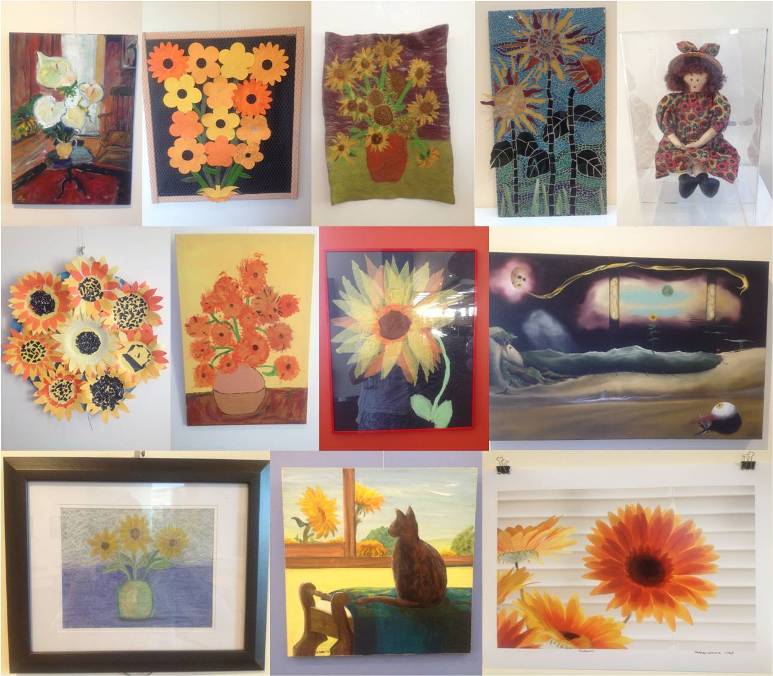
Our current open art exhibition is ‘Sunflowers” and we have received many bright works of art from local people. It is always such a privilege to receive and hang these creative pieces. I totally love the idea of inclusive community art, because after all we are all creative to some extent.

Sunflowers_group_04032013

Yesterday (on a Sunday) I attended a workshop Social Media for Small Business and the Arts presented by John Paul Fischbach and Criag Lambie of Auspicious Arts Incubators. It was a really worthwhile session and these guys really know their stuff. I got a lot out of it and wrote my notes to Twitter until my phone battery went dead. It really gives me a better perspective for revamping the social media presence of our library.

I am currently reading Wild: from lost to found on the Pacific Crest Trail by Cheryl Strayed (this is my favourite genre – true travel stories with a twist or quest) and Face2Face by David Lee King. I am listening to Little Stories by Harry James Angus and podcasts of the Midday Interview with Margaret Throsby and This is Your Life by Michael Hyatt.