Using SlideShare

I have been using SlideShare for many years now as it is a perfect tool for presentations, showing people how to do things, and explaining concepts – on the run. Of course this list is not a complete list of my presentations to date, as I have presented others for a purpose, but not for public access.
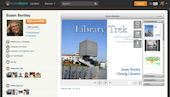
suesbent_on_slideshare_2014

Each presentation here served a specific purpose and was created at a particular moment in time. So you might notice that some of the online tools explained no longer exist or have developed into a slightly different version.

Here is a list of my presentations in order of date creation:

  1. How to create a wiki (2008). I created this ‘how-to’ guide to show school teachers how to create an online platform for collaborative class assignment work. To date: 112757 views; 928 downloads; 5 comments; and 34 likes.
  2. How to create a wiki using PBWiki2 (2008). I created this ‘how-to’ guide when changes were made by the PBWiki team. To date: 3337 views; 38 downloads.
  3. Blogs and RSS in 2009 (2009). Subscribing to RSS feeds is a perfect tool to assist people to refine their information needs from the Internet. It can be a little technical to describe and set up. I gave a talk on this topic back in 2005 to a group of librarians but the tool being used then was Bloglines. In 2009 it amazed me how few people still knew how to use this technique, so I created this presentation to explain why you would want to do it, and how to set it up. Unfortunately Google Reader ceased to exist in 2013, so other RSS readers are required. I now use Feedly and sync this with my mobile phone. To date: 978 views; 4 downloads.
  4. Photos by Susan Bentley (2009). I love taking photos and wanted to collate and share a few of my best shots. To date: 2255 views; 61 downloads.
  5. Social media considerations for local government (2013).  I was part of a team considering and creating a social media policy and procedure for the local government organisation where I was employed. This presentation I created to help explain the situation to other employees. To date: 442 views.
  6. Presentations in Second Life (2013). In 2013 as part of my Masters studies I studied the subject Social Media for Information Professionals. Part of this work requirement was that we visited the Charles Sturt University campus of Jokaydia in Second Life to meet others and watch some presentations of work by students from another subject. To date: 184 views.
  7. Social media for our organisation (2013). Again as part of the training roll-out of online social media use for the organisation where I worked, this presentation offered more information on the topic. To date: 139 views.
  8. Personal digitisation plan (2013). I studied the subject Creating and Preserving Digital Content for my Masters studies, and needed to formulate my own plan of attack for my own collection of photos. To date: 177 views.
  9. Daring greatly (2013). I enjoyed watching the inspirational talks by Brené Brown on TED, and used the words from her manifesto to inspire the team I led at Glenelg Libraries. I matched these words with some photos I had taken of the local area, then edited using Instagram. To date: 226 views; 2 downloads.
  10. Library Trek (2013). I was invited to give a talk about contemporary public libraries to the Red Cross Conference held in Casterton and these are the slides from that talk. I was well aware that the audience mainly consisted of elderly women who have very little experience or knowledge with technology, and yet I wanted to try to give them an idea about the possibilities for them in the online world – and how their local library could help them. Feedback from some of the people there said that it was the least boring talk of the day. Obviously without the speech notes these slides don’t tell you much. To date: 82 views.

Job hunting

Life is funny isn’t it? You think and plan and work diligently towards improving your own circumstances as well as those that employ you, but then life throws you a curve ball.

So I now find myself in the aftermath of quitting a perfectly good job where I was feeling satisfied and fully utilized, in order to care full-time for my ailing father. But that need has now vanished as he has moved beyond this earthly plane.

Now I find myself back in the job-hunting market with all the other over-qualified, experienced and competent folk.

I utilize as many information refining and gathering techniques for this task as I can:

  • I subscribe to many career news feeds via my Feedly account.
  • I subscribe to industry-specific enewsletters.
  • I bookmark employment webpages for organisations where I’d like to work and I check these regularly.
  • I keep an eye on career ads in print and online.
  • I use LinkedIn to connect with professionals I know and others in the industry.

I have been applying for relevant positions as they arise. It takes me about six hours to write a job application answering the requirements fully.

I worry that at my age my resume looks a little long, but it is what it is, and personally I know that means I am experienced in my field, stable in my work attitude, mature in my emotional intelligence, and at the peak of my ability to contribute in a meaningful and practical way.

I also worry about the mistaken view that the younger one is the better they are to adapt to technology. The ability to handle technology varies from person to person, regardless of age. Some people, like me, have a natural inclination and understanding about technology, and this translates readily across all types of devices, software, databases, utilities, and emerging media. I have the kind of brain that has always understood and enjoyed maths, physics, engineering, technology, manufacturing, database structure, etc. That ability does not deteriorate with age, in fact an ability to laterally link those ideas to new trends and emerging technologies increases with age and experience.

kitchen_garden

So I use this valuable time to read, listen to podcasts, learn new things, update my eportfolio, write, take on some new projects, exercise, grow vegetables, and prepare healthy meals.

My ‘to-do’ list is still a mile long and there are only so many hours in the day.


Walking in nature

One strategy I intentionally employed with the objective towards handling the grieving process and retaining a positive outlook on life is to walk in the natural environment.

I know that just being in amongst nature, absorbing the sights, sounds, textures, and smells lifts my spirits and reminds me of my place in the larger scheme of things.

I love the chaotic unpredictable asymmetrical and beautiful variety of nature’s garden: the choir of bird calls and insect buzzing; the extensive palette of green; the movement of leaves, grasses and dust particles; the unusual flowers; the occasional animal; and the absence of manmade ugliness.

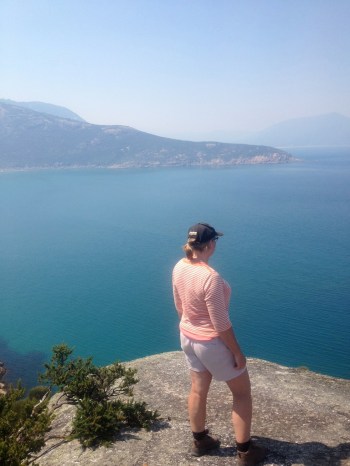
Susan at Pillar Point

So I did and it has. I’ve walked the trails of the Mornington Peninsula and recently some of the rugged walks at Wilsons Promontory. The vistas at ‘The Prom’ are awesome (in the true sense of the word). The greens, aquas, and turquoises of the crystal clear waters sparkle like a precious gemstone. The wind roars like an oncoming freight train. The rocky monoliths stand in perpetuity – daunting shapes remembered from my childhood visits. The beauty fills my spirit and soul. Petty squabbles dissipate. My love of life abounds.

Back in December as I sat in the hospital room beside the waxen corpse of my deceased father on the morning he died, I received the words into my head “Just enjoy your life!” I’m sure this was a message for me from my Dad’s departing spirit, as he knows my serious nature more than most.

Tidal River Duck Race

And Tidal River is a place where adults can let their inner child run free. The group of people we went with really know how to enjoy life with childish abandon without the need for alcohol or drugs. They are a bunch of mostly retired fitness nuts. So we had running relay races on the beach. We rode the waves on body boards. We had a duck race and a boat with egg passenger race on the river. We laughed. We looked for wombats at dusk and rose at dawn with the birds. We snorkelled the rocky shoreline, walked and ran the trails, and relaxed in water holes in the river. We had a heap of fun.

So yes Dad I am getting on with enjoying my life.

Plans for 2014

If there is one thing I learned from 2013 it is that not all plans are successful. Life sometimes takes over and the best laid plans with the right intentions need to be put aside.

But inspired by the ladies from the Up for a Chat podcast, and because I do believe in the power of intention and visualisation, here are some of the things I want to accomplish and/or work towards this year:

Review of 2013

Once again inspired by Chris Guillebeau of The Art of Non-Conformity I look back over my experience of 2013. It was a really difficult and challenging year for me.

Here is what didn’t go well:

  • On 23 January my mother passed away after a four year battle with cancer.
  • Dad was alone for the first time in his life and grieved and this sat heavily on my mind.
  • Dad was diagnosed with Mesothelioma at the end of July just prior to his 77 birthday.
  • With family members I shared care responsibilities for Dad which meant a lot of organisation and travel to and fro.
  • We sold our house and most of our possessions.
  • We resigned from great jobs.
  • We moved and left some great new-found friends.
  • I went from being a fully employed professional to being a full time carer with no wage.
  • Dad passed away on 16 December.
  • The funeral for Dad was held on 20 December.
  • Our annual family Christmas get-together was held on 22 December and was a horrible out-pouring of grief.

Here is what went well:

The man with many hats

So these past three weeks (indeed this whole year) have been life-changing, defining, difficult, enriching, surprising, sad, busy, purposeful, supportive and a privilege – for me.

We left our jobs. We sold our house and most of our stuff. And we moved into my father’s house to be with him as he battled Mesothelioma. My transition was from a full-time, employed, busy, professional, to a full-time carer giving medication around-the-clock and worrying as my father got weaker with each passing day.

Stanley Frederick Smith passed away this morning at about 5am in hospital. I had seen him yesterday, and he gave me a huge smile when he opened his eyes and saw me – a gift. But I felt his time was limited. It was so sad to see such a clever mind be limited by illness and drugs: so sad to witness your own father grow weak.

Of course I knew him as my father, but as I sorted through his files I got to see more of the person. He was a funny bloke who loved a joke. He loved to stir, rile and rouse others. His wit, puns, and jokes were a constant source of entertainment for others. But he was not a clown.

He cannot be defined by one label. He wore many hats. He was: a professional; a manager; a boss; a methods engineer; a car lover; an artist; a friend to many; a president; an organizer; a leader; a committee man; an active member; a foodie; a cook; a HAM radio nut; a Morse code practitioner; a photographer; a joke teller; a conversationalist; a talker; a geek; an intellectual; interested in physics and astronomy and mathematics; a life long learner; a language learner; a family man; constant companion to Margaret; a life participant; an independent thinker; and a kind person.

18 Stan xmas no mo 90s copy

His files were full of jokes, photos of classic cars, caravans and caravan trips, people gathered in groups eating together, and people enjoying each others company. He was a people person.

While his time has ended and he is probably reunited with my mother, my own life journey pauses between life chapters. We will mourn, pay tribute, share stories, then sort out the accumulated possessions and legalities. Then begin the next phase….I have some ideas.

EOM

Don’t you love acronyms? They are useful if you know what they mean and if you are communicating with others who know the same ones. They exist across the range of human subjects and are specific to their own topics. If you don’t know what an acronym stands for then they are as useful as if someone spoke to you in a foreign language.

EOM is commonly used in emails in the local government organisation where I worked for the last four years. And in that time I never knew what it meant. It’s significance seemed unimportant, so I was never prompted to ask.

End Of Message! Superfluous perhaps. It was commonly used in the subject line of an email when there is no content in the body of the email. For example, “Email subject: Leftover sandwiches in staff room. EOM”

On my last day I received a phone call from a local newspaper reporter asking me questions about why I was leaving. I told him that it was because I was going to care for my father who is failing quickly with Mesothelioma. I reminded him that he needed to go through the usual Council communication channels. Prompted by his enquiry I wrote a media release and sent it through to the Council media person. It had not occurred to me that this would be of any interest to the local community. It was published in the newspaper under the cute heading “Portland Library Manager turns the page“.

EOM

20131130-095255.jpg

Happy snaps

I have just studied the subject Creating and Preserving Digital Content through Charles Sturt University for the successful completion of the Master of Information Studies. And it has got me thinking….

All of those family photos held in a variety of forms in a variety of containers need some sorting. There are old printed photographs in photo albums and in boxes. There are digital photographs that reside in cameras, phones, devices, SD cards, CD’s, and computers. There are digital copies of photos sitting in random digital file folders on computers. And we keep producing more each day adding to the digital heap.

So now I know how to go about organising all of this stuff, I need the time to actually sit down and apply myself to the mammoth task of sorting it out.

Once I comprehend the enormity of the task I begin to ask myself – why? For what purpose? Who cares? How many photographs of wind-swept beach scenes are too many?

Then there is the question of the integrity of the captured image: if a filter is applied to an image from a Smartphone app then this should be noted in the metadata or description. But that adds another level of tedium to the task, and yet if it is not done then what does that say about the authenticity of the resulting image. Is it then art or photography? Or both?

The notion of transience emerges too when considering the purpose of such an exercise. With ease and speed of connected social media channels through smart devices, a photo shared across networks among friends and family is enjoyed for the moment, in the context of that moment, and then swept into the ever-moving stream of data creation. Sure it is still ‘there’ somewhere in the digital ether, waiting to be retrieved for future embarrassment; like a baby photo shown by smirking parents at their child’s 21st birthday party. Other than for nostalgic amusement, is there value in spending so much time and effort in sorting out the family photos for ‘the future’?

I can hear the archivists and historians stirring on their leather chairs, leaning forward, fingers cracking, ready to post a heart-felt reply. I welcome it because I need a good reason to justify this effort.

The term ‘digital dark age’ was used in Creating and Preserving Digital Content to illustrate a possible scenario where data is lost through poor preservation techniques. I get it. I wrote an essay about it, elaborately describing the scenes from the original movie version of The Time Machine, where the vacuous stares of the future Eloi people are the result of lost knowledge from crumbling pages in books left to decay.

I appreciate the words of former Prime Minister Harold Holt at the Stone Ceremony March in 1966:

We cannot understand the present or plan for the future without the knowledge of the past.

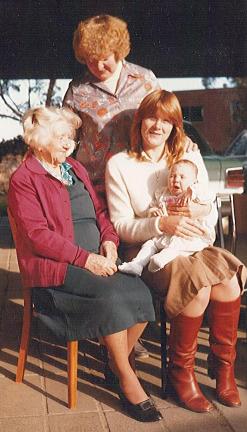
danielle_susan_margaret_alice_1984And yet significant family portraits containing four females spanning four generations might be worthy of preservation for sharing amongst immediate and future family members, but how many “selfie’s” must we have to delete before we gain a representative portrait of one individual.

My thoughts are a jumble between process, content, and value. The process is complex and needs to be worked out to establish some kind of system that works and fulfills preservation standards. The content contains so many variables and raises questions about authenticity. The value is difficult to judge because it is not easy to project into the minds of some future person and decide if this image is worth the effort of the time invested in preserving it.

This article about one family’s preservation project describes some of these issues with a heart-warming narrative and a positive outcome, but concluding that it is “never done.”

My aim is to begin. I have the relevant information about how to approach the task. I have a large external hard-drive. I will gather the photos in all forms. I will start sorting, naming, describing, storing, backing-up, and hopefully one day in the future I will have some kind of result that’s purpose will be apparent.

In the words of Francis Kilvert, as quoted from this article: Digital Curation and the Citizen Archivist by Richard Cox:

Why do I keep this voluminous journal? I can hardly tell. Partly because life appears to me such a curious and wonderful thing that it almost seems a pity that even such a humble and uneventful life as mine should pass altogether away without some record such as this.

Cox, R. J. (2009). Digital Curation and the Citizen Archivist. Digital Curation: Practice, Promises & Prospects. pp. 102-109. http://d-scholarship.pitt.edu/2692/

42 Aussie Librarian Bloggers in 2013

In 2011, I began an investigation into Australian Librarian bloggers: how many could I locate online; who were they; what sector did they work in; the topics they posted about; and the overall look and feel of their blog. I was interested in individuals and did not want to investigate the blogs of library organisations. So I narrowed the field to the personal blogs of Australian Librarians. While I did include librarians from tertiary academia, I narrowed the field by not including the blogs by teacher librarians situated in primary or secondary school libraries. I also added 14 Librarian bloggers from overseas just to provide a measure of comparison.

After a quick and dirty Google search I located Libraries Interact where there is a list of Australian Librarian bloggers. Of these, in 2011, many were already inactive after running out of steam following the 23 Things training. There were other lists and indexes I stumbled across and I soon listed 66 active Australian librarian bloggers. Although my list did include many of the active bloggers from the Libraries Interact list, it also included others not on that list. I looked for the names of the bloggers and their twitter links. I tried to ascertain the library sector that they worked in. I read about their favourite topics and attempted to evaluate the content by gauging them against a content rubric that I created for the task.

Some bloggers like to write book reviews; some like to talk about their experiences answering customer’s questions; others like to pass on information about technology; some vent; some show their creative talents in the kitchen or with crafts; holidays are popular topics; most were personal; and many were superficial. My five-smile rating 🙂 🙂 🙂 🙂 🙂  was a rare gem indeed on my incomplete list.

I was searching for relevant, interesting, deep, and meaningful content. I wanted to hear opinion. And while there is much great content from our bloggers, one stood out – It’s Not About The Books by Hugh Rundle. Good on you Hugh! Hugh continues to boldly post thought-provoking and challenging articles that are written with excellence. He embeds relevant links thoughtfully. He sets the bar high and is a fine example for anyone wanting to lift their own efforts to a new level; myself included.

So I have once again reviewed the list on Libraries Interact. Of the 58 bloggers listed under personal blogs of Aussie Librarians only 27 are still active (46.5%). Of the 66 Aussie Librarians on my list that were active in 2011, 46 bloggers have posted content in the last year; and only 36 in the last 4 months. (69% still active). Of the 14 blogs from overseas all are still active.

Here is my list of Aussie Librarians who are active bloggers:

1 A Chivas Regal Moment @CatyJ
2 Alyson in Library Land @alysondalby
3 A work in progress @fionareadersrr
4 Ballarat Library Chick @gemmas1980
5 Better than cheesecake @susannenewton
6 Biblio Turismo @Biblioturismo
7 Blog Fest at Tiffany’s @LibrarianCat
8 Book boy @bookboy
9 Bronwyn’s Library Blog @pivotalbooks
10 Connecting Librarian @michelleamclean
11 Digital Collaboration @SusanMyburgh
12 explodedlibrary.info @explodedlibrary
13 Feral Library Tales @kalgrl
14 From Melbin @malbooth
15 Girl in Landscape @wateryone
16 Hecuba’s Story @polyxena
17 HeyJudeOnline @heyjudeonline
18 Hmmm @Kridwyn
19 Inn0vate @petahopkins
20 It’s not about the books @HughRundle
21 JayGee Library Log @jaygee35
22 Jenelle Net @jenelle
23 Langridgep @langridgep
24 Librarian Hoi @librarianhoi
25 Librarians Matter @libsmatter
26 Library Dreamings @VesnaC
27 Macaronic @jobeaz
28 Opinions from an OPL @newgradlib
29 Pixelated Mushroom @pixelmushroom
30 Ramblibrarian @boycetrus
31 Ramblings from yet another Librarian @katejf
32 Read Watch Play Participate @ellenforsyth
33 reeling and writhing @mulberry_road
34 Ruminations @flexnib
35 Shallowreader’s Blog @VaVeros
36 Shelterit @shelterit
37 snail @snailx
38 Stained Glass Waterfall @warrencheetham
39 Sues Bent @suesbent
40 The Land of the Surprising Pun @librarianidol
41 There she goes @stephmcg
42 Thoughts and Reflections @shewgirl

And the list of Library bloggers from overseas:

1 Annoyed Librarian @LibraryJournal
2 Circulating Ideas @circideas
3 David Lee King @davidleeking
4 Free Range Librarian @kgs
5 Librarian by Day @bobbinewman
6 Librarian in Black @TheLib
7 Librarian Net @jessamyn
8 Phil Bradley @Philbradley
9 Self-plagarism is style @daveyp
10 Stephen’s Lighthouse @sabram
11 Swiss Army Librarian @SwissArmyLib
12 Tame the Web @mstephens7
13 The Shifted Librarian @shifted
14 Virtual Dave @rdlankes

P.S. This list is not complete in an online world that is constantly changing, but if you are an Australian Librarian who writes a blog and your blog is not listed here and you would like it to be, then please leave a comment below.

Zombies and the future of libraries

What do zombies have to do with the future of libraries you may well ask? In ‘reality’ if there was a zombie apocalypse, libraries would perish along with all of humanity. And being zombies, one would hardly expect them to have an active interest in the future of libraries or indeed any intellectual pursuit.

Like many librarians I have been thinking about the future of libraries a lot lately. It is a hot topic in the library world, mainly due to evolving technology, the proliferation of internet-connected personal devices, and the cheap and easy access to eBooks. The spread of the World Wide Web did not result in the end of libraries, but it has reduced our physical non-fiction collections substantially. Now with the second wave of internet-enabled technologies, does anyone need to go to a library at all to get hold of the reading material they want and need? Perhaps that end is in sight and this has resulted in a lot of talk amongst library professionals. So what are we here for?

The Victorian Public Libraries 2030 Strategic Framework was published in 2013 after 18 months of intensive collaborative discussions by public library staff in Victoria, of which I was privileged to be a part. Future scenarios were discussed in detail, how these scenarios might unfold, and what might be the key drivers to certain future scenarios. The drivers were identified as: technology, environmental issues, commuting, economic problems, health, increasing ageing population, cooperative endeavours, education and lifelong learning. The final stages of these discussions allowed us to add public libraries into the scene, thereby discussing how best to address and take full advantage of some new unfolding situations. Two future scenarios emerged: the creative scenario; and the community scenario. Both of these scenarios described the future public library as a community space.

Library as ‘community space’ has already had a whole lot of verbiage. Isn’t that what public libraries have always been? Perhaps I am not old enough to remember the places of shush, where reading books was done alone and in silence. There is value in the concepts of place-making, maker-spaces, and community collaboration. This has been, and continues to be, my experience of the library. The only quiet library space I can recall is the reading room of the State Library of Victoria; otherwise libraries are full of conversation, activity, people traffic, meetings, entertainment, coffee, and laughter. Oh, and books!

Personally, I am typically bookish, introverted, nerdy, and self-motivated. I like to explore notions on my own. This is the main reason why I love libraries. I enjoy following a pathway through literature that is entirely determined by me and as a result of my reading. I have described this as ‘delving into the book’; it is an entirely unique journey that begins and ends with the book, with regular forays online when new information is needed. I concur with the words that Nancy Pearl wants as her epitaph, “I’d rather be reading.”

The IFLA/UNESCO Public Library Manifesto 1994 does not mention the book at all, despite being written pre-internet. The manifesto defines public libraries as “the local gateway to knowledge”, and is essential for “fostering peace and spiritual welfare through the minds of men and women.” Key mission number two, “supporting both individual and self conducted education”, validates my own habits. Public libraries are seen as fundamental to democracy, prosperity and knowledge, so how can anyone consider a future without libraries?

At the recent ALIA Future of the Profession Summit Mark Pesce urged those librarians present to share their knowledge in order to plan a future for libraries. He reminded them that “the culture of sharing has its origins in the library.” And while “the light of knowledge shines more brightly than ever before, from two billion smartphone screens”, this is an opportunity because it is librarians who are the experts “in an environment of informational hyperadundance.” While the librarians in Victoria did just that last year, the resulting framework is one interpretation of possible future scenarios. The trick is in being able to recognise the triggers and apply the strategies at the right time.

Neil Gaiman is an enthusiastic supporter of libraries and he explained recently that “everything changes when we read”, that “libraries are the gates to the future”, and by closing libraries “you are silencing the voices of the past and you are damaging the future.” A dire warning indeed!

So back to the zombies… Dr. Matthew Finch is responsible for The Zombies of Tullamore:

In an interview with Corin Haines he talks about his approach to attracting people into the library. By choosing a theme that excites the imagination of a particular audience, he uses the activity to enhance the literacy experience within the library. I’m sure lots of librarians and teachers do this already, but this is a good example of how to do it well and to instill the learning opportunity into the activity. It is more than just a trendy promotional hook; it is immersive learning through role play and self discovery.

He identifies “why Zombies are good for libraries:

  1. Zombies attract kids and teens of all backgrounds.
  2. Zombies remind us that libraries are about more than shelves.
  3. Zombies promote choice and independent learning.
  4. Zombies may decay, but immersive literacy lives on.”

A lot more about the future of library profession can be found here.

This is what I know:

  • People will keep creating new content: fiction and non-fiction.
  • People will want to read that content for a multitude of reasons.
  • People will always expect and deserve to get unrestricted access to reading materials.
  • Technology will continue to evolve and change the way we live.
  • Library funding will continue to be threatened.
  • Librarians will continue to want to organise content.
  • Libraries will continue to be adapted and adjusted to accommodate the new.
  • Fun makes learning easier.
  • Zombies are fiction.

P.S. R. David Lankes talks about the future of libraries in this presentation From Loaning to Learning